Department of Biomedical Informatics, School of Basic Medical Sciences, Peking University, Beijing 100191, China.
CAS Key Laboratory of Genome Sciences and Information, Beijing Institute of Genomics, Chinese Academy of Sciences, and China National Center for Bioinformation, Beijing 100101, China.
Sci Adv. 2020 Oct 21;6(43). doi: 10.1126/sciadv.aba3760. Print 2020 Oct.
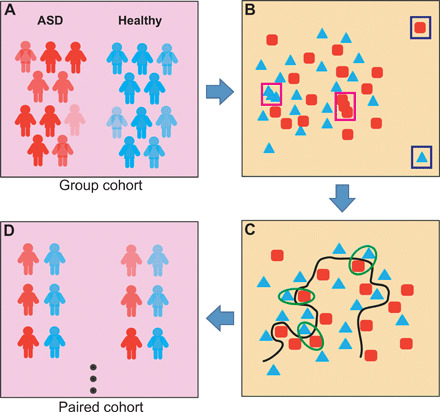
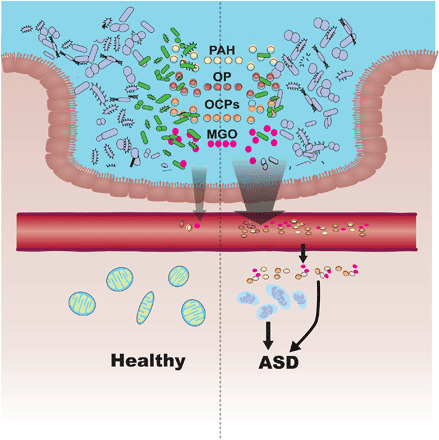
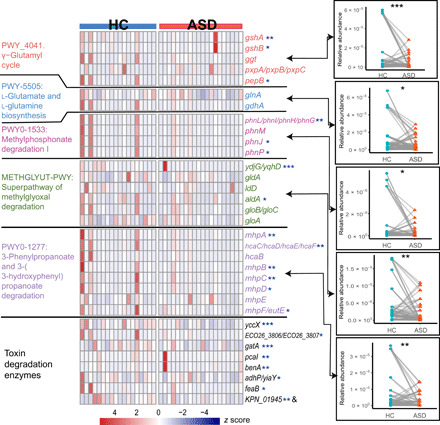
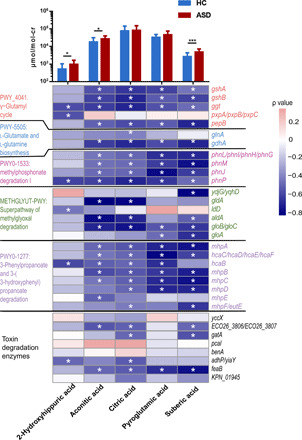
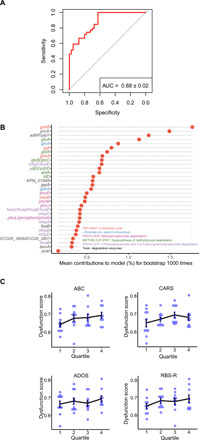
Growing evidence suggests that autism spectrum disorder (ASD) is strongly associated with dysbiosis in the gut microbiome, with the exact mechanisms still unclear. We have proposed a novel analytic strategy-quasi-paired cohort-and applied it to a metagenomic study of the ASD microbiome. By comparing paired samples of ASD and neurotypical subjects, we have identified significant deficiencies in ASD children in detoxifying enzymes and pathways, which show a strong correlation with biomarkers of mitochondrial dysfunction. Diagnostic models based on these detoxifying enzymes accurately distinguished ASD individuals from controls, and the dysfunction score inferred from the model increased with the clinical rating scores of ASD. In summary, our results suggest a previously undiscovered potential role of impaired intestinal microbial detoxification in toxin accumulation and mitochondrial dysfunction, a core component of ASD pathogenesis. These findings pave the way for designing future therapeutic strategies to restore microbial detoxification capabilities for patients with ASD.
越来越多的证据表明,自闭症谱系障碍(ASD)与肠道微生物组的生态失调密切相关,但其确切机制尚不清楚。我们提出了一种新的分析策略——准配对队列,并将其应用于 ASD 微生物组的宏基因组研究。通过比较 ASD 和神经典型受试者的配对样本,我们发现 ASD 儿童在解毒酶和途径方面存在明显缺陷,这些缺陷与线粒体功能障碍的生物标志物强烈相关。基于这些解毒酶的诊断模型能够准确地区分 ASD 个体和对照组,并且从模型推断出的功能障碍评分随着 ASD 的临床评分的增加而增加。总之,我们的研究结果表明,肠道微生物解毒功能受损在毒素积累和线粒体功能障碍中可能发挥了以前未被发现的作用,而后者是 ASD 发病机制的核心组成部分。这些发现为设计未来的治疗策略以恢复 ASD 患者的微生物解毒能力铺平了道路。