Coretti Lorena, Paparo Lorella, Riccio Maria Pia, Amato Felice, Cuomo Mariella, Natale Alessandro, Borrelli Luca, Corrado Giusi, Comegna Marika, Buommino Elisabetta, Castaldo Giuseppe, Bravaccio Carmela, Chiariotti Lorenzo, Berni Canani Roberto, Lembo Francesca
Department of Molecular Medicine and Medical Biotechnology, University of Naples Federico II, Naples, Italy.
Department of Physiology and Biochemistry, Faculty of Medicine and Surgery, University of Malta, Msida, Malta.
Front Microbiol. 2018 Dec 19;9:3146. doi: 10.3389/fmicb.2018.03146. eCollection 2018.
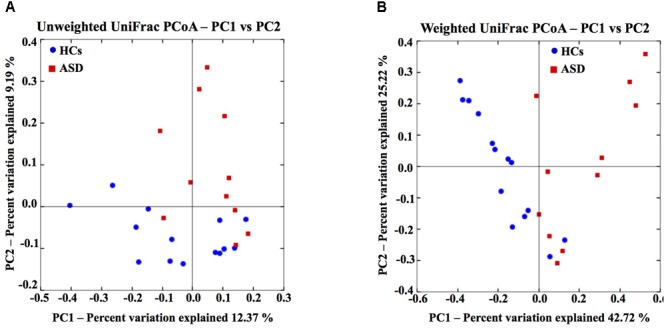
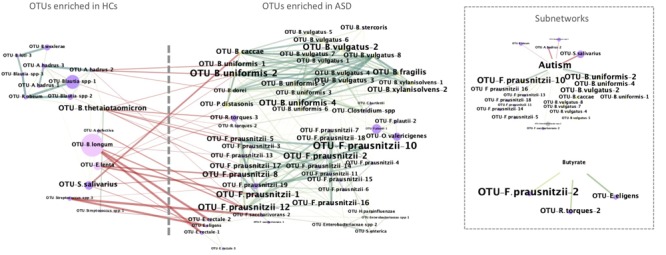
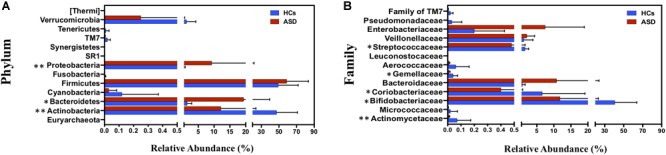
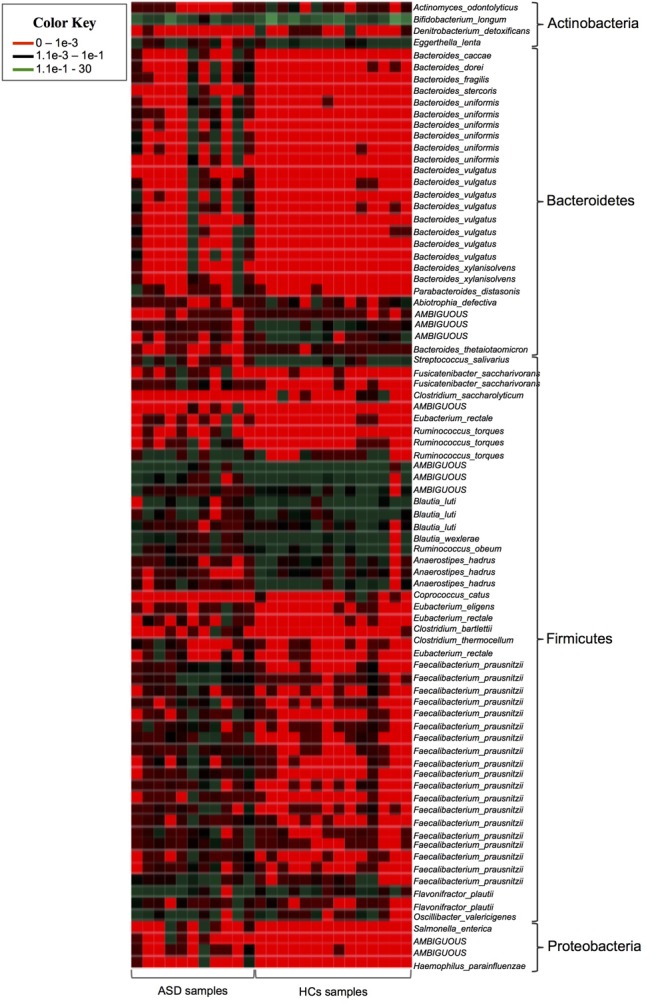
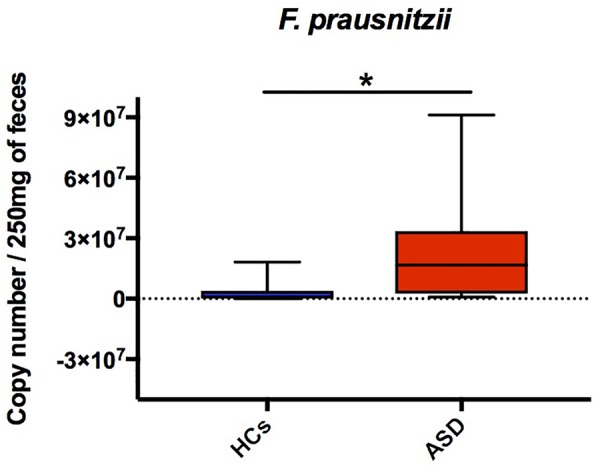
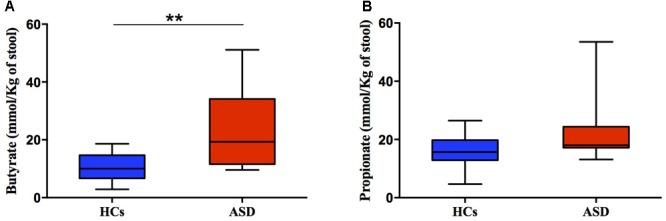
Proliferation and/or depletion of clusters of specific bacteria regulate intestinal functions and may interfere with neuro-immune communication and behavior in patients with autism spectrum disorder (ASD). Consistently, qualitative and quantitative alteration of bacterial metabolites may functionally affect ASD pathophysiology. Up to date, age-restricted cohort studies, that may potentially help to identify specific microbial signatures in ASD, are lacking. We investigated the gut microbiota (GM) structure and fecal short chain fatty acids (SCFAs) levels in a cohort of young children (2-4 years of age) with ASD, with respect to age-matched neurotypical healthy controls. Strong increase of Bacteroidetes and Proteobacteria and decrease of Actinobacteria was observed in these patients. Among the 91 OTUs whose relative abundance was altered in ASD patients, we observed a striking depletion of , one of the dominant bacteria in infant GM and, conversely, an increase of , a late colonizer of healthy human gut and a major butyrate producer. High levels of were associated to increase of fecal butyrate levels within normal range, and over representation of KEGG functions related to butyrate production in ASD patients. Here we report unbalance of GM structure with a shift in colonization by gut beneficial bacterial species in ASD patients as off early childhood.
特定细菌群的增殖和/或减少调节肠道功能,并可能干扰自闭症谱系障碍(ASD)患者的神经免疫通讯和行为。一致地,细菌代谢产物的定性和定量改变可能在功能上影响ASD的病理生理学。迄今为止,缺乏可能有助于识别ASD中特定微生物特征的年龄限制队列研究。我们针对年龄匹配的神经典型健康对照,调查了一组幼儿(2至4岁)ASD患者的肠道微生物群(GM)结构和粪便短链脂肪酸(SCFA)水平。在这些患者中观察到拟杆菌门和变形菌门显著增加,放线菌门减少。在ASD患者中相对丰度发生改变的91个操作分类单元(OTU)中,我们观察到婴儿GM中的主要细菌之一显著减少,相反,健康人肠道的晚期定殖菌和主要丁酸盐产生菌增加。高水平的与粪便丁酸盐水平在正常范围内增加以及ASD患者中与丁酸盐产生相关的KEGG功能过度表达有关。在此我们报告,在幼儿期,ASD患者的GM结构失衡,肠道有益细菌种类的定殖发生改变。