
多时间点数据准备有力地揭示了轻度认知障碍和痴呆风险因素。
Multi-time-point data preparation robustly reveals MCI and dementia risk factors.
作者信息
Kaur Daman, Bucholc Magda, Finn David P, Todd Stephen, Wong-Lin KongFatt, McClean Paula L
机构信息
Northern Ireland Centre for Stratified Medicine Biomedical Sciences Research Institute Clinical Translational Research and Innovation Centre (C-TRIC) Altnagelvin Hospital Site Ulster University Derry/Londonderry Northern Ireland UK.
Intelligent Systems Research Centre School of Computing Engineering and Intelligent Systems Ulster University Derry/Londonderry Northern Ireland UK.
出版信息
Alzheimers Dement (Amst). 2020 Oct 14;12(1):e12116. doi: 10.1002/dad2.12116. eCollection 2020.
INTRODUCTION
Conflicting results on dementia risk factors have been reported across studies. We hypothesize that variation in data preparation methods may partially contribute to this issue.
METHODS
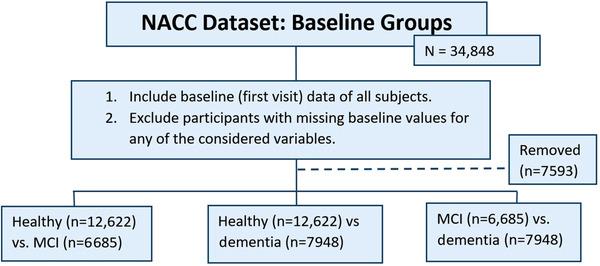
We propose a comprehensive data preparation approach comparing individuals with stable diagnosis over time to those who progress to mild cognitive impairment (MCI)/dementia. This was compared to the often-used "baseline" analysis. Multivariate logistic regression was used to evaluate both methods.
RESULTS
The results obtained from sensitivity analyses were consistent with those from our multi-time-point data preparation approach, exhibiting its robustness. Compared to analysis using only baseline data, the number of significant risk factors identified in progression analyses was substantially lower. Additionally, we found that moderate depression increased healthy-to-MCI/dementia risk, while hypertension reduced MCI-to-dementia risk.
DISCUSSION
Overall, multi-time-point-based data preparation approaches may pave the way for a better understanding of dementia risk factors, and address some of the reproducibility issues in the field.
引言
各项研究报告的痴呆症风险因素结果相互矛盾。我们推测,数据准备方法的差异可能部分导致了这一问题。
方法
我们提出一种全面的数据准备方法,将诊断随时间稳定的个体与进展为轻度认知障碍(MCI)/痴呆症的个体进行比较。并将其与常用的“基线”分析进行比较。使用多变量逻辑回归来评估这两种方法。
结果
敏感性分析得到的结果与我们的多时间点数据准备方法的结果一致,显示出其稳健性。与仅使用基线数据的分析相比,进展分析中确定的显著风险因素数量要少得多。此外,我们发现中度抑郁症会增加从健康状态进展为MCI/痴呆症的风险,而高血压会降低从MCI进展为痴呆症的风险。
讨论
总体而言,基于多时间点的数据准备方法可能为更好地理解痴呆症风险因素铺平道路,并解决该领域的一些可重复性问题。



 Zotero 插件