Yu Wei-Hsuan, Wu Erxi, Li Yongqing, Hou Hsin-Han, Yu Shuan-Su C, Huang Po-Tsang, Kuo Wen-Hung, Qi Dan, Yu Chong-Jen
Institute of Biochemistry and Molecular Biology, College of Medicine, National Taiwan University, Taipei 10051, Taiwan.
Molecular Image Center, College of Medicine. National Taiwan University, Taipei 10051, Taiwan.
iScience. 2020 Sep 23;23(10):101600. doi: 10.1016/j.isci.2020.101600. eCollection 2020 Oct 23.
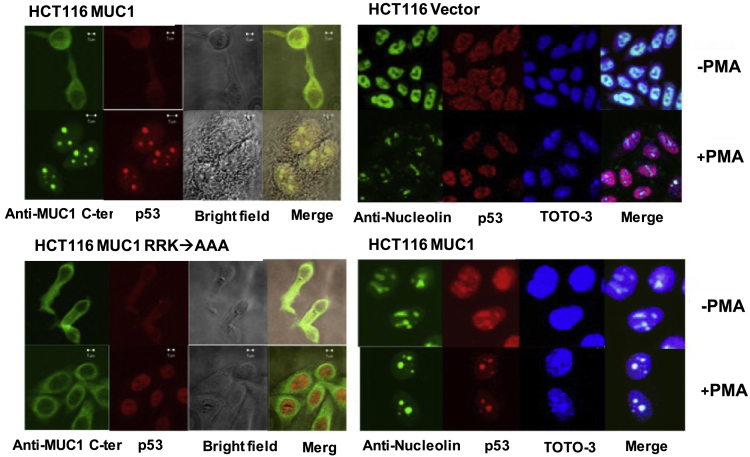
The enlarged distinct bulky-ball-like nucleolus matrix assembly is observed in most cancer stem cells (CSCs); however, the underlying mechanism is largely unknown. We show that matrix metalloproteinase-7 (MMP-7) shedding MUC-1 SEA domain releases MUC-1 C-ter, facilitating the nucleolus trafficking of p53 in gefitinib-resistant lung CSCs. The nucleolus colocalizations of p53, MUC-1 C-ter, MMP-7 and nucleolin were observed in the CD34 CXADR CD44v gefitinib-resistant EGFR CSC colonies. MUC-1 C-ter induced a unique porous bulky-ball-shaped, cagelike nucleolus that functions as a nucleus molecular "garage" for potent tumor suppressor, p53. Nucleolus could also facilitate the novel sub-nucleus compartment for proteolytic processing p53 by MMP-7 to generate a 35 kDa fragment. Moreover, we show that salinomycin, an anti-CSC agent, disrupts nucleolus by inducing nucleoplasm translocation of p53 and sensitizing CSC to chemotherapy drugs. Thus, this study highlights the MMP-7-MUC-1-p53 axis in nucleolus as a potential therapeutic target for anti-CSCs to resolve the chemotherapy-resistance dilemma.
在大多数癌症干细胞(CSCs)中观察到扩大的、明显的、球状核仁基质组装;然而,其潜在机制在很大程度上尚不清楚。我们发现基质金属蛋白酶-7(MMP-7)切割MUC-1 SEA结构域可释放MUC-1 C端,促进吉非替尼耐药肺CSCs中p53的核仁转运。在CD34 CXADR CD44v 吉非替尼耐药EGFR CSC集落中观察到p53、MUC-1 C端、MMP-7和核仁素的核仁共定位。MUC-1 C端诱导形成一种独特的多孔球状、笼状核仁,其作为强效肿瘤抑制因子p53的细胞核分子“车库”。核仁还可促进由MMP-7对p进行蛋白水解加工以产生35 kDa片段的新的核内亚区室形成。此外,我们发现抗CSC药物沙林霉素通过诱导p53的核质转位并使CSC对化疗药物敏感来破坏核仁。因此,本研究强调了核仁中的MMP-7-MUC-1-p53轴作为抗CSCs的潜在治疗靶点以解决化疗耐药困境。