Deng Qin-Fang, Fang Qi-Yu, Ji Xian-Xiu, Zhou Song-Wen
Department of Oncology, Shanghai Pulmonary Hospital, Tongji University School of Medicine, Shanghai, China.
J Cancer. 2020 Mar 26;11(12):3667-3674. doi: 10.7150/jca.42850. eCollection 2020.
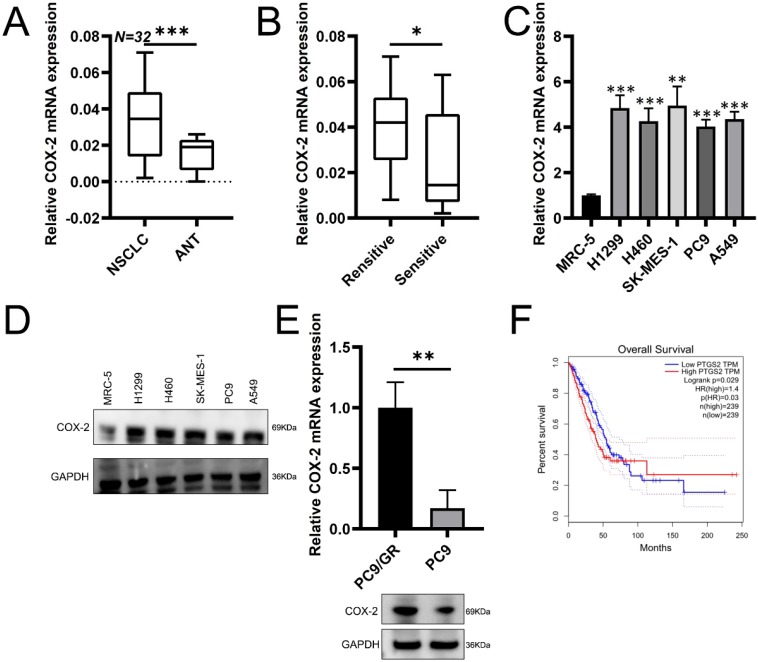
Gefitinib is a potent inhibitor of EGFR and represents the front-line treatment for non-small cell lung cancer (NSCLC) therapeutics. However, NSCLC patients are prone to develop acquired resistance through as yet, undefined mechanisms of resistance. Here, we investigated the role of COX-2 during gefitinib resistance in NSCLC cells and revealed its underlying mechanism(s) of action. We report the upregulation of COX-2 in gefitinib-resistant NSCLC tissues and cells, which is associated with poor prognosis. assays in NSCLC cells (PC9/GR) showed that COX-2 facilitates gefitinib resistance in NSCLC cells through its effects on P-gp, MRP1, and BCRP, and cancer cell migration and invasion. , COX-2 silencing could repress tumor growth. We found that the overexpression of COX-2 enhances the transcription of MMP-2, MMP-7, and MMP-9 which mediates PI3K-AKT activation. In summary, we demonstrate that COX-2 mediates the gefitinib resistance of NSCLC cells through its interaction with EGFR and the PI3K-AKT axis. This highlights COX-2 as a novel molecular target for NSCLC.
吉非替尼是一种有效的表皮生长因子受体(EGFR)抑制剂,是治疗非小细胞肺癌(NSCLC)的一线药物。然而,NSCLC患者容易通过尚未明确的耐药机制产生获得性耐药。在此,我们研究了COX-2在NSCLC细胞对吉非替尼耐药过程中的作用,并揭示了其潜在的作用机制。我们报告了COX-2在吉非替尼耐药的NSCLC组织和细胞中上调,这与预后不良相关。对NSCLC细胞(PC9/GR)的实验表明,COX-2通过影响P-糖蛋白(P-gp)、多药耐药相关蛋白1(MRP1)和乳腺癌耐药蛋白(BCRP)以及癌细胞迁移和侵袭,促进NSCLC细胞对吉非替尼耐药。此外,COX-2沉默可抑制肿瘤生长。我们发现COX-2的过表达增强了介导PI3K-AKT激活的基质金属蛋白酶-2(MMP-2)、基质金属蛋白酶-7(MMP-7)和基质金属蛋白酶-9(MMP-9)的转录。总之,我们证明COX-2通过与EGFR和PI3K-AKT轴相互作用介导NSCLC细胞对吉非替尼的耐药。这突出了COX-2作为NSCLC的一个新的分子靶点。