Labrosciano Clementine, Tavella Rosanna, Reynolds Amy, Air Tracy, Beltrame John F, Ranasinghe Isuru, Adams Robert J T
Adelaide Medical School, University of Adelaide, The Queen Elizabeth Hospital Campus, Woodville, SA 5011, Australia;
Basil Hetzel Institute for Translational Health Research, Adelaide, SA 5011, Australia;
Clocks Sleep. 2020 Apr 2;2(2):120-142. doi: 10.3390/clockssleep2020011. eCollection 2020 Jun.
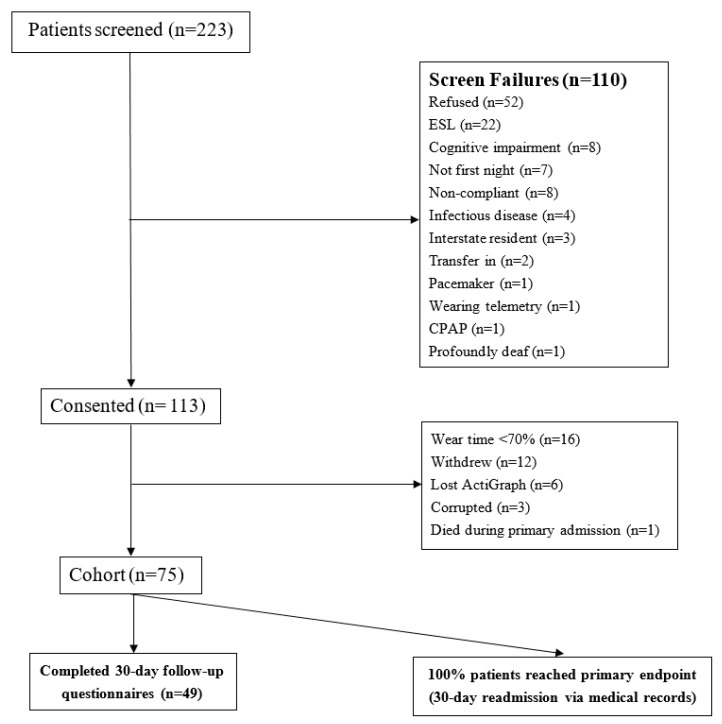
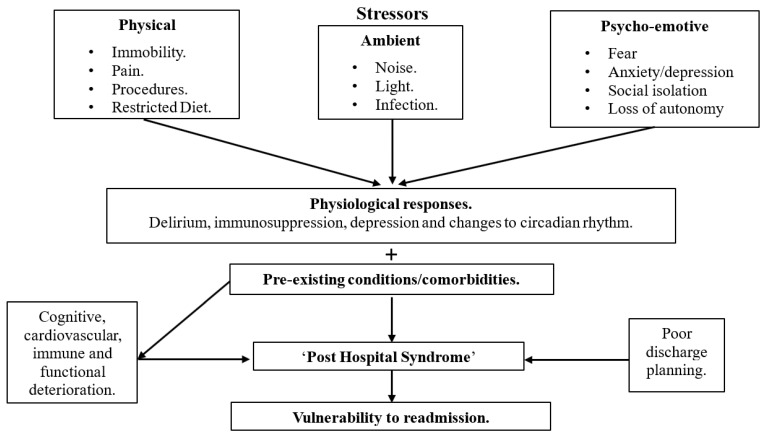
Readmissions within 30 days of discharge are prominent among patients with cardiovascular disease. Post hospital syndrome hypothesizes that sleep disturbance during the index admission contributes to an acquired transient vulnerability, leading to increased risk of readmission. This study evaluated the association of in-hospital sleep (a) duration and (b) quality with 30-day all-cause unplanned readmission. This prospective observational cohort study included patients admitted to the coronary care unit of a South Australian hospital between 2016-2018. Study participants were invited to wear an ActiGraph GT3X+ for the duration of their admission and for two weeks post-discharge. Validated sleep and quality of life questionnaires, including the Pittsburgh Sleep Quality Index (PSQI), were administered. Readmission status and questionnaires were assessed at 30 days post-discharge via patient telephone interview and a review of hospital records. The final cohort consisted of 75 patients (readmitted: = 15, non-readmitted: = 60), of which 72% were male with a mean age 66.9 ± 13.1 years. Total sleep time (TST), both in hospital (6.9 ± 1.3 vs. 6.8 ± 2.9 h, = 0.96) and post-discharge (7.4 ± 1.3 h vs. 8.9 ± 12.6 h, = 0.76), was similar in all patients. Patient's perception of sleep, reflected by PSQI scores, was poorer in readmitted patients (9.13 ± 3.6 vs. 6.4 ± 4.1, = 0.02). Although an association between total sleep time and 30-day readmission was not found, patients who reported poorer sleep quality were more likely to be readmitted within 30 days. This study also highlighted the importance of improving sleep, both in and out of the hospital, to improve the outcomes of cardiology inpatients.
出院后30天内再入院在心血管疾病患者中很常见。院后综合征假说认为,首次住院期间的睡眠障碍会导致获得性短暂易损性,从而增加再入院风险。本研究评估了住院期间睡眠(a)时长和(b)质量与30天全因非计划再入院之间的关联。这项前瞻性观察性队列研究纳入了2016年至2018年间入住南澳大利亚一家医院冠心病监护病房的患者。研究参与者被邀请在住院期间以及出院后两周佩戴ActiGraph GT3X+。发放了经过验证的睡眠和生活质量问卷,包括匹兹堡睡眠质量指数(PSQI)。出院后30天通过患者电话访谈和医院记录审查评估再入院状态和问卷情况。最终队列由75名患者组成(再入院:n = 15,未再入院:n = 60),其中72%为男性,平均年龄66.9±13.1岁。所有患者的总睡眠时间(TST),无论是住院期间(6.9±1.3小时对6.8±2.9小时,p = 0.96)还是出院后(7.4±1.3小时对8.9±12.6小时,p = 0.76),均相似。用PSQI评分反映的患者对睡眠的感知,再入院患者较差(9.13±3.6对6. − 4.1,p = 0.02)。虽然未发现总睡眠时间与30天再入院之间存在关联,但报告睡眠质量较差的患者在30天内更有可能再入院。本研究还强调了改善住院期间和出院后的睡眠对改善心脏病住院患者预后的重要性。