Kreyden Victoria A, Mawi Elly B, Rush Kristen M, Kowalski Jennifer R
Department of Biological Sciences, Butler University, Indianapolis, IN, USA.
Neurosci Insights. 2020 Oct 5;15:2633105520962792. doi: 10.1177/2633105520962792. eCollection 2020.
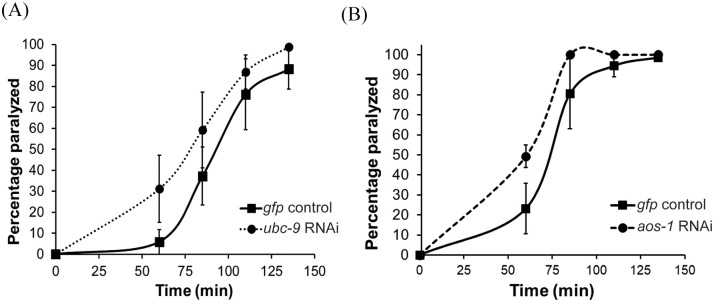
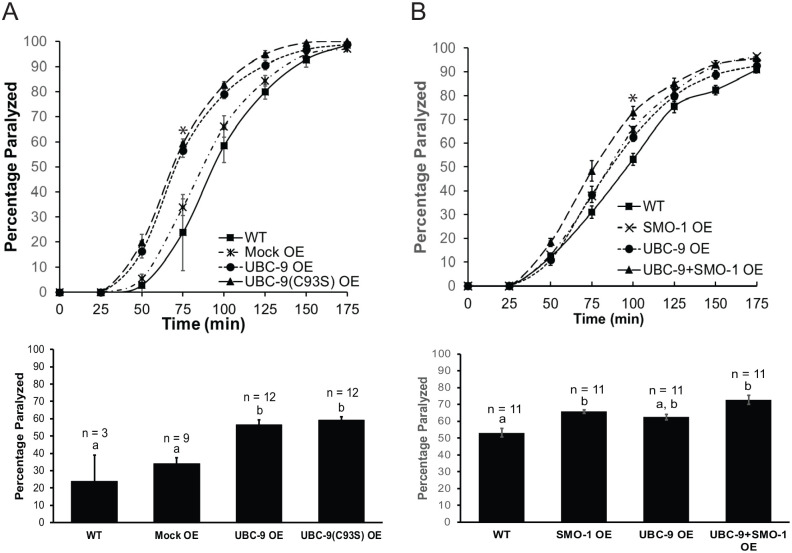
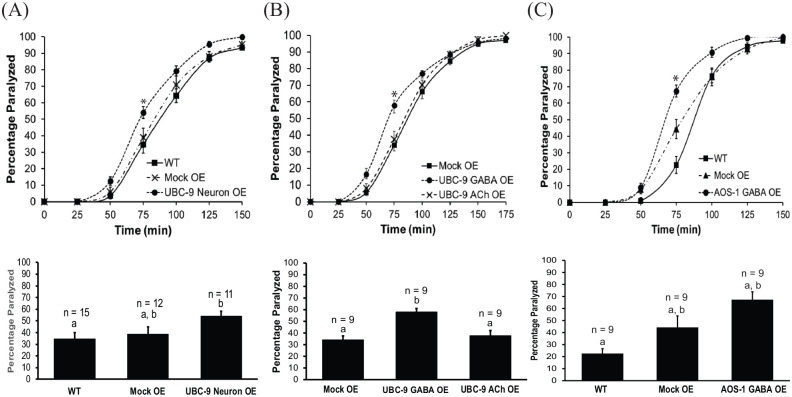
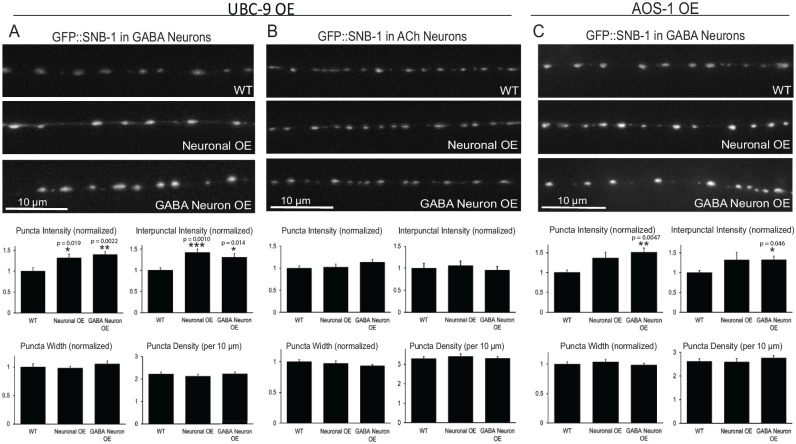
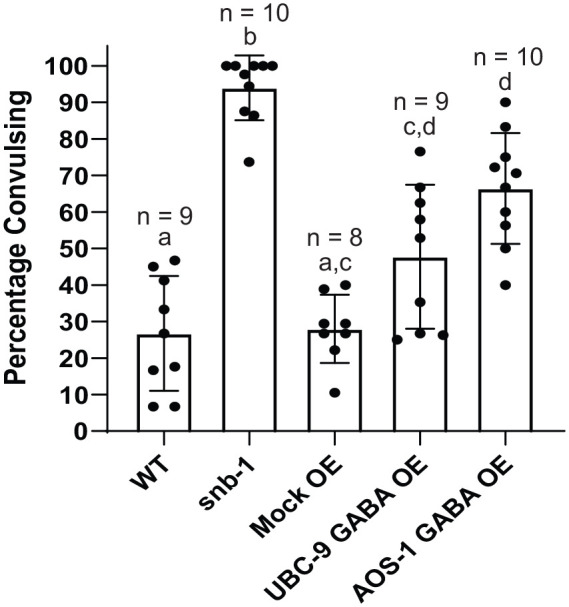
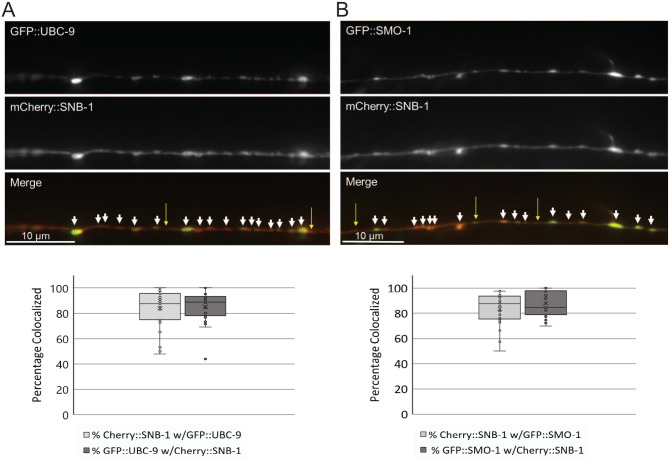
Regulation of excitatory to inhibitory signaling balance is essential to nervous system health and is maintained by numerous enzyme systems that modulate the activity, localization, and abundance of synaptic proteins. SUMOylation is a key post-translational regulator of protein function in diverse cells, including neurons. There, its role in regulating synaptic transmission through pre- and postsynaptic effects has been shown primarily at glutamatergic central nervous system synapses, where the sole SUMO-conjugating enzyme Ubc9 is a critical player. However, whether Ubc9 functions globally at other synapses, including inhibitory synapses, has not been explored. Here, we investigated the role of UBC-9 and the SUMOylation pathway in controlling the balance of excitatory cholinergic and inhibitory GABAergic signaling required for muscle contraction in . We found inhibition or overexpression of UBC-9 in neurons modestly increased muscle excitation. Similar and even stronger phenotypes were seen with UBC-9 overexpression specifically in GABAergic neurons, but not in cholinergic neurons. These effects correlated with accumulation of synaptic vesicle-associated proteins at GABAergic presynapses, where UBC-9 and the SUMO ortholog SMO-1 localized, and with defects in GABA-dependent behaviors. Experiments involving expression of catalytically inactive UBC-9 [UBC-9(C93S)], as well as co-expression of UBC-9 and SMO-1, suggested wild type UBC-9 overexpressed alone may act via substrate sequestration in the absence of sufficient free SUMO, underscoring the importance of tightly regulated SUMO enzyme function. Similar effects on muscle excitation, GABAergic signaling, and synaptic vesicle localization occurred with overexpression of the SUMO activating enzyme subunit AOS-1. Together, these data support a model in which UBC-9 and the SUMOylation system act at presynaptic sites in inhibitory motor neurons to control synaptic signaling balance in . Future studies will be important to define UBC-9 targets at this synapse, as well as mechanisms by which UBC-9 and the SUMO pathway are regulated.
兴奋性与抑制性信号平衡的调节对于神经系统健康至关重要,且由众多调节突触蛋白活性、定位和丰度的酶系统维持。SUMO化是包括神经元在内的多种细胞中蛋白质功能的关键翻译后调节因子。在神经元中,其通过突触前和突触后效应调节突触传递的作用主要在谷氨酸能中枢神经系统突触中得到证实,其中唯一的SUMO连接酶Ubc9起着关键作用。然而,Ubc9是否在包括抑制性突触在内的其他突触中全局发挥作用尚未得到探索。在这里,我们研究了UBC - 9和SUMO化途径在控制秀丽隐杆线虫肌肉收缩所需的兴奋性胆碱能和抑制性GABA能信号平衡中的作用。我们发现,神经元中UBC - 9的抑制或过表达适度增加了肌肉兴奋性。在GABA能神经元中特异性过表达UBC - 9时观察到了类似甚至更强的表型,但在胆碱能神经元中未观察到。这些效应与UBC - 9和SUMO同源物SMO - 1定位的GABA能突触前膜处突触小泡相关蛋白的积累以及GABA依赖性行为的缺陷相关。涉及催化无活性的UBC - 9 [UBC - 9(C93S)]表达以及UBC - 9和SMO - 1共表达的实验表明,单独过表达的野生型UBC - 在缺乏足够游离SUMO的情况下可能通过底物隔离起作用,强调了严格调节SUMO酶功能的重要性。SUMO激活酶亚基AOS - 1的过表达对肌肉兴奋性、GABA能信号和突触小泡定位产生了类似的影响。总之,这些数据支持了一个模型,即UBC - 9和SUMO化系统在抑制性运动神经元的突触前位点起作用,以控制秀丽隐杆线虫的突触信号平衡。未来的研究对于确定该突触处的UBC - 9靶点以及UBC - 9和SUMO途径的调节机制将非常重要。