Department of Psychiatry, Weill Institute for Neurosciences, and Kavli Institute for Fundamental Neuroscience, University of California San Francisco, San Francisco, CA, 94143, USA.
Mol Psychiatry. 2019 Sep;24(9):1248-1257. doi: 10.1038/s41380-019-0426-0. Epub 2019 May 14.
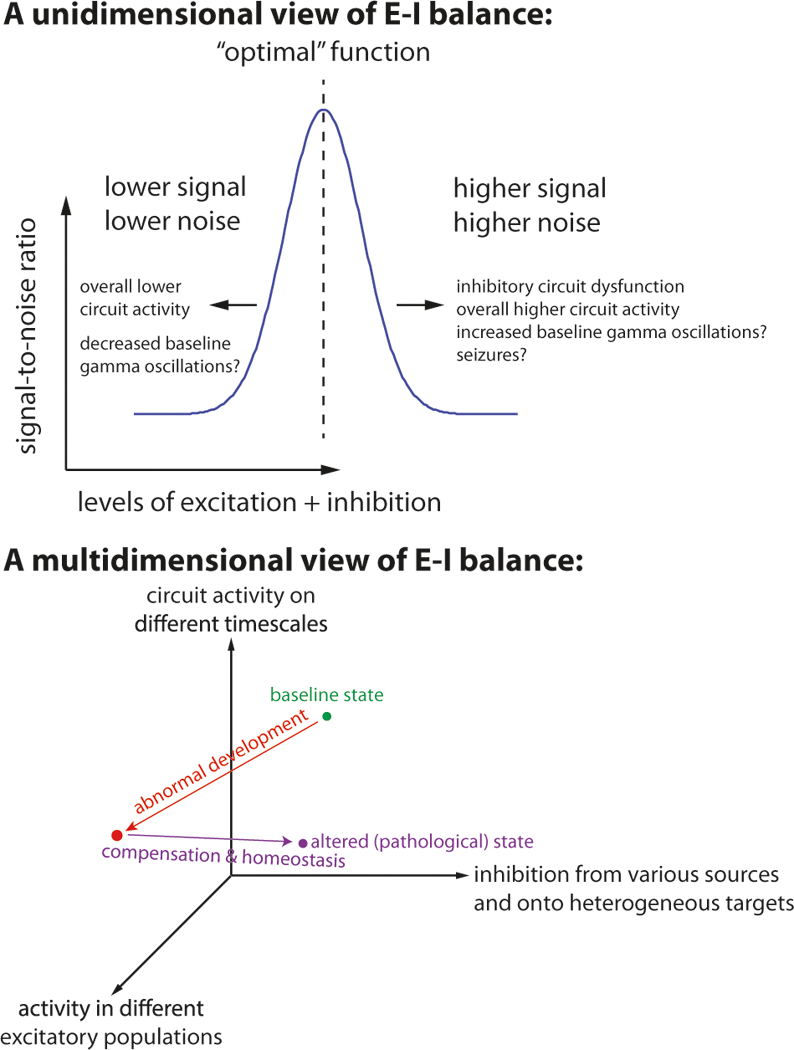
In 2003 Rubenstein and Merzenich hypothesized that some forms of Autism (ASD) might be caused by a reduction in signal-to-noise in key neural circuits, which could be the result of changes in excitatory-inhibitory (E-I) balance. Here, we have clarified the concept of E-I balance, and updated the original hypothesis in light of the field's increasingly sophisticated understanding of neuronal circuits. We discuss how specific developmental mechanisms, which reduce inhibition, affect cortical and hippocampal functions. After describing how mutations of some ASD genes disrupt inhibition in mice, we close by suggesting that E-I balance represents an organizing framework for understanding findings related to pathophysiology and for identifying appropriate treatments.
2003 年,鲁宾斯坦和梅尔策尼希假设某些形式的自闭症(ASD)可能是由于关键神经回路中的信号噪声比降低引起的,这可能是兴奋性抑制(E-I)平衡变化的结果。在这里,我们澄清了 E-I 平衡的概念,并根据该领域对神经元回路日益复杂的理解更新了原始假设。我们讨论了特定的发育机制如何通过减少抑制来影响皮质和海马功能。在描述了一些 ASD 基因的突变如何破坏小鼠的抑制作用后,我们最后提出 E-I 平衡代表了一个理解病理生理学相关发现和确定适当治疗方法的组织框架。