Department of Surgical Pathology, Women's Hospital, School of Medicine, Zhejiang University, Hangzhou, PR China.
Center for Uterine Cancer Diagnosis and Therapy Research of Zhejiang Province, Women's Hospital, Zhejiang University, Hangzhou, PR China.
J Pathol Clin Res. 2021 Jan;7(1):86-95. doi: 10.1002/cjp2.184. Epub 2020 Oct 22.
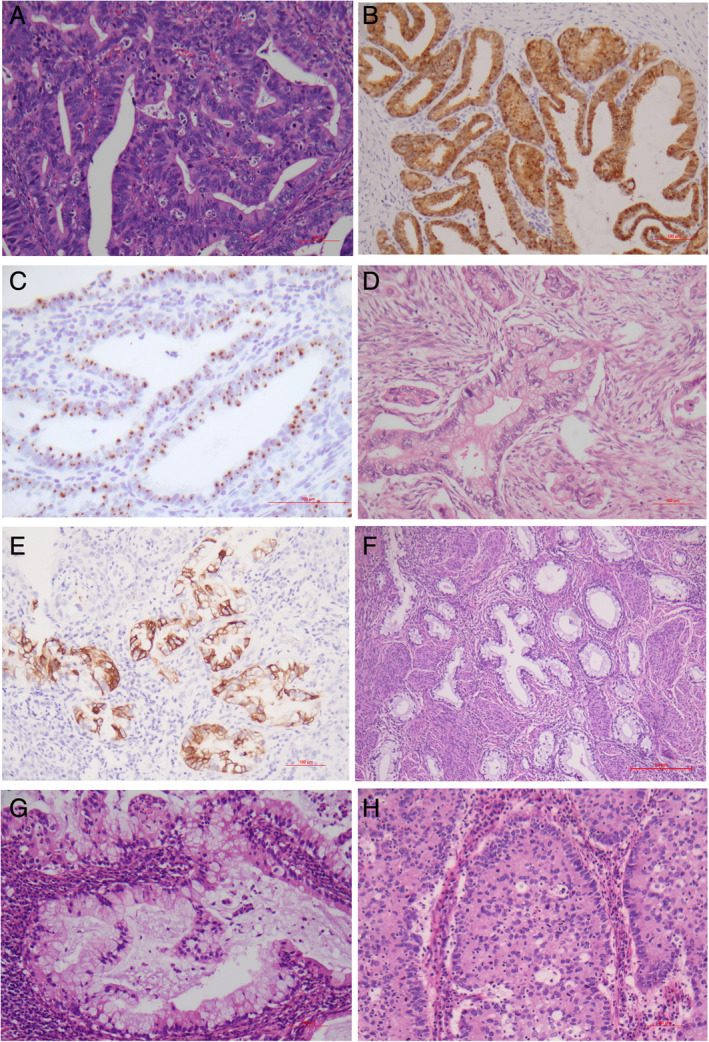
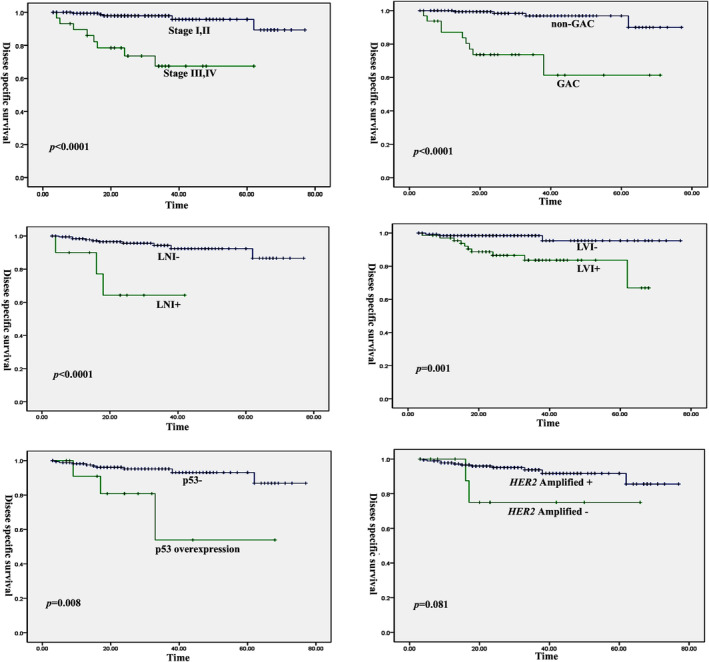
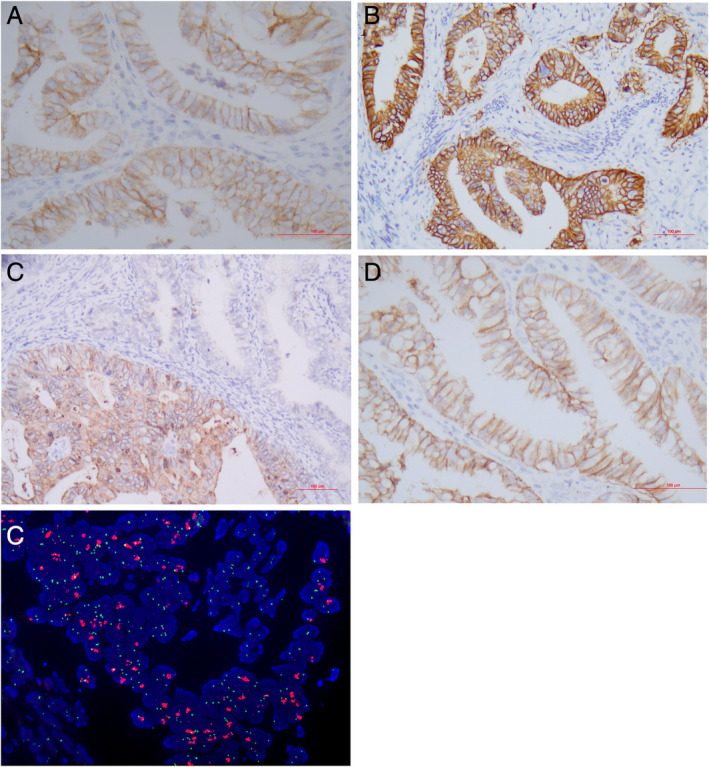
Few studies have explored HER2 status in cervical adenocarcinoma, particularly in the gastric-type adenocarcinoma (GAC), a nonhuman-papillomavirus-related subtype with poor clinical outcomes. In this study, we investigated HER2 expression and amplification by immunohistochemistry (IHC) and fluorescence in situ hybridization (FISH) in 209 well annotated cervical adenocarcinomas diagnosed using the International Endocervical Adenocarcinoma Criteria and Classification. IHC identified HER2 protein expression in 57.4% (123/209) of adenocarcinomas, of which 62 were IHC 1+ (negative), 38 2+ (equivocal) and 23 3+ (positive). HER2 amplification was found in 13 cases (6.2%) including 10 with IHC 3+ and 3 with IHC 2+. Among all the major histotypes of cervical adenocarcinoma, HER2 amplification was most common in GAC cases with a frequency of 14.7% (5/34). Moreover, HER2 amplification was more frequently associated with 2018 International Federation of Gynecology & Obstetrics (FIGO) stage III/IV, perineural involvement and ovarian spread (p < 0.05) while IHC 3+ was more common in patients with lymphovascular invasion and ovarian involvement (p < 0.05). Survival analysis indicated that FIGO stage III/IV, GAC, and p53 overexpression were associated with poor disease-specific survival and tumor recurrence (p < 0.05). In conclusion, HER2 amplification was present in a subset of adenocarcinomas, and more common in GAC, pointing to a potential benefit from trastuzumab treatment. HER2 overexpression does not identify gene amplification status in cervical adenocarcinoma; therefore, FISH is suggested for both IHC positive and equivocal cases. Further investigation on more cases with longer follow-up times is required to consolidate these findings.
这项研究调查了 209 例经国际宫颈内膜腺癌标准和分类诊断的宫颈腺癌中,免疫组织化学(IHC)和荧光原位杂交(FISH)检测的 HER2 表达和扩增情况。IHC 鉴定出 57.4%(123/209)的腺癌存在 HER2 蛋白表达,其中 62 例为 IHC 1+(阴性),38 例为 IHC 2+(不确定),23 例为 IHC 3+(阳性)。发现 13 例(6.2%)存在 HER2 扩增,包括 10 例 IHC 3+和 3 例 IHC 2+。在所有主要宫颈腺癌组织学类型中,GAC 中 HER2 扩增最常见,频率为 14.7%(5/34)。此外,HER2 扩增更常与 2018 年国际妇产科联盟(FIGO)分期 III/IV、神经周围浸润和卵巢转移相关(p<0.05),而 IHC 3+更常见于有淋巴血管侵犯和卵巢转移的患者(p<0.05)。生存分析表明,FIGO 分期 III/IV、GAC 和 p53 过表达与疾病特异性生存和肿瘤复发不良相关(p<0.05)。总之,HER2 扩增存在于一部分腺癌中,在 GAC 中更为常见,提示曲妥珠单抗治疗可能有效。HER2 过表达不能确定宫颈腺癌的基因扩增状态;因此,建议对 IHC 阳性和不确定病例进行 FISH。需要进一步调查更多病例并进行更长时间的随访,以证实这些发现。