Institute of Medical Genetics and Human Genetics, Charité - Universitätsmedizin Berlin, corporate member of Freie Universität Berlin, Humboldt-Universität zu Berlin and Berlin Institute of Health, Berlin, Germany.
Institute for Genomic Statistics and Bioinformatics, University Hospital Bonn, Rheinische Friedrich-Wilhelms-Universität Bonn, Bonn, Germany.
J Med Internet Res. 2020 Oct 22;22(10):e19263. doi: 10.2196/19263.
Collectively, an estimated 5% of the population have a genetic disease. Many of them feature characteristics that can be detected by facial phenotyping. Face2Gene CLINIC is an online app for facial phenotyping of patients with genetic syndromes. DeepGestalt, the neural network driving Face2Gene, automatically prioritizes syndrome suggestions based on ordinary patient photographs, potentially improving the diagnostic process. Hitherto, studies on DeepGestalt's quality highlighted its sensitivity in syndromic patients. However, determining the accuracy of a diagnostic methodology also requires testing of negative controls.
The aim of this study was to evaluate DeepGestalt's accuracy with photos of individuals with and without a genetic syndrome. Moreover, we aimed to propose a machine learning-based framework for the automated differentiation of DeepGestalt's output on such images.
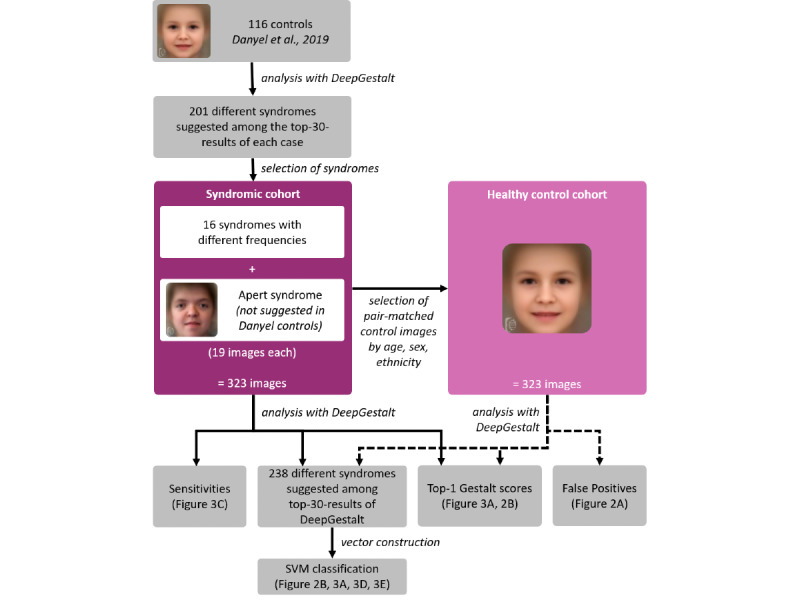
Frontal facial images of individuals with a diagnosis of a genetic syndrome (established clinically or molecularly) from a convenience sample were reanalyzed. Each photo was matched by age, sex, and ethnicity to a picture featuring an individual without a genetic syndrome. Absence of a facial gestalt suggestive of a genetic syndrome was determined by physicians working in medical genetics. Photos were selected from online reports or were taken by us for the purpose of this study. Facial phenotype was analyzed by DeepGestalt version 19.1.7, accessed via Face2Gene CLINIC. Furthermore, we designed linear support vector machines (SVMs) using Python 3.7 to automatically differentiate between the 2 classes of photographs based on DeepGestalt's result lists.
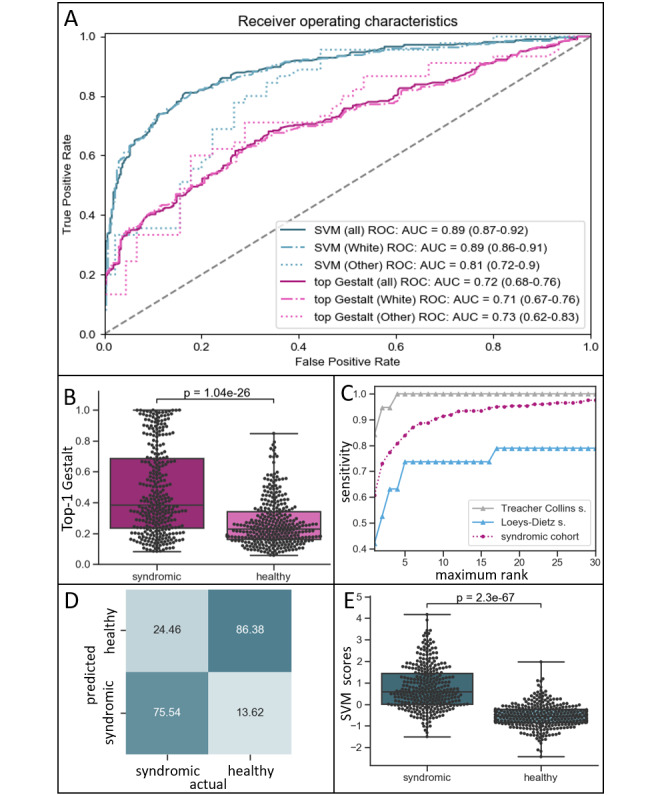
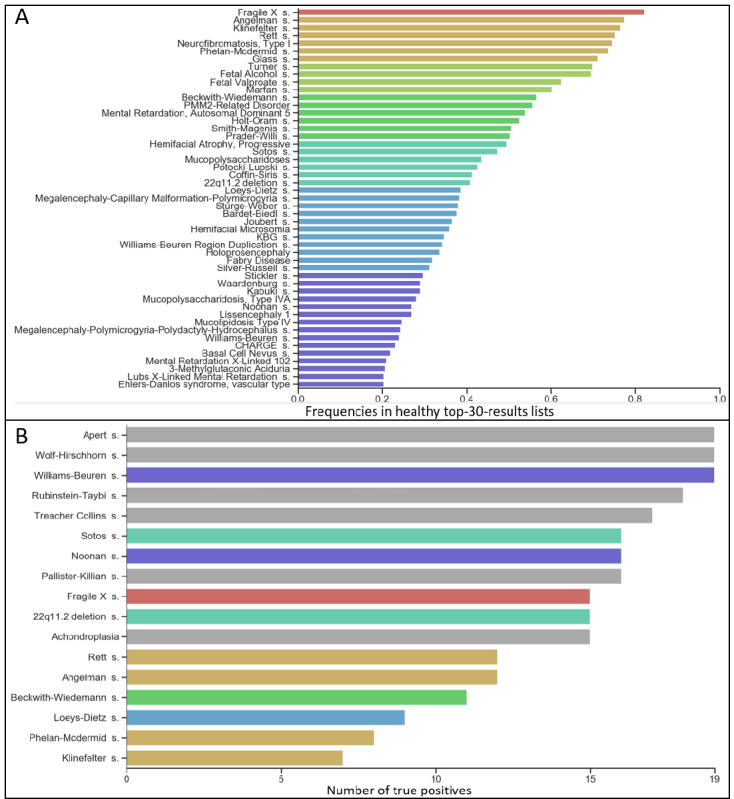
We included photos of 323 patients diagnosed with 17 different genetic syndromes and matched those with an equal number of facial images without a genetic syndrome, analyzing a total of 646 pictures. We confirm DeepGestalt's high sensitivity (top 10 sensitivity: 295/323, 91%). DeepGestalt's syndrome suggestions in individuals without a craniofacially dysmorphic syndrome followed a nonrandom distribution. A total of 17 syndromes appeared in the top 30 suggestions of more than 50% of nondysmorphic images. DeepGestalt's top scores differed between the syndromic and control images (area under the receiver operating characteristic [AUROC] curve 0.72, 95% CI 0.68-0.76; P<.001). A linear SVM running on DeepGestalt's result vectors showed stronger differences (AUROC 0.89, 95% CI 0.87-0.92; P<.001).
DeepGestalt fairly separates images of individuals with and without a genetic syndrome. This separation can be significantly improved by SVMs running on top of DeepGestalt, thus supporting the diagnostic process of patients with a genetic syndrome. Our findings facilitate the critical interpretation of DeepGestalt's results and may help enhance it and similar computer-aided facial phenotyping tools.
据估计,人群中约有 5%患有遗传性疾病。其中许多疾病的特征可以通过面部表型检测出来。Face2Gene CLINIC 是一款用于遗传综合征患者面部表型分析的在线应用程序。驱动 Face2Gene 的 DeepGestalt 神经网络会根据普通患者的照片自动优先考虑综合征建议,从而可能改善诊断过程。迄今为止,关于 DeepGestalt 质量的研究强调了其在综合征患者中的敏感性。然而,确定诊断方法的准确性还需要对阴性对照进行测试。
本研究旨在评估 DeepGestalt 在有和没有遗传综合征的个体的照片上的准确性。此外,我们旨在提出一种基于机器学习的框架,用于自动区分 DeepGestalt 在这些图像上的输出。
对来自便利样本的临床或分子诊断为遗传综合征的个体的正面面部图像进行重新分析。每一张照片都与一位没有遗传综合征的个体的照片按年龄、性别和种族相匹配。由从事医学遗传学的医生确定是否存在提示遗传综合征的面部特征。照片选自在线报告或为进行本研究而拍摄。使用 Python 3.7 设计线性支持向量机(SVM),通过 Face2Gene CLINIC 访问 DeepGestalt 版本 19.1.7 进行面部表型分析。
我们纳入了 323 名诊断为 17 种不同遗传综合征的患者的照片,并与相同数量无遗传综合征的面部图像相匹配,共分析了 646 张照片。我们确认了 DeepGestalt 的高敏感性(前 10 名敏感性:323/323,91%)。在没有颅面畸形综合征的个体中,DeepGestalt 的综合征建议呈非随机分布。在 50%以上无畸形图像的前 30 个建议中,共有 17 种综合征出现。综合征图像和对照图像的 DeepGestalt 最高得分存在差异(接受者操作特征曲线下面积 [AUROC]为 0.72,95%CI 为 0.68-0.76;P<.001)。在 DeepGestalt 结果向量上运行的线性 SVM 显示出更强的差异(AUROC 为 0.89,95%CI 为 0.87-0.92;P<.001)。
DeepGestalt 可以很好地区分有和没有遗传综合征的个体的图像。通过在 DeepGestalt 上运行 SVM,可以显著提高这种区分能力,从而支持遗传综合征患者的诊断过程。我们的发现有助于对 DeepGestalt 结果进行批判性解释,并可能有助于增强它和类似的计算机辅助面部表型分析工具。