Department of Otolaryngology/Head and Neck Surgery, Washington University School of Medicine, Saint Louis, MO, USA.
Division of Public Health Science, Department of Surgery, Washington University School of Medicine, Saint Louis, MO, USA.
Cancer Med. 2020 Dec;9(24):9326-9335. doi: 10.1002/cam4.3539. Epub 2020 Oct 23.
People living with HIV/AIDS (PLWH) have an excess risk for head and neck squamous cell carcinoma (HNSCC) compared to the general U.S. population, but little is known about HIV-specific risk factors associated with the incidence and outcomes HNSCC. We aim to identify clinical and HIV-specific risk factors associated with oropharyngeal and non-oropharyngeal HNSCC incidence and outcomes separately.
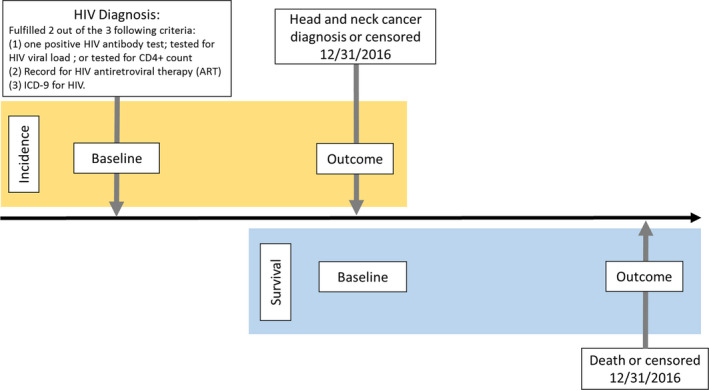
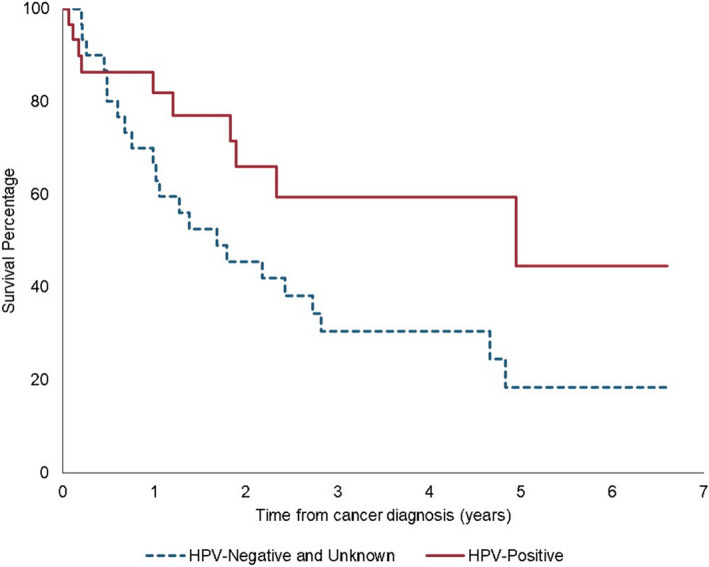
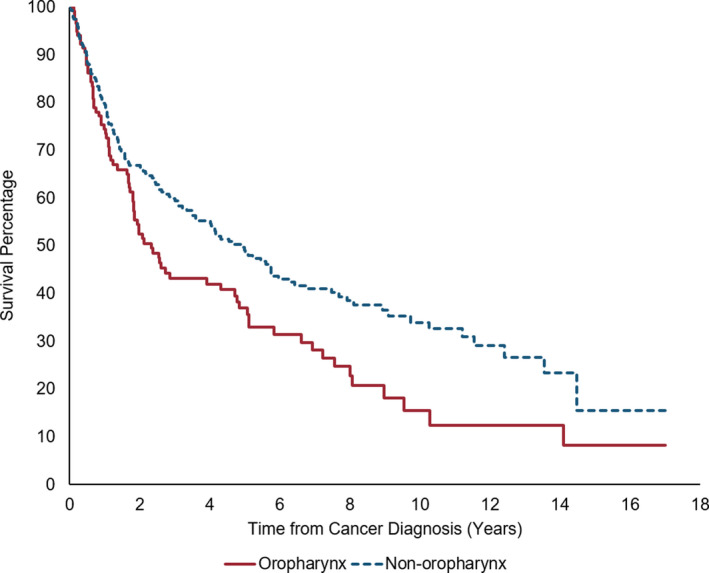
We constructed a retrospective cohort study of 45,052 PLWH aged 18 or above from the national Veteran Affairs (VA) Corporate Data from 1999 to 2015. We extracted demographic data and risk factor information, including history of alcohol abuse, smoking, CD4 count (cells/μl), and percent of follow-up time with undetectable HIV viral load as time-updated variables. We calculated the age-standardized incidence rates of oropharyngeal and non-oropharyngeal HNSCC and estimated adjusted hazard ratios (HR). We also examined overall survival using Kaplan-Meier curves and adjusted HR.
The standardized incidence rate of oropharyngeal and non-oropharyngeal HNSCC in this veteran cohort of PLWH is 23.0 (95% confidence intervals (CIs): 17.1-28.9) and 55.4 (95% CI: 46.5-64.3) per 100,000 person-years, respectively. Nadir CD4 count ≤200 was associated with an increased risk of non-oropharyngeal HNSCC (HR: 1.78; 95% CI: 1.31-2.30 vs >200). Five-year overall survival of OPSCC (37.0%) was significantly lower than non-oropharyngeal HNSCC (49.1%).
PLWH who receive care in the VA had higher age-adjusted HNSCC incidence rates than reported in the general population, suggesting that HIV and immunosuppression play a role. Additional studies should be conducted to study the interaction between HPV and HIV.
与普通美国人群相比,感染人类免疫缺陷病毒/艾滋病(HIV/AIDS)的人群(PLWH)患头颈部鳞状细胞癌(HNSCC)的风险更高,但对于与 HNSCC 的发病率和结果相关的 HIV 特异性风险因素知之甚少。我们旨在分别确定与口咽和非口咽 HNSCC 的发病率和结果相关的临床和 HIV 特异性风险因素。
我们构建了一个回顾性队列研究,该研究使用来自 1999 年至 2015 年国家退伍军人事务部(VA)公司数据的 45052 名年龄在 18 岁或以上的 PLWH。我们提取了人口统计学数据和风险因素信息,包括酒精滥用史、吸烟史、CD4 计数(细胞/μl)以及未检出 HIV 病毒载量的随访时间百分比作为时间更新变量。我们计算了口咽和非口咽 HNSCC 的年龄标准化发病率,并估计了调整后的危险比(HR)。我们还使用 Kaplan-Meier 曲线和调整后的 HR 检查了总生存率。
在这个感染 PLWH 的退伍军人队列中,口咽和非口咽 HNSCC 的标准化发病率分别为 23.0(95%置信区间(CI):17.1-28.9)和 55.4(95%CI:46.5-64.3)每 100,000 人年。最低 CD4 计数≤200 与非口咽 HNSCC 的风险增加相关(HR:1.78;95%CI:1.31-2.30 与>200)。OPSCC(37.0%)的 5 年总生存率明显低于非口咽 HNSCC(49.1%)。
在 VA 接受治疗的 PLWH 的年龄调整 HNSCC 发病率高于普通人群报告的发病率,这表明 HIV 和免疫抑制作用起一定作用。应该进行更多的研究来研究 HPV 和 HIV 之间的相互作用。