Department of Microbiology, Perelman School of Medicine, University of Pennsylvania, Philadelphia, PA, United States of America.
Institute for Immunology, Perelman School of Medicine, University of Pennsylvania, Philadelphia, PA, United States of America.
PLoS Pathog. 2018 Apr 13;14(4):e1006973. doi: 10.1371/journal.ppat.1006973. eCollection 2018 Apr.
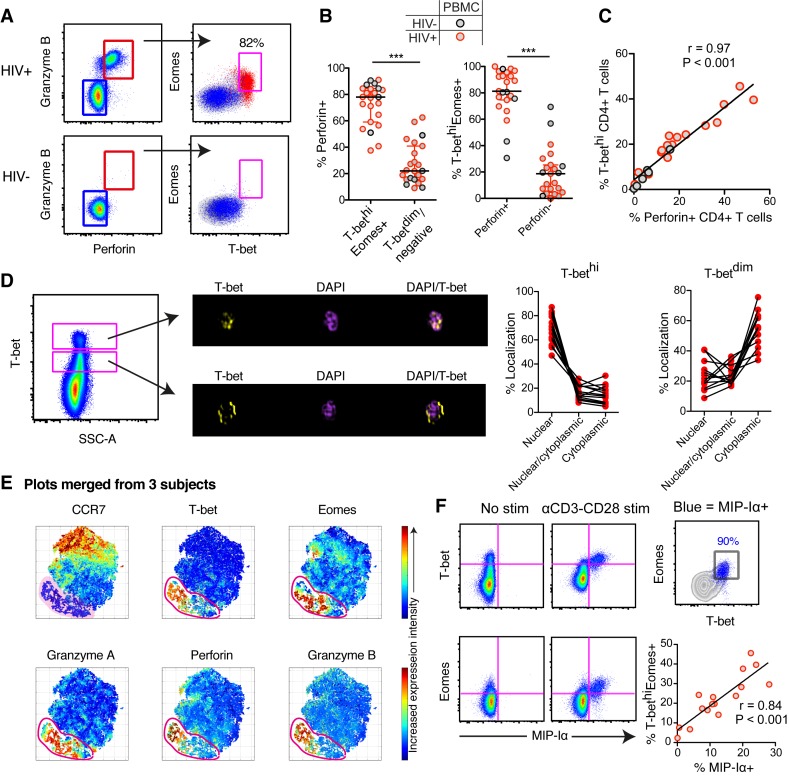
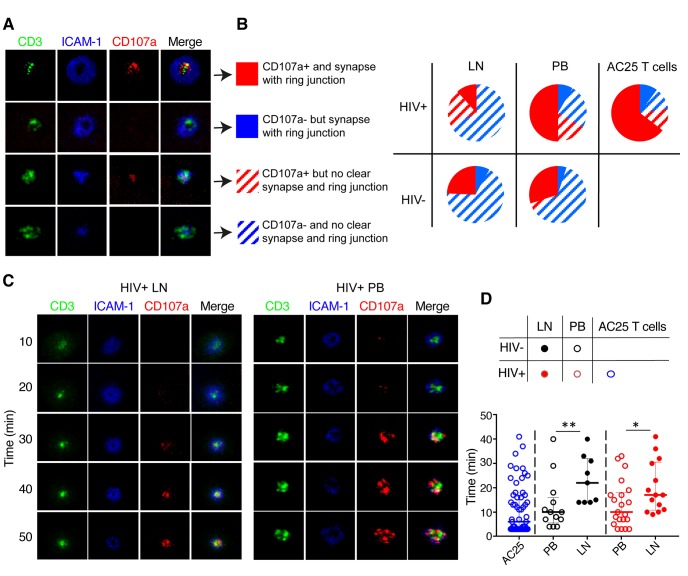
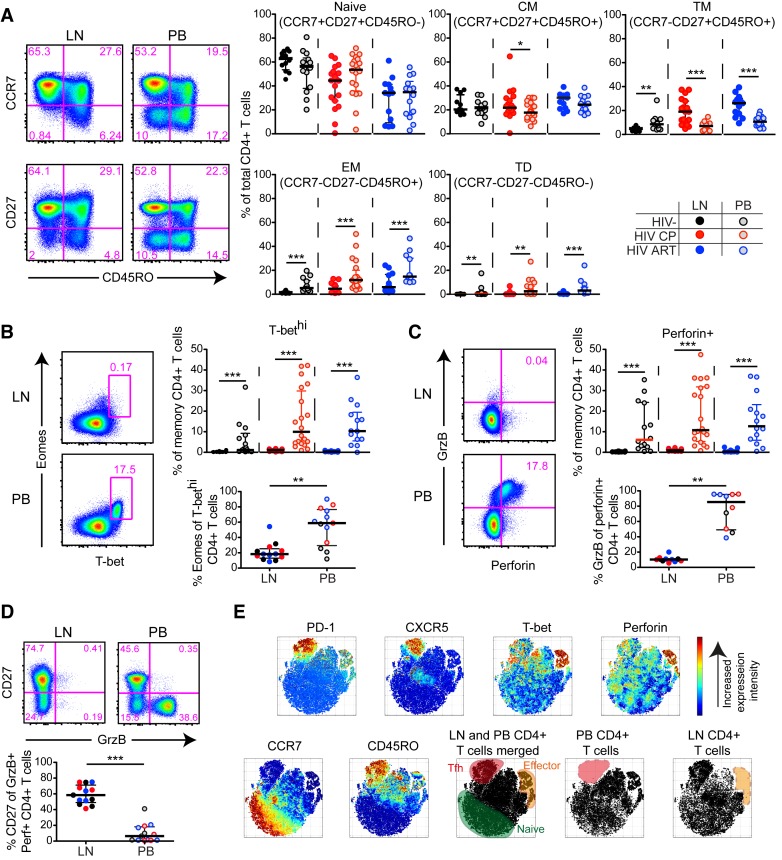
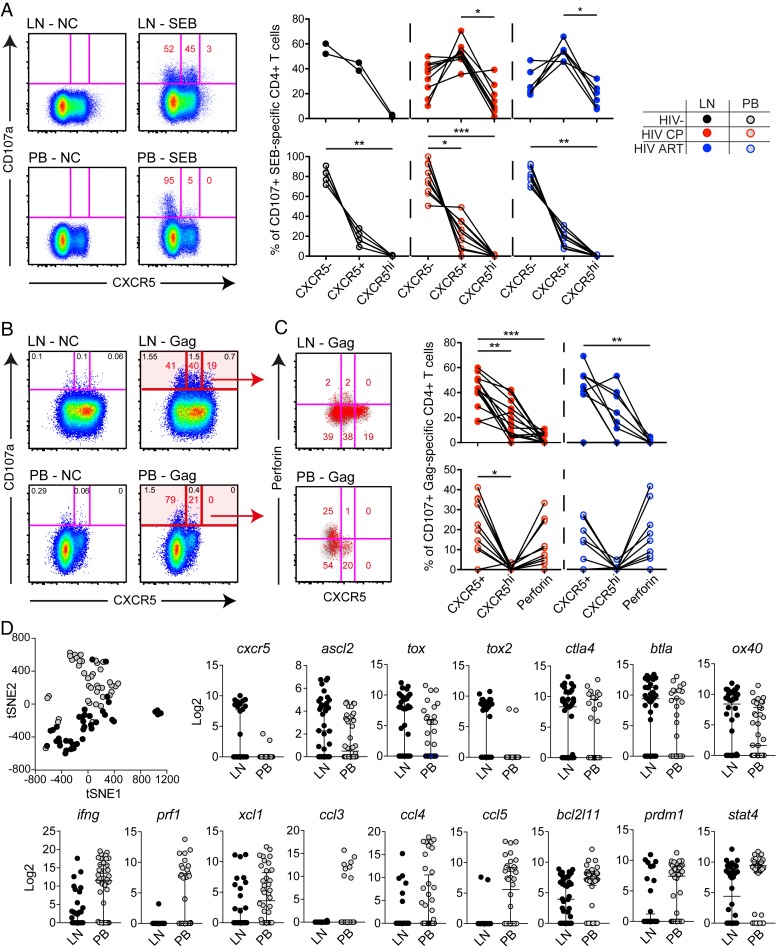
CD4+ T cells subsets have a wide range of important helper and regulatory functions in the immune system. Several studies have specifically suggested that circulating effector CD4+ T cells may play a direct role in control of HIV replication through cytolytic activity or autocrine β-chemokine production. However, it remains unclear whether effector CD4+ T cells expressing cytolytic molecules and β-chemokines are present within lymph nodes (LNs), a major site of HIV replication. Here, we report that expression of β-chemokines and cytolytic molecules are enriched within a CD4+ T cell population with high levels of the T-box transcription factors T-bet and eomesodermin (Eomes). This effector population is predominately found in peripheral blood and is limited in LNs regardless of HIV infection or treatment status. As a result, CD4+ T cells generally lack effector functions in LNs, including cytolytic capacity and IFNγ and β-chemokine expression, even in HIV elite controllers and during acute/early HIV infection. While we do find the presence of degranulating CD4+ T cells in LNs, these cells do not bear functional or transcriptional effector T cell properties and are inherently poor to form stable immunological synapses compared to their peripheral blood counterparts. We demonstrate that CD4+ T cell cytolytic function, phenotype, and programming in the peripheral blood is dissociated from those characteristics found in lymphoid tissues. Together, these data challenge our current models based on blood and suggest spatially and temporally dissociated mechanisms of viral control in lymphoid tissues.
CD4+ T 细胞亚群在免疫系统中具有广泛的重要辅助和调节功能。有几项研究特别表明,循环效应 CD4+ T 细胞可能通过细胞溶解活性或自分泌β趋化因子产生直接参与控制 HIV 复制。然而,效应 CD4+ T 细胞是否表达细胞溶解分子和β趋化因子尚不清楚,这些细胞存在于淋巴结(LN)中,这是 HIV 复制的主要部位。在这里,我们报告说,β趋化因子和细胞溶解分子的表达在具有高水平 T 盒转录因子 T-bet 和 Eomesodermin(Eomes)的 CD4+ T 细胞群体中得到富集。该效应细胞群主要存在于外周血中,无论 HIV 感染或治疗状况如何,在 LN 中均受到限制。因此,CD4+ T 细胞通常缺乏 LN 中的效应功能,包括细胞溶解能力以及 IFNγ和β趋化因子的表达,即使在 HIV 精英控制器中和急性/早期 HIV 感染期间也是如此。虽然我们确实在 LN 中发现了脱颗粒的 CD4+ T 细胞,但这些细胞不具有功能或转录效应 T 细胞特性,与外周血中的对应物相比,形成稳定免疫突触的能力较差。我们证明,外周血中 CD4+ T 细胞的细胞溶解功能、表型和编程与在淋巴组织中发现的特征分离。这些数据共同挑战了我们基于血液的现有模型,并表明在淋巴组织中存在空间和时间上分离的病毒控制机制。