Department of Infection Biology, Faculty of Infectious and Tropical Diseases, London School of Hygiene and Tropical Medicine, Keppel St, London WC1E 7HT, UK.
Center for Global Health, Perelman School of Medicine, University of Pennsylvania, Philadelphia 19104, PA, USA.
FEMS Microbiol Rev. 2021 May 5;45(3). doi: 10.1093/femsre/fuaa056.
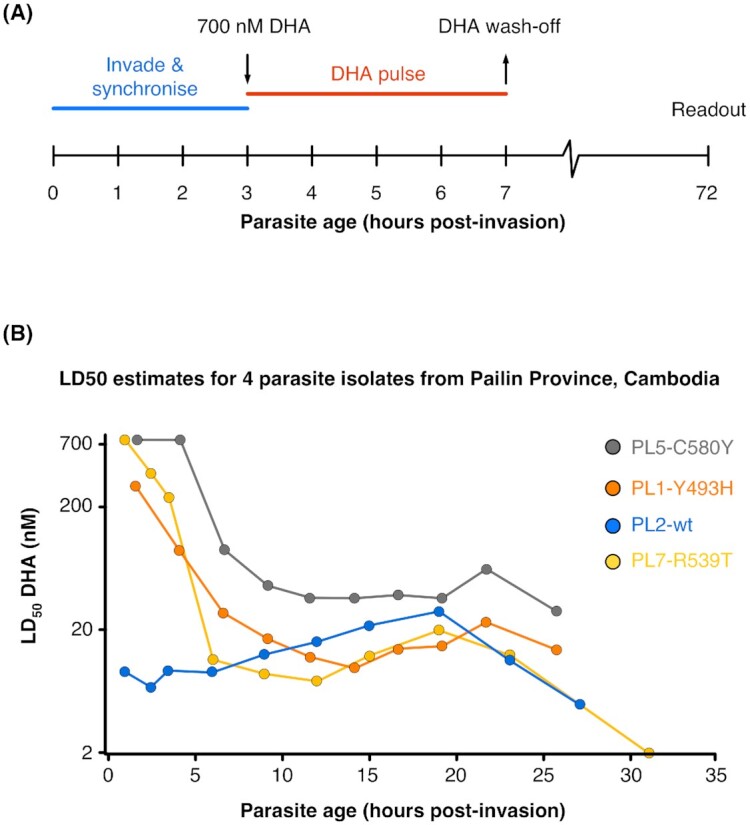
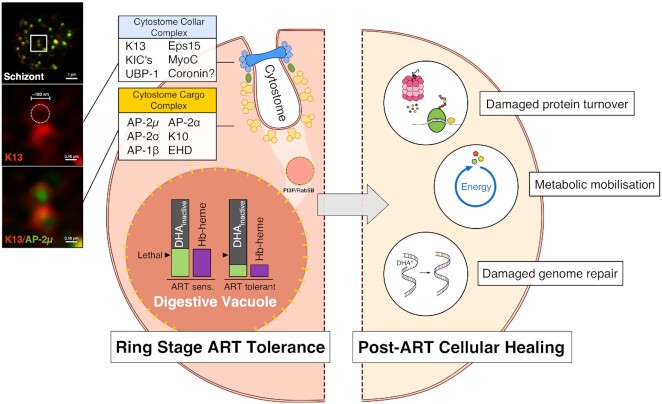
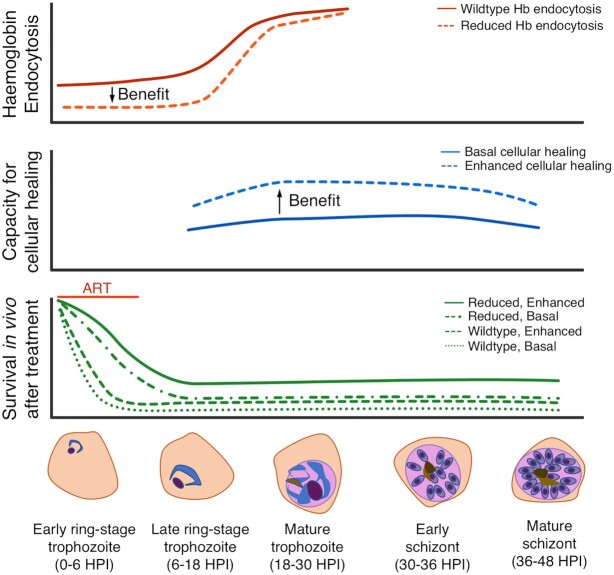
Studies of the susceptibility of Plasmodium falciparum to the artemisinin family of antimalarial drugs provide a complex picture of partial resistance (tolerance) associated with increased parasite survival in vitro and in vivo. We present an overview of the genetic loci that, in mutant form, can independently elicit parasite tolerance. These encode Kelch propeller domain protein PfK13, ubiquitin hydrolase UBP-1, actin filament-organising protein Coronin, also carrying a propeller domain, and the trafficking adaptor subunit AP-2μ. Detailed studies of these proteins and the functional basis of artemisinin tolerance in blood-stage parasites are enabling a new synthesis of our understanding to date. To guide further experimental work, we present two major conclusions. First, we propose a dual-component model of artemisinin tolerance in P. falciparum comprising suppression of artemisinin activation in early ring stage by reducing endocytic haemoglobin capture from host cytosol, coupled with enhancement of cellular healing mechanisms in surviving cells. Second, these two independent requirements limit the likelihood of development of complete artemisinin resistance by P. falciparum, favouring deployment of existing drugs in new schedules designed to exploit these biological limits, thus extending the useful life of current combination therapies.
疟原虫对青蒿素类抗疟药物敏感性的研究呈现出部分耐药(耐受)的复杂情况,这种耐药与寄生虫在体外和体内的生存能力增加有关。我们概述了可以独立引发寄生虫耐受的基因突变。这些基因编码Kelch 螺旋桨结构域蛋白 PfK13、泛素水解酶 UBP-1、肌动蛋白丝组织蛋白 Coronin(也带有螺旋桨结构域)和运输衔接子亚基 AP-2μ。对这些蛋白的详细研究以及疟原虫血期寄生虫对青蒿素耐受的功能基础,使我们能够对目前的理解进行新的综合。为了指导进一步的实验工作,我们提出了两个主要结论。首先,我们提出了疟原虫对青蒿素耐受的双组分模型,该模型包括通过减少宿主细胞质中内吞血红素捕获来抑制早期环期青蒿素的激活,同时增强存活细胞中的细胞修复机制。其次,这两个独立的要求限制了疟原虫产生完全青蒿素耐药的可能性,有利于在新方案中部署现有的药物,以利用这些生物学限制,从而延长现有联合疗法的使用寿命。