Lee Jihwan, Liu Zhuohe, Suzuki Peter H, Ahrens John F, Lai Shujuan, Lu Xiaoyu, Guan Sihui, St-Pierre François
Systems, Synthetic, and Physical Biology Program, Rice University, Houston, TX 77005, USA.
Department of Electrical and Computer Engineering, Rice University, Houston, TX 77005, USA.
Sci Adv. 2020 Oct 23;6(43). doi: 10.1126/sciadv.abb7438. Print 2020 Oct.
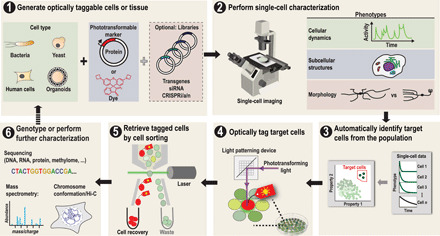
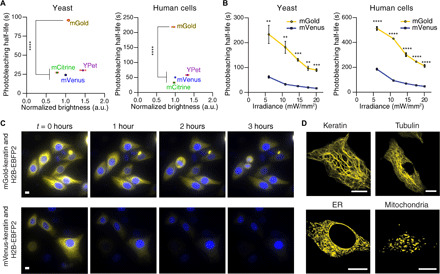
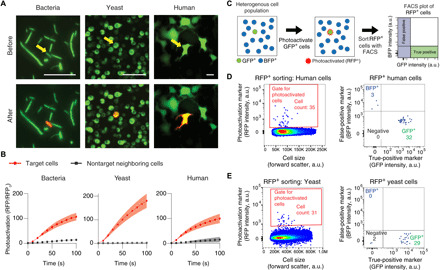
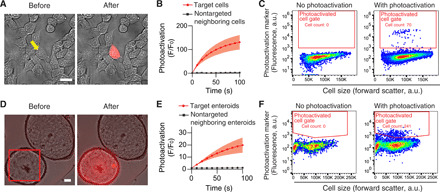
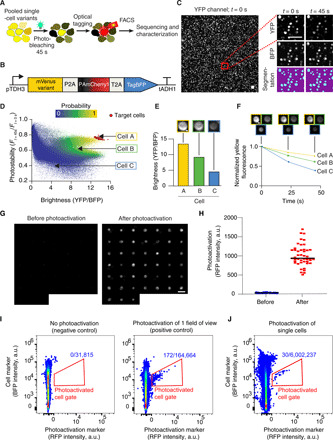
Unraveling the genetic and epigenetic determinants of phenotypes is critical for understanding and re-engineering biology and would benefit from improved methods to separate cells based on phenotypes. Here, we report SPOTlight, a versatile high-throughput technique to isolate individual yeast or human cells with unique spatiotemporal profiles from heterogeneous populations. SPOTlight relies on imaging visual phenotypes by microscopy, precise optical tagging of single target cells, and retrieval of tagged cells by fluorescence-activated cell sorting. To illustrate SPOTlight's ability to screen cells based on temporal properties, we chose to develop a photostable yellow fluorescent protein for extended imaging experiments. We screened 3 million cells expressing mutagenesis libraries and identified a bright new variant, mGold, that is the most photostable yellow fluorescent protein reported to date. We anticipate that the versatility of SPOTlight will facilitate its deployment to decipher the rules of life, understand diseases, and engineer new molecules and cells.
揭示表型的遗传和表观遗传决定因素对于理解和重新设计生物学至关重要,并且将受益于基于表型分离细胞的改进方法。在此,我们报告了SPOTlight,这是一种通用的高通量技术,可从异质群体中分离出具有独特时空特征的单个酵母或人类细胞。SPOTlight依靠显微镜对视觉表型进行成像、对单个靶细胞进行精确的光学标记以及通过荧光激活细胞分选来检索标记细胞。为了说明SPOTlight基于时间特性筛选细胞的能力,我们选择开发一种用于延长成像实验的光稳定黄色荧光蛋白。我们筛选了表达诱变文库的300万个细胞,并鉴定出一种明亮的新变体mGold,它是迄今为止报道的最光稳定的黄色荧光蛋白。我们预计,SPOTlight的多功能性将有助于其用于破译生命规则、理解疾病以及设计新的分子和细胞。