
尿足细胞 mRNA 先于微量白蛋白尿,成为人类 2 型糖尿病肾病进展的风险标志物。
Urinary podocyte mRNAs precede microalbuminuria as a progression risk marker in human type 2 diabetic nephropathy.
机构信息
Department of Endocrinology, Metabolism, Rheumatology and Nephrology, Faculty of Medicine, Oita University, 1-1 Idaigaoka, Hasama-machi, Yufu, Oita, 879-5593, Japan.
Division of Nephrology, Department of Internal Medicine, Faculty of Medicine, University of Miyazaki, Miyazaki, Japan.
出版信息
Sci Rep. 2020 Oct 23;10(1):18209. doi: 10.1038/s41598-020-75320-1.
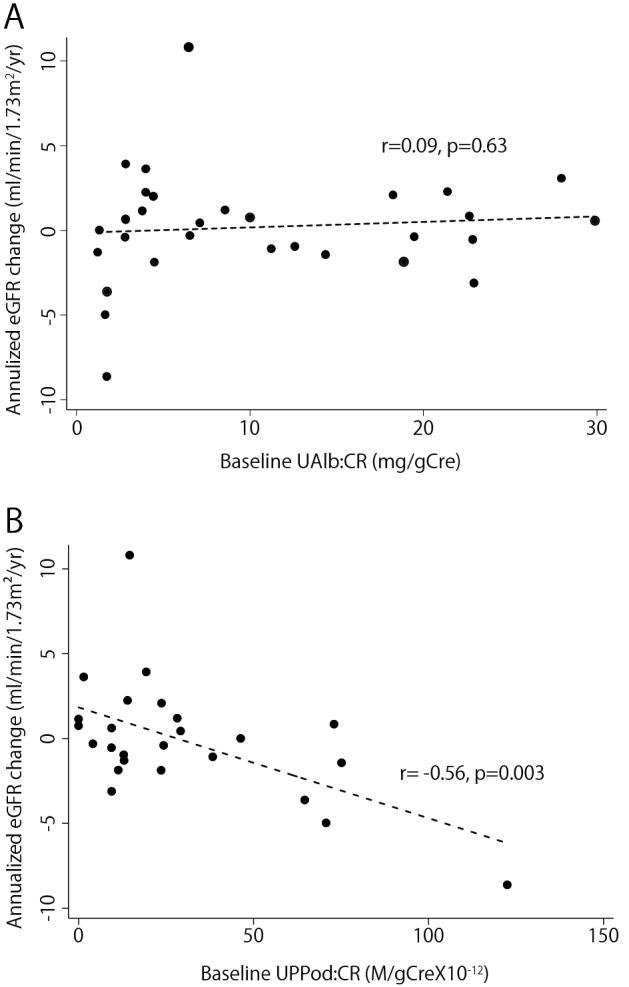
Earlier detection of progression risk in diabetic nephropathy will allow earlier intervention to reduce progression. The hypothesis that urinary pellet podocyte mRNA is a more sensitive progression risk marker than microalbuminuria was tested. A cross sectional cohort of 165 type 2 diabetics and 41 age and sex-matched controls were enrolled. Podocyte stress (Urinary pellet podocin:nephrin mRNA ratio), podocyte detachment (Urinary pellet podocin mRNA:creatinine ratio: UPPod:CR) and a tubular marker (Urinary pellet aquaporin 2:creatinine ratio) were measured in macro-albuminuric, micro-albuminuric and norm-albuminuric groups. eGFR was reassessed after 4 years in 124 available diabetic subjects. Urinary pellet podocyte and tubular mRNA markers were increased in all diabetic groups in cross-sectional analysis. After 4 years of follow-up univariable and multivariate model analysis showed that the only urinary markers significantly related to eGFR slope were UPPod:CR (P < 0.01) and albuminuria (P < 0.01). AUC analysis using K-fold cross validation to predict eGFR loss of ≥ 3 ml/min/1.73m/year showed that UPPod:CR and albuminuria each improved the AUC similarly such that combined with clinical variables they gave an AUC = 0.70. Podocyte markers and albuminuria had overlapping AUC contributions, as expected if podocyte depletion causes albuminuria. In the norm-albuminuria cohort (n = 75) baseline UPPod:CR was associated with development of albuminuria (P = 0.007) and, in the tertile with both normal kidney function (eGFR 84 ± 11.7 ml/min/1.73m) and norm-albuminuria at baseline, UPPod:CR was associated with eGFR loss rate (P = 0.003). In type 2 diabetics with micro- or macro-albuminuria UPPod:CR and albuminuria were equally good at predicting eGFR loss. For norm-albuminuric type 2 diabetics UPPod:CR predicted both albuminuria and eGFR loss.
早期发现糖尿病肾病的进展风险将有助于更早地进行干预以减缓其进展。本研究旨在检验尿沉渣足细胞 mRNA 是否比微量白蛋白尿更能作为预测进展的敏感标志物。本研究纳入了 165 例 2 型糖尿病患者和 41 例年龄和性别匹配的对照者,对其进行横断面研究。分别测量了大量白蛋白尿、微量白蛋白尿和正常白蛋白尿患者的足细胞应激(尿沉渣足细胞裂孔隔膜蛋白/nephrin mRNA 比值)、足细胞脱落(尿沉渣足细胞裂孔隔膜蛋白/肌酐比值:UPPod:CR)和管状标记物(尿沉渣水通道蛋白 2/肌酐比值)。在 124 例可评估的糖尿病患者中,4 年后重新评估了 eGFR。在横断面分析中,所有糖尿病组的尿沉渣足细胞和管状 mRNA 标志物均升高。在 4 年的随访中,单变量和多变量模型分析显示,与 eGFR 斜率显著相关的唯一尿标志物是 UPPod:CR(P<0.01)和白蛋白尿(P<0.01)。使用 K 折交叉验证的 AUC 分析来预测 eGFR 下降≥3ml/min/1.73m/年,结果显示 UPPod:CR 和白蛋白尿各自同样提高了 AUC,因此结合临床变量,它们的 AUC 值为 0.70。如果足细胞耗竭导致白蛋白尿,则可预期足细胞标志物和白蛋白尿的 AUC 贡献存在重叠,正如预期的那样。在正常白蛋白尿组(n=75)中,UPPod:CR 与白蛋白尿的发生相关(P=0.007),在肾小球滤过率(eGFR)为 84±11.7ml/min/1.73m,且基线时为正常白蛋白尿的三分位中,UPPod:CR 与 eGFR 下降率相关(P=0.003)。在微量白蛋白尿或大量白蛋白尿的 2 型糖尿病患者中,UPPod:CR 和白蛋白尿同样能很好地预测 eGFR 下降。对于正常白蛋白尿的 2 型糖尿病患者,UPPod:CR 可预测白蛋白尿和 eGFR 下降。


 Zotero 插件