Department of Organic Chemistry, Faculty of Chemistry, Jagiellonian University, Krakow, Poland.
Department of Biochemistry and Molecular Biology, Medical University of Lublin, Lublin, Poland.
Sci Rep. 2020 Oct 23;10(1):18191. doi: 10.1038/s41598-020-75331-y.
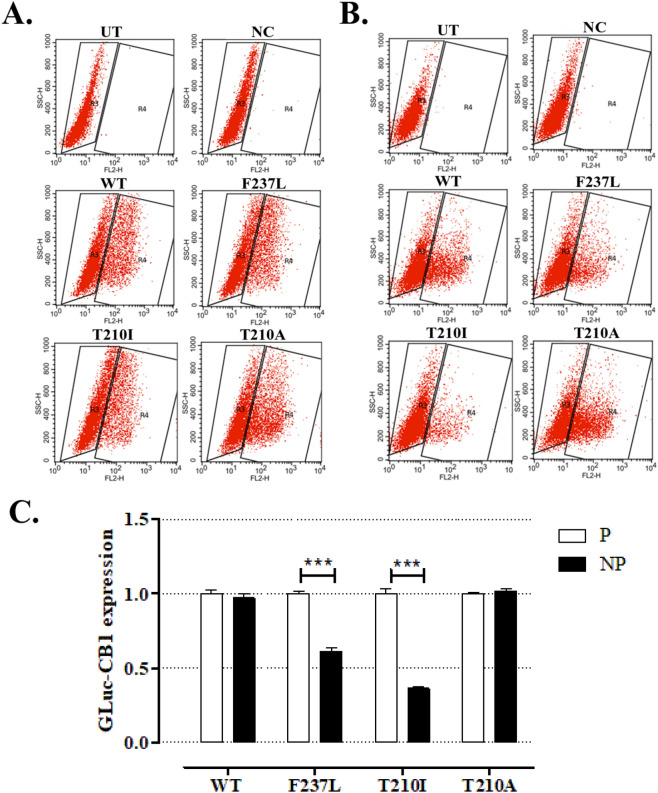
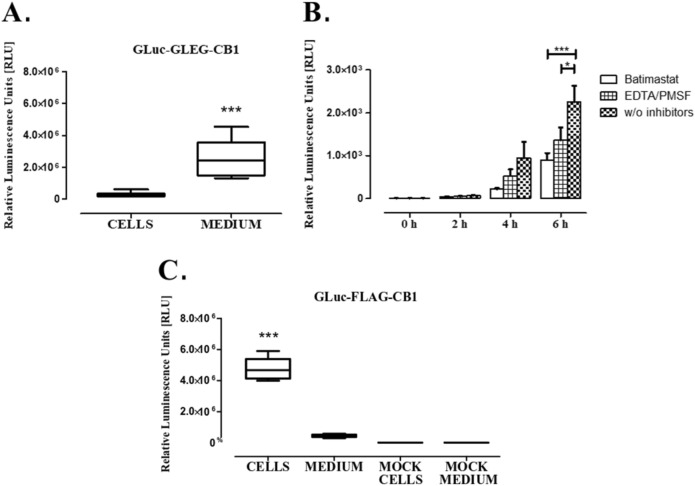
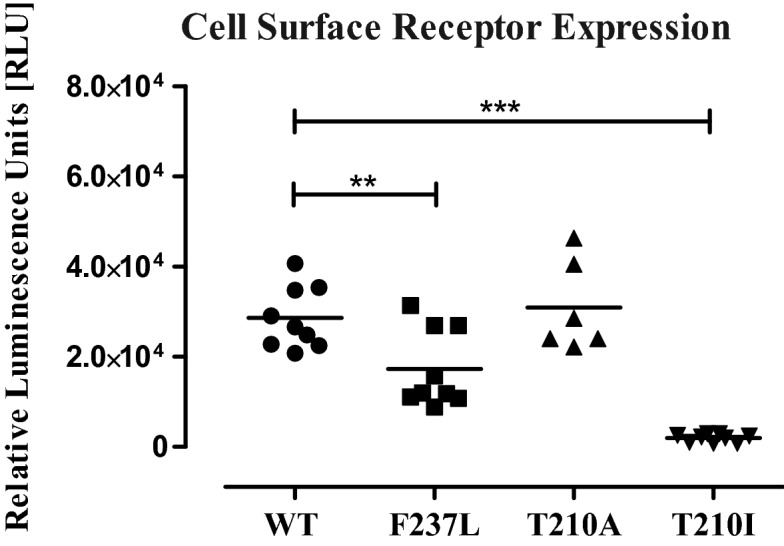
The cannabinoid receptor type 1 (CB1) plays critical roles in multiple physiological processes such as pain perception, brain development and body temperature regulation. Mutations on this gene (CNR1), results in altered functionality and/or biosynthesis such as reduced membrane expression, changes in mRNA stability or changes in downstream signaling that act as triggers for diseases such as obesity, Parkinson's, Huntington's, among others; thus, it is considered as a potential pharmacological target. To date, multiple quantification methods have been employed to determine how these mutations affect receptor expression and localization; however, they present serious disadvantages that may arise quantifying errors. Here, we describe a sensitive bioassay to quantify receptor surface expression; in this bioassay the Gaussia Luciferase (GLuc) was fused to the extracellular portion of the CB1. The GLuc activity was assessed by coelenterazine addition to the medium followed by immediate readout. Based on GLuc activity assay, we show that the GLuc signals corelate with CB1 localization, besides, we showed the assay's functionality and reliability by comparing its results with those generated by previously reported mutations on the CNR1 gene and by using flow cytometry to determine the cell surface receptor expression. Detection of membrane-bound CB1, and potentially other GPCRs, is able to quickly screen for receptor levels and help to understand the effect of clinically relevant mutations or polymorphisms.
大麻素受体 1 型(CB1)在多种生理过程中发挥着关键作用,如疼痛感知、大脑发育和体温调节。该基因(CNR1)的突变会导致功能和/或生物合成改变,例如膜表达减少、mRNA 稳定性改变或下游信号转导改变,这些改变可作为肥胖症、帕金森症、亨廷顿症等疾病的触发因素;因此,它被认为是一个潜在的药理学靶点。迄今为止,已经采用了多种定量方法来确定这些突变如何影响受体表达和定位;然而,它们在定量时可能会出现严重的错误。在这里,我们描述了一种敏感的生物测定法来定量受体表面表达;在该生物测定中,将海肾荧光素酶(GLuc)融合到 CB1 的细胞外部分。通过向培养基中添加腔肠素,然后立即读取,评估 GLuc 活性。基于 GLuc 活性测定,我们表明 GLuc 信号与 CB1 定位相关,此外,我们通过将其结果与先前报道的 CNR1 基因突变和使用流式细胞术来确定细胞表面受体表达产生的结果进行比较,证明了该测定的功能和可靠性。检测膜结合的 CB1,以及可能的其他 GPCR,可以快速筛选受体水平,并有助于理解临床相关突变或多态性的影响。