Whybrow Rebecca, Webster Louise, Girling Joanna, Brown Heather, Wilson Hannah, Sandall Jane, Chappell Lucy
Women and Children's Health, King's College London, London, UK
Division of Women and Children's Health, Guy's and Saint Thomas' Hospitals NHS Trust, London, UK.
BMJ Open. 2020 Oct 23;10(10):e035762. doi: 10.1136/bmjopen-2019-035762.
To evaluate the implementation of National Institute for Health and Care Excellence antenatal hypertension guidelines, to identify strategies to reduce incidences of severe hypertension and associated maternal and perinatal morbidity and mortality in pregnant women with chronic hypertension.
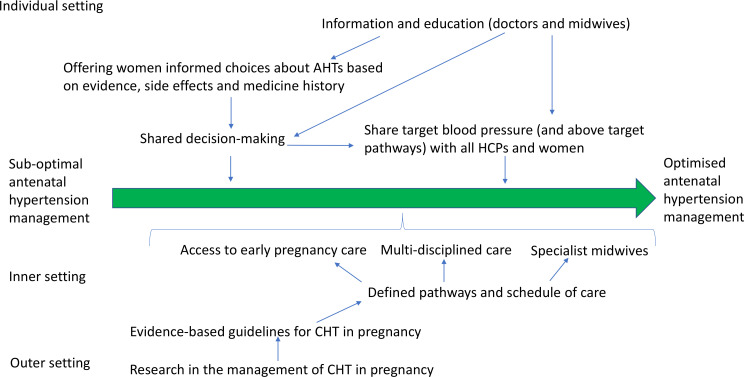
We used a multiple method multisite approach to establish implementation of guidelines and the associated barriers and facilitators. We used a national survey of healthcare professionals (n=97), case notes review (n=55) and structured observations (n=42) to assess implementation. The barriers and facilitators to implementation were identified from semistructured qualitative interviews with healthcare professionals (n=13) and pregnant women (n=18) using inductive thematic analysis. The findings were integrated and evaluated using the Consolidated Framework for Implementation Research.
Pregnant women with chronic hypertension and their principal carers (obstetricians, midwives and physicians), at three National Health Service hospital trusts with different models of care.
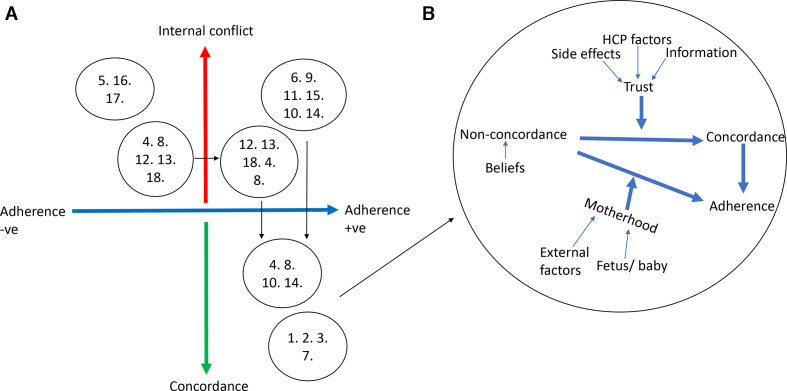
We found severe hypertension to be prevalent (46% of case notes reviewed) and target blood pressure practices to be suboptimal (56% of women had an antenatal blood pressure target documented). Women were infrequently given information (52%) or offered choice (19%) regarding antihypertensives. Women (14/18) reported internal conflict in taking antihypertensives and non-adherence was prevalent (8/18). Women who were concordant with treatment recommendations described having mutual trust with professionals mediated through appropriate information, side effect management and involvement in decision making. Professionals reported needing updates and tools for target blood pressure setting and shared decision making underpinned by antihypertensive safety and effectiveness research.
Women's non-adherence to antihypertensives is higher than anticipated. Suboptimal information provision around treatment, choice of antihypertensives and target setting practices by healthcare professionals may be contributory. Understanding the reasons for non-adherence will inform education and decision-making strategies needed to address both clinician and women's behaviour. Further research into the effectiveness and long-term safety of common antihypertensives is also required.
评估英国国家卫生与临床优化研究所(National Institute for Health and Care Excellence)产前高血压指南的实施情况,确定降低慢性高血压孕妇严重高血压发病率以及相关孕产妇和围产期发病率及死亡率的策略。
我们采用多种方法、多地点的方式来确定指南的实施情况以及相关障碍和促进因素。我们通过对医疗保健专业人员进行全国性调查(n = 97)、病历审查(n = 55)和结构化观察(n = 42)来评估实施情况。通过对医疗保健专业人员(n = 13)和孕妇(n = 18)进行半结构化定性访谈,并采用归纳主题分析法,确定实施的障碍和促进因素。使用实施研究综合框架对研究结果进行整合和评估。
在三个采用不同护理模式的国民保健服务医院信托机构中,患有慢性高血压的孕妇及其主要护理人员(产科医生、助产士和内科医生)。
我们发现严重高血压很普遍(在审查的病历中有46%),目标血压控制情况不理想(56%的女性有记录的产前血压目标)。关于抗高血压药物,很少向女性提供信息(52%)或给予选择(19%)。女性(14/18)报告在服用抗高血压药物方面存在内心冲突,不依从情况普遍存在(8/18)。与治疗建议一致的女性表示,通过适当的信息、副作用管理和参与决策,与专业人员建立了相互信任。专业人员报告需要有关目标血压设定的更新内容和工具,以及基于抗高血压药物安全性和有效性研究的共同决策。
女性对抗高血压药物的不依从性高于预期。医疗保健专业人员在治疗、抗高血压药物选择和目标设定方面提供的信息不足可能是原因之一。了解不依从的原因将为解决临床医生和女性行为问题所需的教育和决策策略提供依据。还需要进一步研究常用抗高血压药物的有效性和长期安全性。