Bajwa Sukhminder Jit Singh, Gupta Ritu, Wahi Ajay, Goraya S P S
Department of Anaesthesiology and Intensive Care, Gian Sagar Medical College and Hospital, Banur, Patiala, Punjab, India.
Department of Obstetrics and Gynaecology, Gian Sagar Medical College and Hospital, Banur, Patiala, Punjab, India.
J Anaesthesiol Clin Pharmacol. 2020 Aug;36(Suppl 1):S77-S80. doi: 10.4103/joacp.JOACP_350_20. Epub 2020 Jul 25.
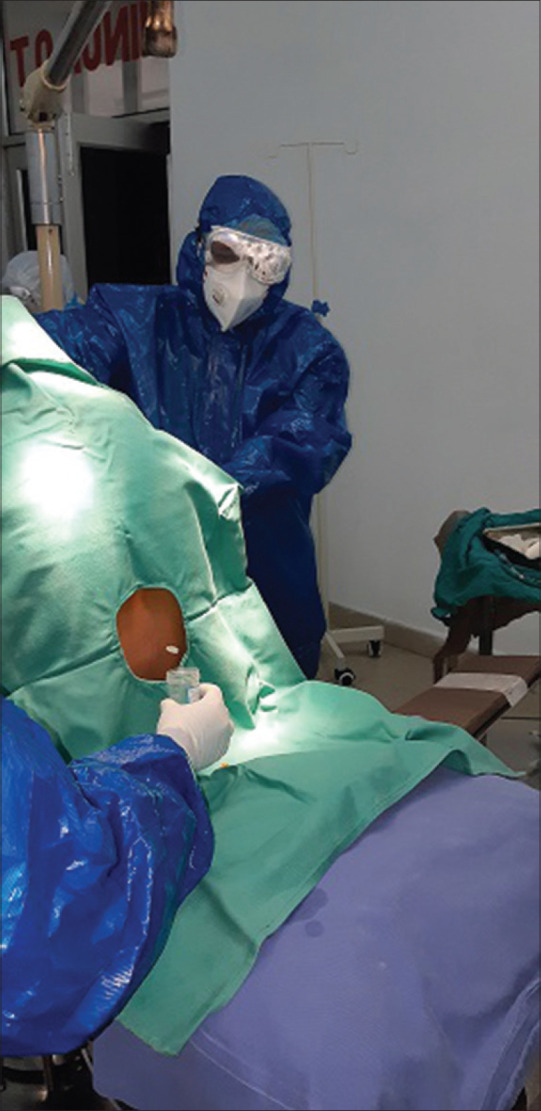
It is now well known that the severe acute respiratory syndrome (SARS-CoV-2) originated in the Wuhan province of Hubei, China in 2019. Having spread across different countries of the world, this highly contagious disease has posed many challenges for the healthcare workers to work without endangering themselves and their patients' wellbeing. Several things are yet not clear about the virus and the presence or absence of the virus in the cerebrospinal fluid (CSF) is currently a debated topic. This article reports the perioperative management of two coronavirus disease-19 positive cases, one of whom was a pregnant patient. Their CSF samples, which were collected during the administration of spinal anesthesia, tested to be negative for viral reverse transcription polymerase chain reaction (RT-PCR) test. We wish to highlight from these cases, that during spinal anesthesia, CSF in mildly symptomatic COVID-19 cases probably does not pose a risk of transmission to the anesthesiologist. However, we suggest that due to the varied presentations of the virus, health care personnel, especially anesthesiologists have to be careful during the perioperative management of such cases.
众所周知,严重急性呼吸综合征冠状病毒2(SARS-CoV-2)于2019年起源于中国湖北省武汉市。这种高传染性疾病已蔓延至世界各国,给医护人员在不危及自身及患者健康的情况下开展工作带来了诸多挑战。关于该病毒仍有一些情况尚不清楚,其在脑脊液(CSF)中是否存在目前仍是一个有争议的话题。本文报道了两例新型冠状病毒肺炎阳性病例的围手术期管理情况,其中一例为孕妇。她们在脊髓麻醉给药期间采集的脑脊液样本,经病毒逆转录聚合酶链反应(RT-PCR)检测呈阴性。我们希望从这些病例中强调,在脊髓麻醉期间,症状较轻的新型冠状病毒肺炎病例的脑脊液可能不会对麻醉医生构成传播风险。然而,我们建议,由于该病毒表现多样,医护人员,尤其是麻醉医生在对此类病例进行围手术期管理时必须谨慎。