Zhang Jinqiang, Yi Saini, Xiao Chenghong, Li Yahui, Liu Chan, Jiang Weike, Yang Changgui, Zhou Tao
Guizhou University of Traditional Chinese Medicine, Guiyang 550025, China.
Saudi J Biol Sci. 2020 Nov;27(11):3138-3144. doi: 10.1016/j.sjbs.2020.07.013. Epub 2020 Jul 14.
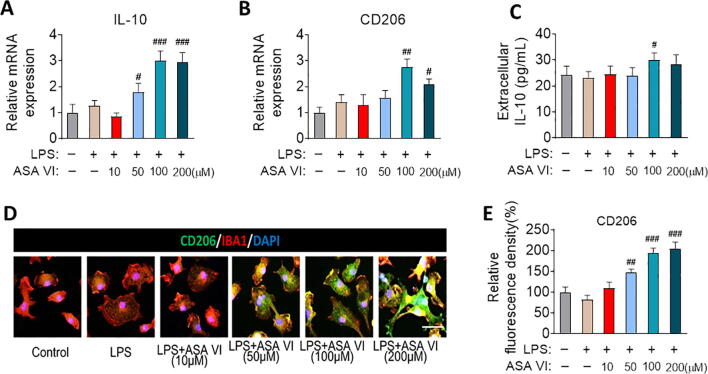
Microglia cells are the main mediators of neuroinflammation. Activation of microglia often aggravates the pathological process of various neurological diseases. Natural chemicals have unique advantages in inhibiting microglia-mediated neuroinflammation and improving neuronal function. Here, we examined the effects of asperosaponin VI (ASA VI) on LPS-activated primary microglia. Microglia were isolated from mice and pretreated with different doses of ASA VI, following lipopolysaccharide (LPS) administration. Activation and inflammatory response of microglia cells were evaluated by real-time fluorescence quantitative polymerase chain reaction (q-PCR), immunohistochemistry and enzyme-linked immunosorbent assay (ELISA). Signaling pathways were detected by western blotting. We found that the ASA VI inhibited the morphological expansion of microglia cells, decreased the expression and release of proinflammatory cytokines, and promoted the expression of antiinflammatory cytokines in a dose-dependent manner. ASA VI also activated PPAR-γ signaling pathway in LPS-treated microglia. The anti-inflammatory effects of ASA VI in microglia were blocked by treating PPAR-γ antagonist (GW9662). These results showed that ASA VI promote the transition of microglia cells from proinflammatory to anti-inflammatory by regulating PPAR-γ pathway.
小胶质细胞是神经炎症的主要介质。小胶质细胞的激活常常会加剧各种神经疾病的病理进程。天然化学物质在抑制小胶质细胞介导的神经炎症和改善神经元功能方面具有独特优势。在此,我们研究了五加皂苷VI(ASA VI)对脂多糖(LPS)激活的原代小胶质细胞的影响。从小鼠中分离出小胶质细胞,在给予脂多糖(LPS)后用不同剂量的ASA VI进行预处理。通过实时荧光定量聚合酶链反应(q-PCR)、免疫组织化学和酶联免疫吸附测定(ELISA)评估小胶质细胞的激活和炎症反应。通过蛋白质印迹法检测信号通路。我们发现,ASA VI以剂量依赖的方式抑制小胶质细胞的形态扩张,降低促炎细胞因子的表达和释放,并促进抗炎细胞因子的表达。ASA VI还激活了LPS处理的小胶质细胞中的PPAR-γ信号通路。通过用PPAR-γ拮抗剂(GW9662)处理,阻断了ASA VI在小胶质细胞中的抗炎作用。这些结果表明,ASA VI通过调节PPAR-γ途径促进小胶质细胞从促炎状态向抗炎状态转变。