Matoba Keiichiro, Takeda Yusuke, Nagai Yosuke, Sekiguchi Kensuke, Yokota Tamotsu, Utsunomiya Kazunori, Nishimura Rimei
Division of Diabetes, Metabolism, and Endocrinology, Department of Internal Medicine, The Jikei University School of Medicine, Tokyo, Japan.
Center for Preventive Medicine, The Jikei University School of Medicine, Tokyo, Japan.
Front Pharmacol. 2020 Sep 25;11:585633. doi: 10.3389/fphar.2020.585633. eCollection 2020.
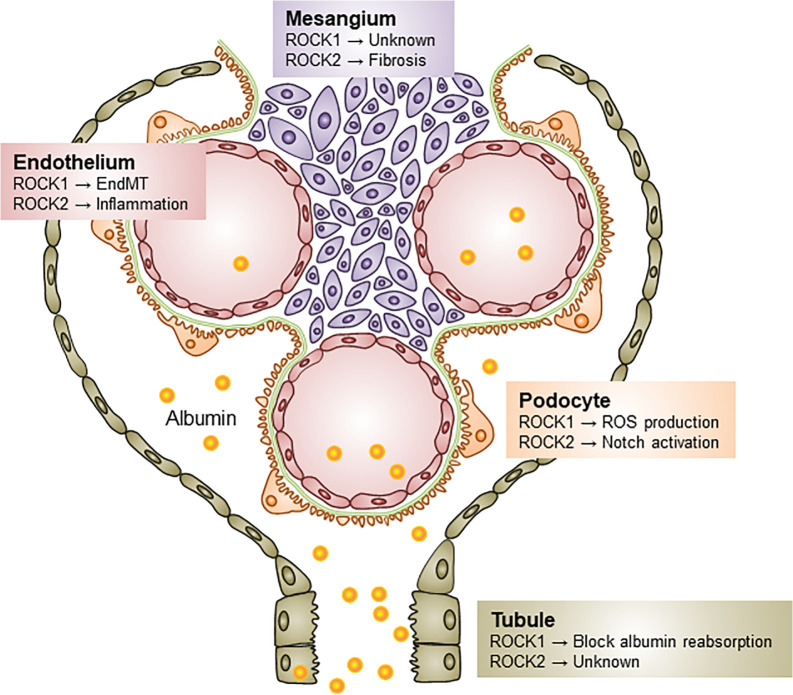
Rho-associated coiled-coil-containing protein kinase (ROCK) is a serine/threonine kinase that was originally identified as RhoA interacting protein. A diverse array of cellular functions, including migration, proliferation, and phenotypic modulation, are orchestrated by ROCK through a mechanism involving cytoskeletal rearrangement. Mammalian cells express two ROCK isoforms: ROCK1 (Rho-kinase β/ROKβ) and ROCK2 (Rho-kinase α/ROKα). While both isoforms have structural similarities and are widely expressed across multiple tissues, investigations in gene knockout animals and cell-based studies have revealed distinct functions of ROCK1 and ROCK2. With respect to the kidney, inhibiting ROCK activity has proven effective for the preventing diabetic kidney disease (DKD) in both type 1 and type 2 diabetic rodent models. However, despite significant progress in the understanding of the renal ROCK biology over the past decade, the pathogenic roles of the ROCK isoforms is only beginning to be elucidated. Recent studies have demonstrated the involvement of renal ROCK1 in mitochondrial dynamics and cellular transdifferentiation, whereas ROCK2 activation leads to inflammation, fibrosis, and cell death in the diabetic kidney. This review provides a conceptual framework for dissecting the molecular underpinnings of ROCK-driven renal injury, focusing on the differences between ROCK1 and ROCK2.
Rho相关卷曲螺旋蛋白激酶(ROCK)是一种丝氨酸/苏氨酸激酶,最初被鉴定为RhoA相互作用蛋白。ROCK通过一种涉及细胞骨架重排的机制协调多种细胞功能,包括迁移、增殖和表型调节。哺乳动物细胞表达两种ROCK亚型:ROCK1(Rho激酶β/ROKβ)和ROCK2(Rho激酶α/ROKα)。虽然这两种亚型具有结构相似性且在多种组织中广泛表达,但对基因敲除动物的研究和基于细胞的研究揭示了ROCK1和ROCK2的不同功能。就肾脏而言,在1型和2型糖尿病啮齿动物模型中,抑制ROCK活性已被证明对预防糖尿病肾病(DKD)有效。然而,尽管在过去十年中对肾脏ROCK生物学的理解取得了重大进展,但ROCK亚型的致病作用才刚刚开始被阐明。最近的研究表明,肾脏ROCK1参与线粒体动力学和细胞转分化,而ROCK2的激活则导致糖尿病肾脏中的炎症、纤维化和细胞死亡。本综述提供了一个概念框架,用于剖析ROCK驱动的肾损伤的分子基础,重点关注ROCK1和ROCK2之间的差异。