Peng Fangfang, Zhao Zhe, Xu Bei, Han Jie, Yang Qian, Lei Yunjing, Tian Bin, Liu Zhan-Lin
Key Laboratory of Resource Biology and Biotechnology in Western China (Ministry of Education), College of Life Sciences, Northwest University, Xi'an, China.
Key Laboratory of Biodiversity Conservation in Southwest China, State Forestry Administration, Southwest Forestry University, Kunming, China.
Front Genet. 2020 Sep 25;11:573226. doi: 10.3389/fgene.2020.573226. eCollection 2020.
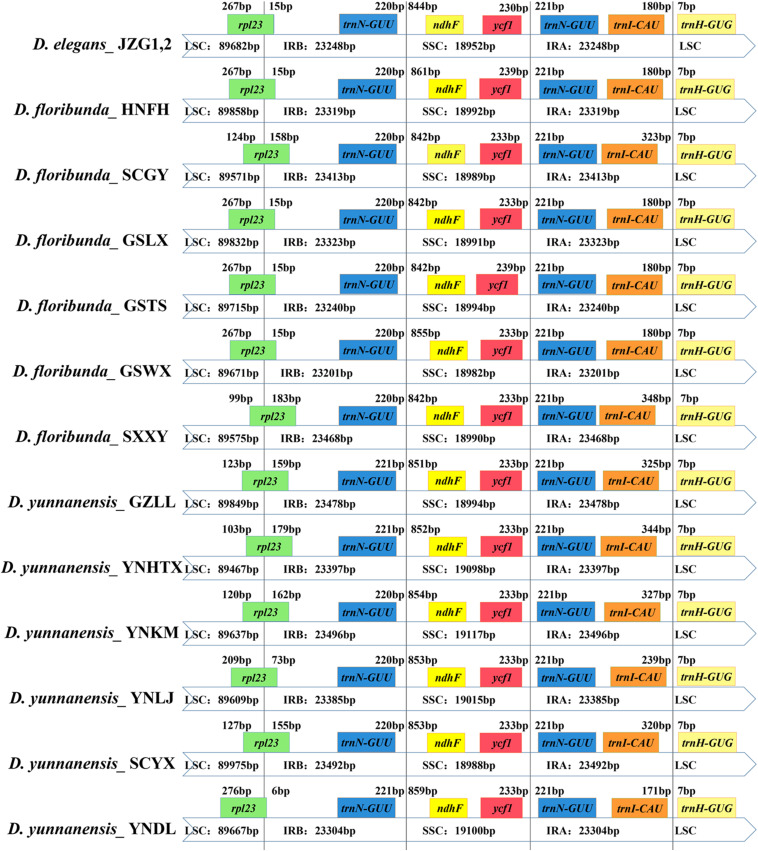
(Caprifoliaceae) is a Tertiary relict genus endemic to China, comprising three species with horticultural and medicinal values. For the lack of genomic information, interspecific relationships and divergence times in the genus remain unresolved. In the present study, we assembled and characterized the complete plastomes, the partial mitogenomes, and nuclear internal transcribed spacer (ITS) fragments from genome skimming datasets of 14 individuals. The plastomes were conserved in genomic structure, gene order, and gene content, but with highly variable repeat sequences. Three genes (, , ) were examined with positive selection, and nine divergent hotpot regions (, , , , , , , , and intron) were potentially valuable for DNA barcodes. Contrasted to the variability in plastome sequences, mitogenomes contained 12 protein-coding genes with limited indels and nucleotide substitutions, and no gene was found under positive selection. Genes in organellar genomes tended to have a similar pattern of codon usage bias, with a preference of A/U ending codons. Phylogenetic trees constructed with plastomes, mitogenomes, and ITS sequences consistently supported that was monophyletic, and was sister to the other two taxa. Interspecific divergences were estimated at about 33-37 Ma in the Eocene/Oligocene boundary, suggesting the paleo-endemism of the extant species as "living fossils" of the East Asian Flora. Our study well-exhibited that genome skimming could provide valuable genomic information to elucidate the evolutionary history of the complex group in a cost-efficient way.
忍冬科是中国特有的第三纪残遗属,包含三个具有园艺和药用价值的物种。由于缺乏基因组信息,该属的种间关系和分化时间仍未解决。在本研究中,我们从14个个体的基因组浅层测序数据集中组装并表征了完整的叶绿体基因组、部分线粒体基因组和核内转录间隔区(ITS)片段。叶绿体基因组在基因组结构、基因顺序和基因含量上保守,但重复序列高度可变。三个基因(,,)受到正选择检测,九个分歧热点区域(,,,,,,,,和内含子)对DNA条形码可能具有重要价值。与叶绿体基因组序列的变异性形成对比的是,线粒体基因组包含12个蛋白质编码基因,插入缺失和核苷酸替换有限,未发现有基因受到正选择。细胞器基因组中的基因倾向于具有相似的密码子使用偏好模式,偏好以A/U结尾的密码子。用叶绿体基因组、线粒体基因组和ITS序列构建的系统发育树一致支持为单系类群,且与其他两个类群是姐妹关系。种间分化估计发生在始新世/渐新世边界约33 - 37百万年前,表明现存物种作为东亚植物区系的“活化石”具有古特有性。我们的研究很好地表明,基因组浅层测序能够以经济高效的方式提供有价值的基因组信息,以阐明复杂类群的进化历史。