Sakyi Samuel Asamoah, Buckman Tonnies Abeku, Antwi-Berko Daniel, Yeboah-Mensah Kwame, Dey Dzifa, Owiredu Eddie-Williams, Amoani Benjamin, Mantey Richard
Department of Molecular Medicine, School of Medicine and Dentistry, Kwame Nkrumah University of Science and Technology, Kumasi, Ghana.
Department of Basic and Applied Biology, University of Energy and Natural Resources, Sunyani, Ghana.
Int J Rheumatol. 2020 Oct 8;2020:2808413. doi: 10.1155/2020/2808413. eCollection 2020.
T cell cytokines play important roles in the development and progression of rheumatoid arthritis (RA). Loss of Th1/Th2 and Th17/Treg balance has been reported in several inflammatory autoimmune diseases. However, their role in RA within hitherto rare Ghanaian context has not been explored. Here, we evaluated the intracytoplasmic CD4+ T cell cytokine patterns in rheumatoid arthritis patients in Ghana and determined their relationship with disease activity.
This case-control study included 48 newly diagnosed RA patients and 30 apparent healthy controls from two major hospitals in Ghana. Validated structured questionnaires were administered to obtain demographic data; blood samples were collected and processed for flow cytometric analysis.
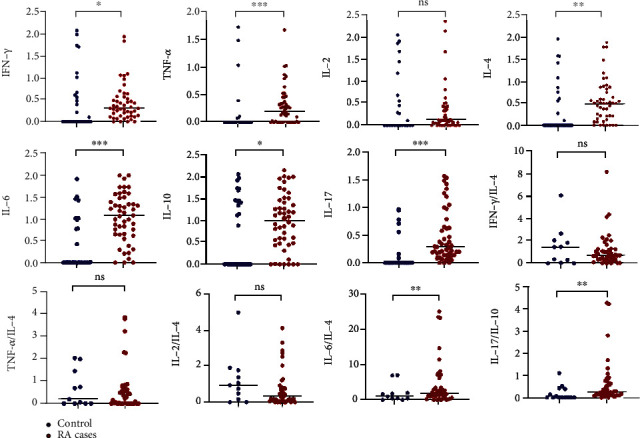
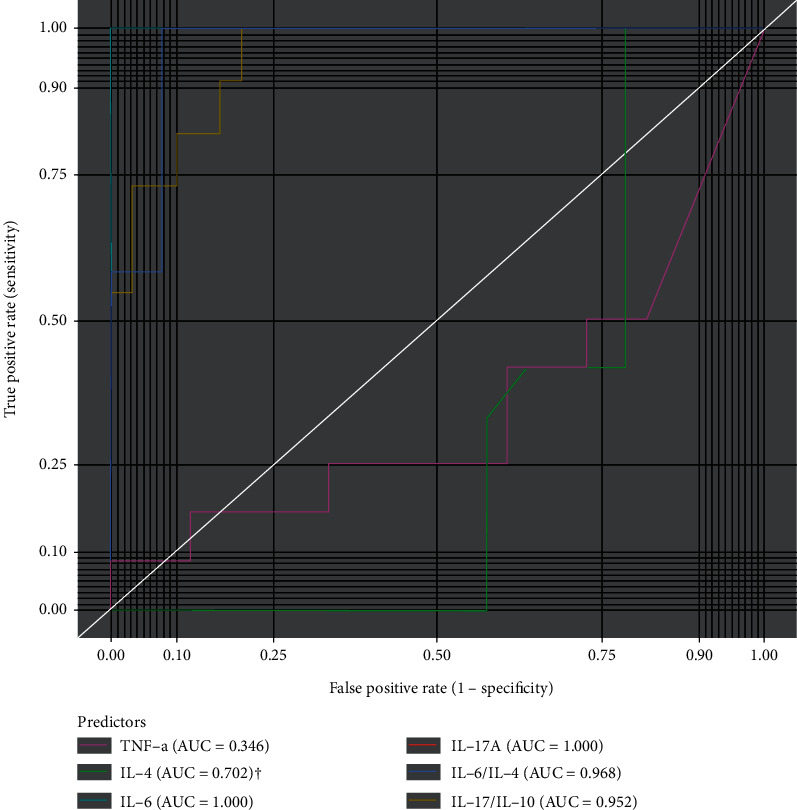
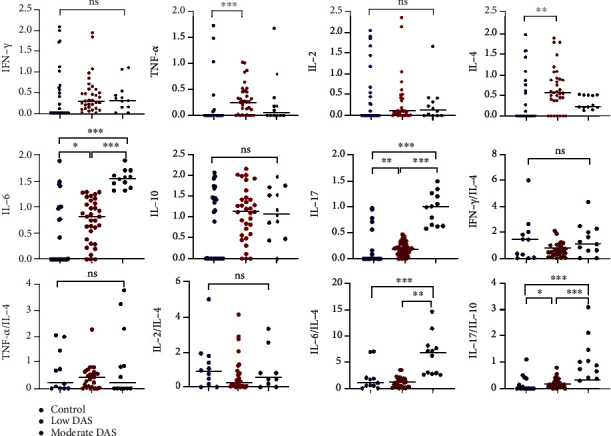
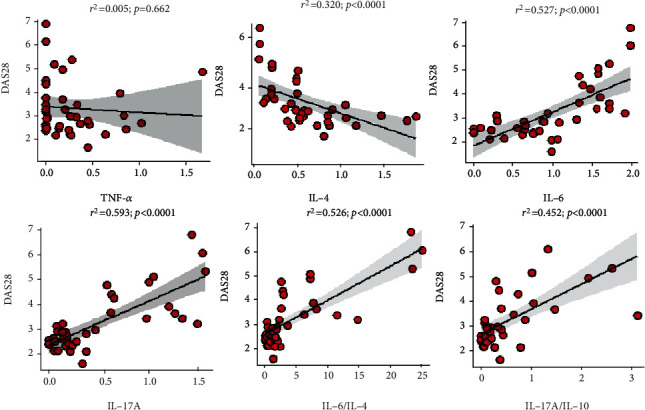
IFN-, TNF-, IL-4, IL-6, IL-10, IL-17A, IL-6/IL-4, and IL-17/IL-10 expressions were significantly higher in RA cases compared to the healthy controls. The expression of IL-6 (0.00 (0.00-0.98) vs. 0.82 (0.34-1.10) vs. 1.56 (1.39-1.68), < 0.0001), IL-17A (0.00 (0.00-0.02) vs. 0.19 (0.09-0.30) vs. 0.99 (0.64-1.25), < 0.0001), and IL-17A/IL-10 (0.00 (0.00-0.39) vs. 0.15 (0.09-0.26) vs. 0.88 (0.41-1.47), < 0.0001) increased significantly from the healthy controls through RA patients with low DAS scores to RA patients with moderate DAS scores. IL-6 ( = 0.681, = 0.527, < 0.0001), IL-17A ( = 0.770, = 0.593, < 0.0001), and IL-17A/IL-10 ( = 0.677, = 0.452, < 0.0001) expressions were significantly directly associated with DAS28 scores. IL-6 (cutoff = 1.32, sensitivity = 100.0%, specificity = 100.0%, accuracy = 100.0%, and AUC = 1.000) and IL-17A (cutoff = 0.58, sensitivity = 100.0%, specificity = 100.0%, accuracy = 100.0%, and AUC = 1.000) presented with the best discriminatory power in predicting moderate DAS scores from low DAS scores.
Th1- and Th17-related cytokines predominate in the pathophysiology of RA, with IL-6 and IL-17 being principally and differentially expressed based on the severity of the disease. IL-6 and IL-17A could serve as useful prognostic and disease-monitoring markers in RA in the African context.
T细胞细胞因子在类风湿关节炎(RA)的发生和发展中起重要作用。在几种炎症性自身免疫疾病中,已报道存在Th1/Th2和Th17/Treg平衡的丧失。然而,在迄今罕见的加纳背景下,它们在RA中的作用尚未得到探索。在此,我们评估了加纳类风湿关节炎患者的细胞质内CD4+T细胞细胞因子模式,并确定了它们与疾病活动的关系。
这项病例对照研究纳入了来自加纳两家主要医院的48例新诊断的RA患者和30例明显健康的对照。使用经过验证的结构化问卷获取人口统计学数据;采集血样并进行处理以进行流式细胞术分析。
与健康对照相比,RA患者中IFN-、TNF-、IL-4、IL-6、IL-10、IL-17A、IL-6/IL-4和IL-17/IL-10的表达显著更高。IL-6(0.00(0.00 - 0.98)对0.82(0.34 - 1.10)对1.56(1.39 - 1.68),P < 0.0001)、IL-17A(0.00(0.00 - 0.02)对0.19(0.09 - 0.30)对0.99(0.64 - 1.25),P < 0.0001)和IL-17A/IL-10(0.00(0.00 - 0.39)对0.15(0.09 - 0.26)对0.88(0.41 - 1.47),P < 0.0001)从健康对照到低疾病活动度评分的RA患者再到中度疾病活动度评分的RA患者显著增加。IL-6(r = 0.681,P = 0.527,P < 0.0001)、IL-17A(r = 0.770,P = 0.593,P < 0.0001)和IL-17A/IL-10(r = 0.677,P = 0.452,P < 0.0001)的表达与DAS28评分显著直接相关。IL-6(临界值 = 1.32,敏感性 = 100.0%,特异性 = 100.0%,准确性 = 100.0%,AUC = 1.000)和IL-17A(临界值 = 0.58,敏感性 = 100.0%,特异性 = 100.0%,准确性 = 100.0%,AUC = 1.000)在从低DAS评分预测中度DAS评分方面具有最佳的鉴别能力。
Th1和Th17相关细胞因子在RA的病理生理学中占主导地位,IL-6和IL-17根据疾病严重程度主要且差异表达。在非洲背景下,IL-6和IL-17A可作为RA中有用的确预后和疾病监测标志物。