• 文献检索
  • 文档翻译
  • 深度研究
  • 学术资讯
  • Suppr Zotero 插件Zotero 插件
  • 邀请有礼
  • 套餐&价格
  • 历史记录
应用&插件
Suppr Zotero 插件Zotero 插件浏览器插件Mac 客户端Windows 客户端微信小程序
定价
高级版会员购买积分包购买API积分包
服务
文献检索文档翻译深度研究API 文档MCP 服务
关于我们
关于 Suppr公司介绍联系我们用户协议隐私条款
关注我们

Suppr 超能文献

核心技术专利:CN118964589B侵权必究
粤ICP备2023148730 号-1Suppr @ 2026

文献检索

告别复杂PubMed语法,用中文像聊天一样搜索,搜遍4000万医学文献。AI智能推荐,让科研检索更轻松。

立即免费搜索

文件翻译

保留排版,准确专业,支持PDF/Word/PPT等文件格式,支持 12+语言互译。

免费翻译文档

深度研究

AI帮你快速写综述,25分钟生成高质量综述,智能提取关键信息,辅助科研写作。

立即免费体验

类风湿关节炎患者传统合成改善病情抗风湿药(csDMARDs)临床反应预测列线图的建立、验证及初步研究

Establishment and verification of a nomogram and a preliminary study on predicting the clinical response of conventional synthetic disease-modifying antirheumatic drugs (csDMARDs) in rheumatoid arthritis patients.

作者信息

Sun Zhijian, Wang Feiying, Chen Jie, Liu Xinlei, Sun Jiao, Sui Yameng, Zhang Xiaojie, Shu Qiang

机构信息

Department of Rheumatology, The Second Hospital of Shandong University, Jinan, China.

Department of Hematology, Women and Children's Hospital, Qingdao, China.

出版信息

Ann Transl Med. 2022 Dec;10(24):1365. doi: 10.21037/atm-22-5791.

DOI:10.21037/atm-22-5791
PMID:36660697
原文链接:https://pmc.ncbi.nlm.nih.gov/articles/PMC9843374/
Abstract

BACKGROUND

Rheumatoid arthritis (RA) is an autoinflammatory disease, its core treatment principle is to achieve remission as soon as possible. There is no good prediction model that can accurately predict the remission rate of patients to choose a good treatment scheme. Here, we aimed to verify the prognostic value of some inflammatory indicators in RA and establish a prediction model to predict the remission rate after treatment.

METHODS

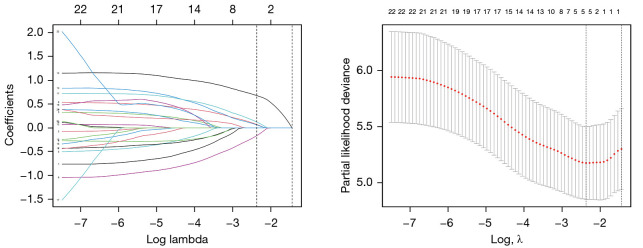
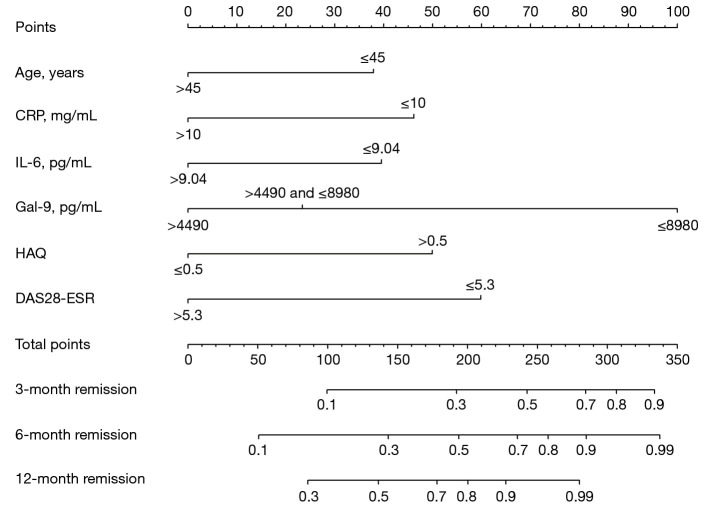
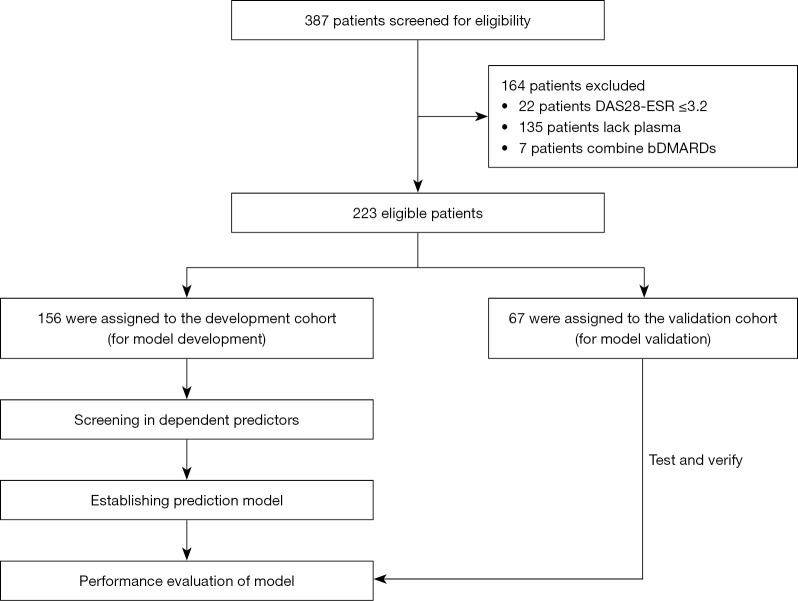
A total of 223 patients were enrolled at Qilu Hospital from June 2014 to June 2020. Baseline clinical data were collected and plasma was obtained to detect the inflammatory indicators. All patients were treated with conventional synthetic disease-modifying antirheumatic drugs (csDMARDs). All patients were followed up and were recorded the time to reach the disease activity score-28 with erythrocyte sedimentation rate (DAS28-ESR) of <2.6. A total of 156 patients were randomly assigned to the development cohort, and 67 patients were assigned to the validation cohort. Inflammatory indicators in plasma were detected by enzyme-linked immunosorbent assay (ELISA). The predictive factors were screeded by using least absolute shrinkage and selection operator (LASSO) and Cox regression. The model was created and verified by using the standard method. A total of 6 independent risk factors were analyzed to construct a nomogram to predict the remission rate in 3, 6 and 12 months.

RESULTS

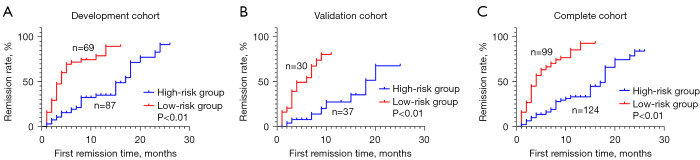
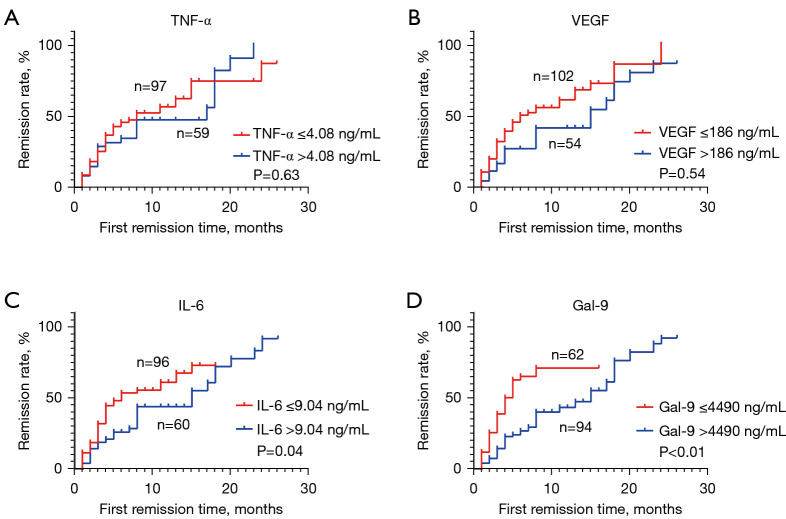
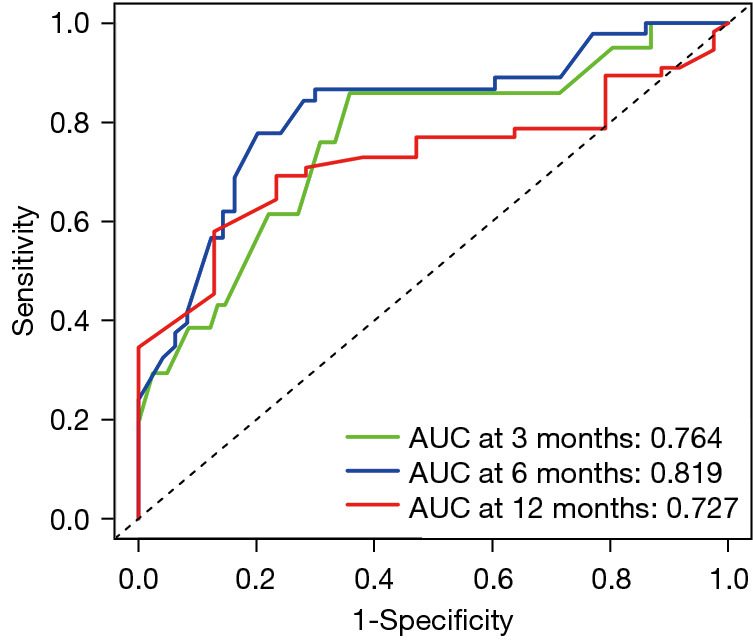
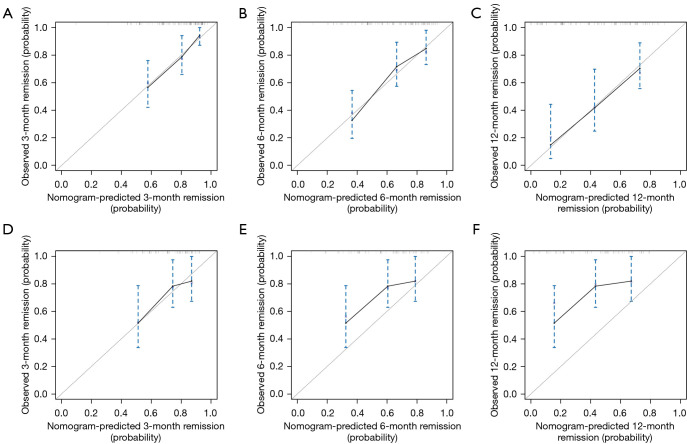
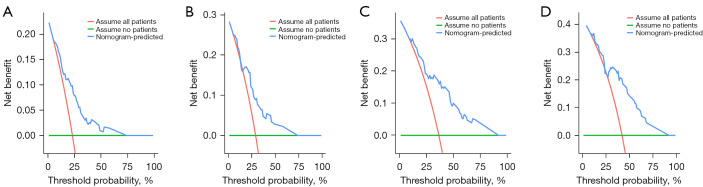
The remission rates after treatment in 3, 6 and 12 months were 38.76%, 58.91%, and 81.40%, respectively. Patient age, C-reactive protein (CRP), interleukin (IL)-6, galectin-9 (Gal-9), health assessment questionnaire (HAQ), and DAS28-ESR were included in the prognostic model to predict the remission rate. The resulting model had good discrimination ability in both the development cohort (C-index, 0.729) and the validation cohort (C-index, 0.710). Time-dependent receiver operating characteristic (ROC) curve, calibration analysis, and decision curve analysis (DCA) showed that the model has significant discriminant power and clinical practicability in predicting the remission rate.

CONCLUSIONS

We established a new predictive model and validated it. The model can predict the remission rate in 3, 6 and 12 months after receiving csDMARDs treatment. By using this model, we can facilitate the identification of high-risk patients early and intervene with them as soon as possible.

摘要

背景

类风湿关节炎(RA)是一种自身炎症性疾病,其核心治疗原则是尽快实现病情缓解。目前尚无能够准确预测患者缓解率以选择合适治疗方案的良好预测模型。在此,我们旨在验证一些炎症指标在RA中的预后价值,并建立一个预测模型来预测治疗后的缓解率。

方法

2014年6月至2020年6月期间,共有223例患者在齐鲁医院入组。收集基线临床数据并获取血浆以检测炎症指标。所有患者均接受传统合成改善病情抗风湿药物(csDMARDs)治疗。对所有患者进行随访,并记录达到疾病活动评分28(DAS28)且红细胞沉降率(ESR)<2.6的时间。共有156例患者被随机分配至开发队列,67例患者被分配至验证队列。采用酶联免疫吸附测定(ELISA)法检测血浆中的炎症指标。通过使用最小绝对收缩和选择算子(LASSO)及Cox回归筛选预测因素。采用标准方法创建并验证模型。分析6个独立危险因素以构建列线图,预测3、6和12个月后的缓解率。

结果

治疗后3、6和12个月的缓解率分别为38.76%、58.91%和81.40%。患者年龄、C反应蛋白(CRP)、白细胞介素(IL)-6、半乳糖凝集素-9(Gal-9)、健康评估问卷(HAQ)和DAS28-ESR被纳入预后模型以预测缓解率。所得模型在开发队列(C指数,0.729)和验证队列(C指数,0.710)中均具有良好的区分能力。时间依赖性受试者工作特征(ROC)曲线、校准分析和决策曲线分析(DCA)表明,该模型在预测缓解率方面具有显著的判别力和临床实用性。

结论

我们建立并验证了一个新的预测模型。该模型可以预测接受csDMARDs治疗后3、6和12个月的缓解率。通过使用该模型,我们可以尽早识别高危患者并尽快对其进行干预。
https://cdn.ncbi.nlm.nih.gov/pmc/blobs/a0a4/9843374/3488b5301da8/atm-10-24-1365-f8.jpg
https://cdn.ncbi.nlm.nih.gov/pmc/blobs/a0a4/9843374/94ca56f65044/atm-10-24-1365-f1.jpg
https://cdn.ncbi.nlm.nih.gov/pmc/blobs/a0a4/9843374/fca115718a3b/atm-10-24-1365-f2.jpg
https://cdn.ncbi.nlm.nih.gov/pmc/blobs/a0a4/9843374/c329d4859943/atm-10-24-1365-f3.jpg
https://cdn.ncbi.nlm.nih.gov/pmc/blobs/a0a4/9843374/3d60e1542df1/atm-10-24-1365-f4.jpg
https://cdn.ncbi.nlm.nih.gov/pmc/blobs/a0a4/9843374/14951a4ab2af/atm-10-24-1365-f5.jpg
https://cdn.ncbi.nlm.nih.gov/pmc/blobs/a0a4/9843374/6e94f21a6dd3/atm-10-24-1365-f6.jpg
https://cdn.ncbi.nlm.nih.gov/pmc/blobs/a0a4/9843374/4b48234d2d59/atm-10-24-1365-f7.jpg
https://cdn.ncbi.nlm.nih.gov/pmc/blobs/a0a4/9843374/3488b5301da8/atm-10-24-1365-f8.jpg
https://cdn.ncbi.nlm.nih.gov/pmc/blobs/a0a4/9843374/94ca56f65044/atm-10-24-1365-f1.jpg
https://cdn.ncbi.nlm.nih.gov/pmc/blobs/a0a4/9843374/fca115718a3b/atm-10-24-1365-f2.jpg
https://cdn.ncbi.nlm.nih.gov/pmc/blobs/a0a4/9843374/c329d4859943/atm-10-24-1365-f3.jpg
https://cdn.ncbi.nlm.nih.gov/pmc/blobs/a0a4/9843374/3d60e1542df1/atm-10-24-1365-f4.jpg
https://cdn.ncbi.nlm.nih.gov/pmc/blobs/a0a4/9843374/14951a4ab2af/atm-10-24-1365-f5.jpg
https://cdn.ncbi.nlm.nih.gov/pmc/blobs/a0a4/9843374/6e94f21a6dd3/atm-10-24-1365-f6.jpg
https://cdn.ncbi.nlm.nih.gov/pmc/blobs/a0a4/9843374/4b48234d2d59/atm-10-24-1365-f7.jpg
https://cdn.ncbi.nlm.nih.gov/pmc/blobs/a0a4/9843374/3488b5301da8/atm-10-24-1365-f8.jpg

相似文献

1
Establishment and verification of a nomogram and a preliminary study on predicting the clinical response of conventional synthetic disease-modifying antirheumatic drugs (csDMARDs) in rheumatoid arthritis patients.类风湿关节炎患者传统合成改善病情抗风湿药(csDMARDs)临床反应预测列线图的建立、验证及初步研究
Ann Transl Med. 2022 Dec;10(24):1365. doi: 10.21037/atm-22-5791.
2
Effect of Half-Dose vs Stable-Dose Conventional Synthetic Disease-Modifying Antirheumatic Drugs on Disease Flares in Patients With Rheumatoid Arthritis in Remission: The ARCTIC REWIND Randomized Clinical Trial.半量与稳定剂量传统合成改善病情抗风湿药物对缓解期类风湿关节炎患者疾病复发的影响:ARCTIC REWIND随机临床试验
JAMA. 2021 May 4;325(17):1755-1764. doi: 10.1001/jama.2021.4542.
3
Development and validation of a predictive model assessing the risk of sarcopenia in rheumatoid arthritis patients.评估类风湿关节炎患者肌少症风险的预测模型的建立和验证。
Front Immunol. 2024 Jul 29;15:1437980. doi: 10.3389/fimmu.2024.1437980. eCollection 2024.
4
Assessing prognosis and prediction of treatment response in early rheumatoid arthritis: systematic reviews.评估早期类风湿关节炎的预后和治疗反应预测:系统评价。
Health Technol Assess. 2018 Nov;22(66):1-294. doi: 10.3310/hta22660.
5
A combination model to predict relapse and successful conventional DMARDs de-escalation in rheumatoid arthritis patients with sustained clinical remission.一种用于预测类风湿性关节炎持续临床缓解患者复发及传统改善病情抗风湿药成功减停的联合模型。
Clin Exp Rheumatol. 2019 Jan-Feb;37(1):120-126. Epub 2018 Jul 18.
6
Anti-citrullinated peptide antibodies are the strongest predictor of clinically relevant radiographic progression in rheumatoid arthritis patients achieving remission or low disease activity: A post hoc analysis of a nationwide cohort in Japan.抗瓜氨酸化肽抗体是类风湿关节炎患者达到缓解或低疾病活动度时临床相关影像学进展的最强预测指标:日本全国队列的事后分析。
PLoS One. 2017 May 15;12(5):e0175281. doi: 10.1371/journal.pone.0175281. eCollection 2017.
7
Clinical predictors of response to methotrexate in patients with rheumatoid arthritis: a machine learning approach using clinical trial data.类风湿关节炎患者对甲氨蝶呤反应的临床预测因子:使用临床试验数据的机器学习方法。
Arthritis Res Ther. 2022 Jul 1;24(1):162. doi: 10.1186/s13075-022-02851-5.
8
Comparative effectiveness of treatment with the first TNF antagonist in monotherapy, the first TNF antagonist plus one conventional synthetic disease-modifying antirheumatic drug, and the first TNF antagonist plus two or more conventional synthetic disease-modifying antirheumatic drugs in patients with rheumatoid arthritis.在类风湿关节炎患者中,第一种肿瘤坏死因子拮抗剂单药治疗、第一种肿瘤坏死因子拮抗剂加一种传统合成改善病情抗风湿药以及第一种肿瘤坏死因子拮抗剂加两种或更多种传统合成改善病情抗风湿药治疗的比较疗效。
Arthritis Res Ther. 2016 Nov 8;18(1):259. doi: 10.1186/s13075-016-1137-4.
9
Effect of initiating biologics compared to intensifying conventional DMARDs on clinical and MRI outcomes in established rheumatoid arthritis patients in clinical remission: Secondary analyses of the IMAGINE-RA trial.在临床缓解的已确诊类风湿关节炎患者中,与强化常规 DMARDs 相比,起始生物制剂对临床和 MRI 结局的影响:IMAGINE-RA 试验的二次分析。
Scand J Rheumatol. 2022 Jul;51(4):268-278. doi: 10.1080/03009742.2021.1935312. Epub 2021 Sep 2.
10
Clinical and sonographic biomarkers of structural damage progression in RA patients in clinical remission: A prospective study with 12 months follow-up.临床缓解的 RA 患者结构损伤进展的临床和超声生物标志物:一项前瞻性研究,随访 12 个月。
Semin Arthritis Rheum. 2017 Dec;47(3):303-309. doi: 10.1016/j.semarthrit.2017.04.007. Epub 2017 May 1.

引用本文的文献

1
Artificial intelligence to predict treatment response in rheumatoid arthritis and spondyloarthritis: a scoping review.人工智能预测类风湿关节炎和脊柱关节炎的治疗反应:一项范围综述
Rheumatol Int. 2025 Apr 7;45(4):91. doi: 10.1007/s00296-025-05825-3.
2
Machine learning-based remission prediction in rheumatoid arthritis patients treated with biologic disease-modifying anti-rheumatic drugs: findings from the Kuwait rheumatic disease registry.基于机器学习的生物性改善病情抗风湿药物治疗的类风湿关节炎患者缓解预测:科威特风湿性疾病登记处的研究结果
Front Big Data. 2024 Oct 3;7:1406365. doi: 10.3389/fdata.2024.1406365. eCollection 2024.
3

本文引用的文献

1
A novel aGAPSS-based nomogram for the prediction of ischemic stroke in patients with antiphospholipid syndrome.一种基于新型 aGAPSS 的抗磷脂综合征患者缺血性脑卒中预测列线图。
Front Immunol. 2022 Jul 29;13:930087. doi: 10.3389/fimmu.2022.930087. eCollection 2022.
2
One-year renal outcome in lupus nephritis patients with acute kidney injury: a nomogram model.狼疮性肾炎急性肾损伤患者 1 年肾脏结局:列线图模型。
Rheumatology (Oxford). 2022 Jul 6;61(7):2886-2893. doi: 10.1093/rheumatology/keab818.
3
Treatment response and several patient-reported outcomes are early determinants of future self-efficacy in rheumatoid arthritis.
Galectin-9 as an indicator of functional limitations and radiographic joint damage in patients with rheumatoid arthritis.
半乳糖凝集素-9 作为类风湿关节炎患者功能受限和放射学关节损伤的指标。
Front Immunol. 2024 Jun 18;15:1419676. doi: 10.3389/fimmu.2024.1419676. eCollection 2024.
治疗反应和几项患者报告的结局是类风湿关节炎患者未来自我效能感的早期决定因素。
Arthritis Res Ther. 2021 Oct 27;23(1):269. doi: 10.1186/s13075-021-02651-3.
4
Identification of prognostic factors and construction of a nomogram for patients with relapse/refractory adult-onset Still's disease.识别复发/难治性成人Still 病患者的预后因素并构建列线图。
Clin Rheumatol. 2021 Oct;40(10):3951-3960. doi: 10.1007/s10067-021-05722-7. Epub 2021 May 18.
5
A multi-predictor model to predict risk of scleroderma renal crisis in systemic sclerosis: a multicentre, retrospective, cohort study.多预测因子模型预测系统性硬化症肾危象风险:一项多中心、回顾性队列研究。
Clin Exp Rheumatol. 2021 Jul-Aug;39(4):721-726. doi: 10.55563/clinexprheumatol/sd1exj. Epub 2021 May 14.
6
Inclusion of Synovial Tissue-Derived Characteristics in a Nomogram for the Prediction of Treatment Response in Treatment-Naive Rheumatoid Arthritis Patients.滑膜组织衍生特征纳入预测初治类风湿关节炎患者治疗反应的列线图中。
Arthritis Rheumatol. 2021 Sep;73(9):1601-1613. doi: 10.1002/art.41726. Epub 2021 Aug 9.
7
Galectin-9 expression correlates with therapeutic effect in rheumatoid arthritis.半乳糖凝集素-9 的表达与类风湿关节炎的治疗效果相关。
Sci Rep. 2021 Mar 10;11(1):5562. doi: 10.1038/s41598-021-85152-2.
8
Galectin-9 as a biomarker of disease severity.半乳糖凝集素-9 作为疾病严重程度的生物标志物。
Cell Immunol. 2021 Mar;361:104287. doi: 10.1016/j.cellimm.2021.104287. Epub 2021 Jan 14.
9
Persistent inflammatory and non-inflammatory mechanisms in refractory rheumatoid arthritis.难治性类风湿关节炎中的持续炎症和非炎症机制。
Nat Rev Rheumatol. 2021 Jan;17(1):17-33. doi: 10.1038/s41584-020-00541-7. Epub 2020 Dec 8.
10
Intracytoplasmic Expression of IL-6 and IL-17A in Circulating CD4+ T Cells Are Strongly Associated with and Predict Disease Activity in Rheumatoid Arthritis: A Case-Control Study in Ghana.循环CD4+ T细胞中IL-6和IL-17A的胞浆内表达与类风湿关节炎的疾病活动密切相关并可预测疾病活动:加纳的一项病例对照研究
Int J Rheumatol. 2020 Oct 8;2020:2808413. doi: 10.1155/2020/2808413. eCollection 2020.