Weiland Florian, Lokman Noor A, Klingler-Hoffmann Manuela, Jobling Thomas, Stephens Andrew N, Sundfeldt Karin, Hoffmann Peter, Oehler Martin K
Adelaide Proteomics Centre, The University of Adelaide, Adelaide, SA, Australia.
Institute for Photonics and Advanced Sensing, The University of Adelaide, Adelaide, SA, Australia.
Front Oncol. 2020 Sep 25;10:1767. doi: 10.3389/fonc.2020.01767. eCollection 2020.
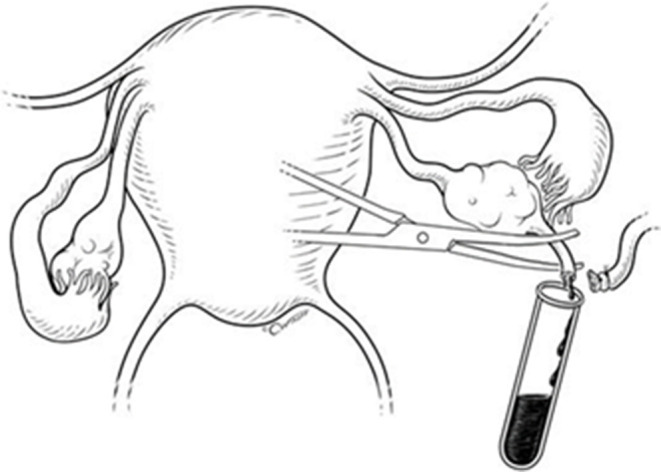
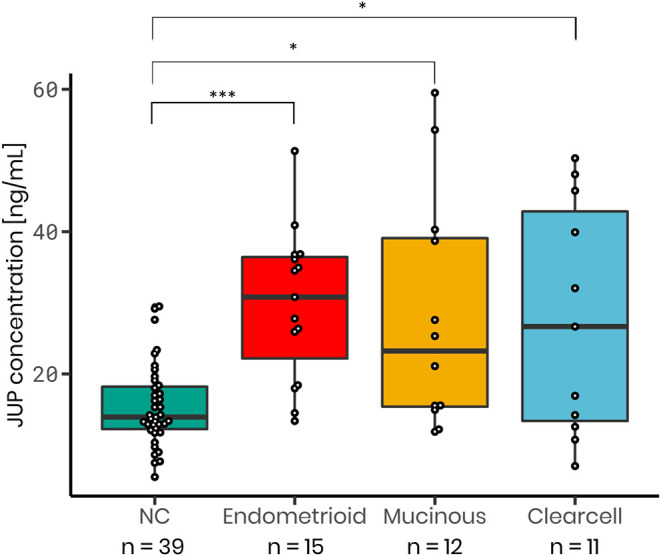
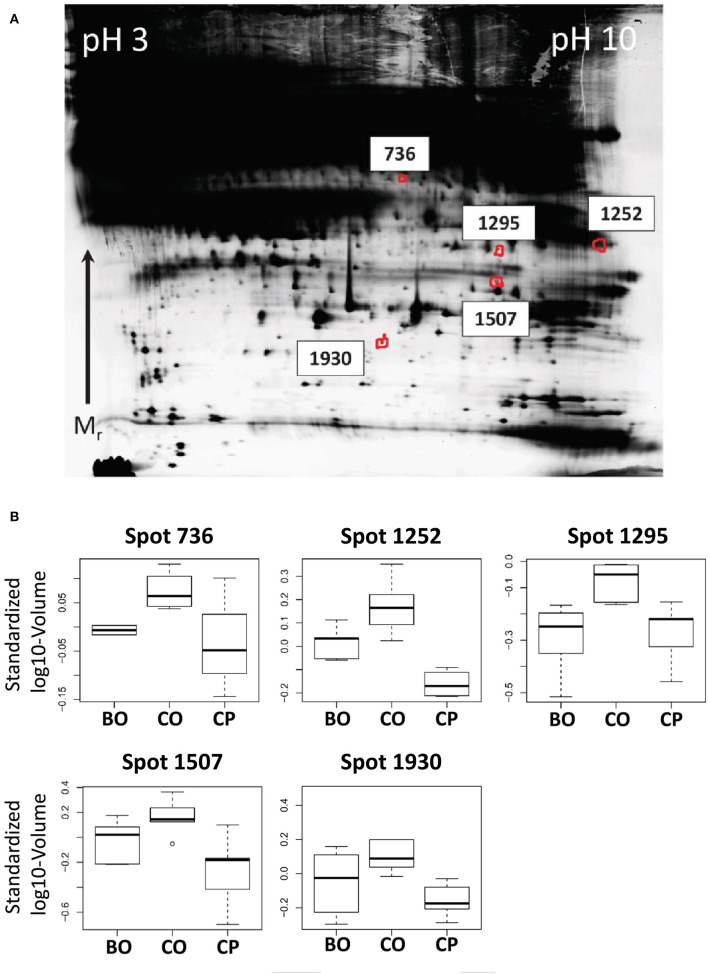
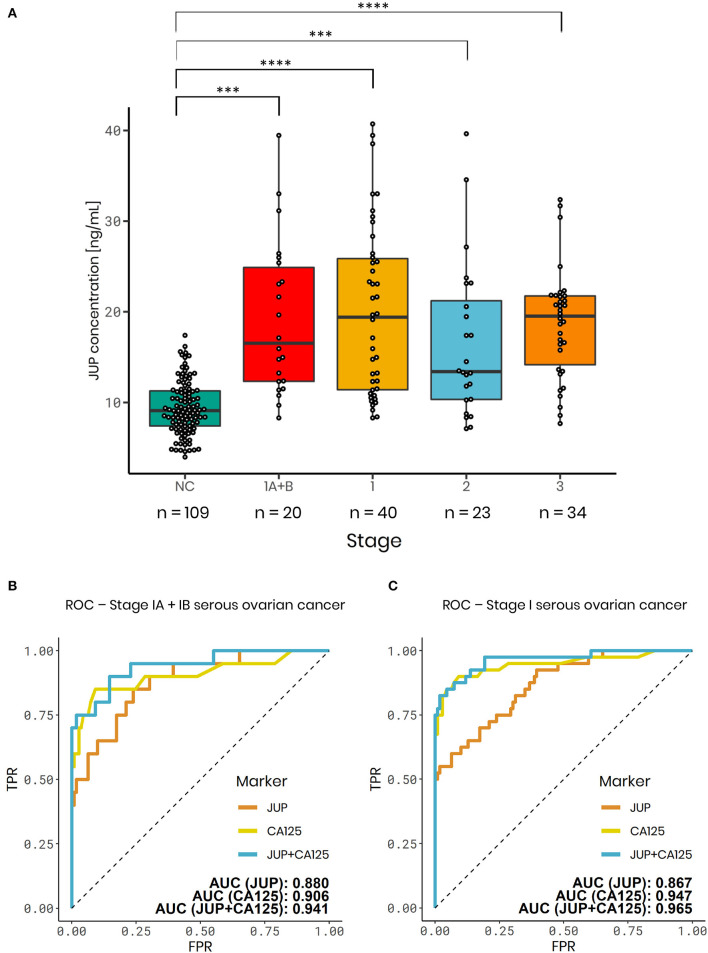
Ovarian cancer is the most lethal gynecologic malignancy. Early detection would improve survival, but an effective diagnostic test does not exist. Novel biomarkers for early ovarian cancer diagnosis are therefore warranted. We performed intraoperative blood sampling from ovarian veins of stage I epithelial ovarian carcinomas and analyzed the serum proteome. Junction plakoglobin (JUP) was found to be elevated in venous blood from ovaries with malignancies when compared to those with benign disease. Peripheral plasma JUP levels were validated by ELISA in a multicenter international patient cohort. JUP was significantly increased in FIGO serous stage IA+B (1.97-fold increase; < 0.001; = 20), serous stage I (2.09-fold increase; < 0.0001; = 40), serous stage II (1.81-fold increase, < 0.001, = 23) and serous stage III ovarian carcinomas (1.98-fold increase; < 0.0001; = 34) vs. normal controls ( = 109). JUP plasma levels were not increased in early stage breast cancer ( = 0.122; = 12). In serous ovarian cancer patients, JUP had a sensitivity of 85% in stage IA+B and 60% in stage IA-C, with specificities of 76 and 94%, respectively. A logistic regression model of JUP and Cancer Antigen 125 (CA125) revealed a sensitivity of 70% for stage IA+B and 75% for stage IA-C serous carcinomas at 100% specificity. Our novel ovarian blood sampling - proteomics approach identified JUP as a promising new biomarker for epithelial ovarian cancer, which in combination with CA125 might fulfill the test criteria for ovarian cancer screening.
卵巢癌是最致命的妇科恶性肿瘤。早期检测可提高生存率,但目前尚无有效的诊断测试。因此,新型的早期卵巢癌诊断生物标志物很有必要。我们对I期上皮性卵巢癌患者的卵巢静脉进行术中采血,并分析血清蛋白质组。结果发现,与良性疾病患者相比,患有恶性肿瘤的卵巢静脉血中连接盘状球蛋白(JUP)水平升高。通过酶联免疫吸附测定(ELISA)在一个多中心国际患者队列中验证了外周血浆JUP水平。在国际妇产科联盟(FIGO)浆液性IA + B期(增加1.97倍;P < 0.001;n = 20)、浆液性I期(增加2.09倍;P < 0.0001;n = 40)、浆液性II期(增加1.81倍,P < 0.001,n = 23)和浆液性III期卵巢癌患者(增加1.98倍;P < 0.0001;n = 34)中,JUP水平相较于正常对照组(n = 109)显著升高。早期乳腺癌患者的JUP血浆水平未升高(P = 0.122;n = 12)。在浆液性卵巢癌患者中,JUP在IA + B期的敏感性为85%,在IA - C期为60%,特异性分别为76%和94%。JUP与癌抗原125(CA125)的逻辑回归模型显示,在特异性为100%时,浆液性IA + B期的敏感性为70%,IA - C期为75%。我们采用的新型卵巢采血 - 蛋白质组学方法确定JUP是上皮性卵巢癌一种很有前景的新型生物标志物,它与CA125联合使用可能符合卵巢癌筛查的测试标准。