Lokman Noor A, Ricciardelli Carmela, Stephens Andrew N, Jobling Thomas W, Hoffmann Peter, Oehler Martin K
Discipline of Obstetrics and Gynaecology, Adelaide Medical School, Robinson Research Institute, The University of Adelaide, Adelaide, SA 5005, Australia.
Future Industries Institute, University of South Australia, Adelaide, SA 5001, Australia.
Diagnostics (Basel). 2021 Jan 4;11(1):69. doi: 10.3390/diagnostics11010069.
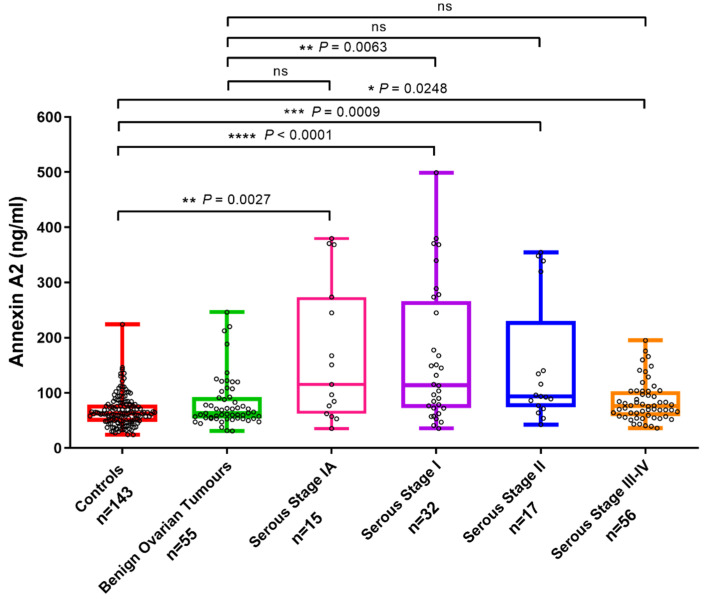
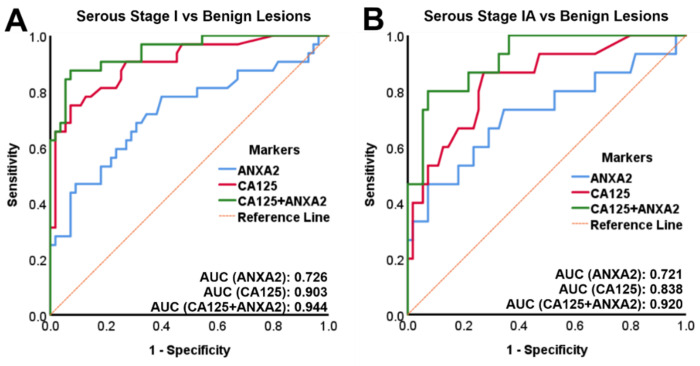
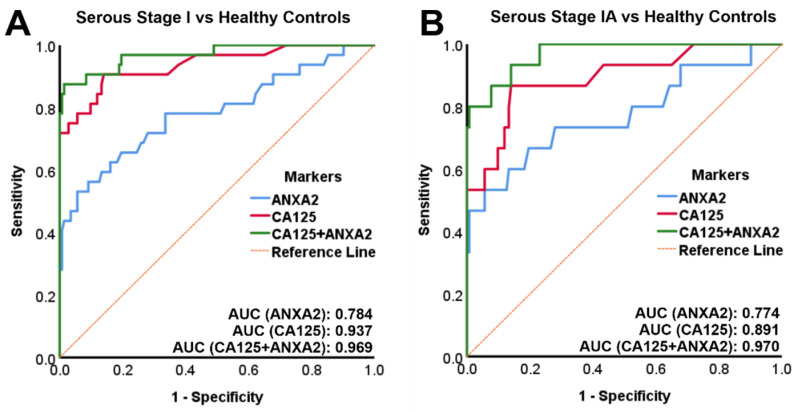
Ovarian cancer (OC) is commonly diagnosed at advanced stage when prognosis is poor. Consequently, there is an urgent clinical need to identify novel biomarkers for early detection to improve survival. We examined the diagnostic value of the calcium phospholipid binding protein annexin A2 (ANXA2), which plays an important role in OC metastasis. Annexin A2 plasma levels in patients with high grade serous OC ( = 105), benign ovarian lesions ( = 55) and healthy controls ( = 143) were measured by ELISA. Annexin A2 levels were found to be significantly increased in patients with stage I ( < 0.0001) and stage IA ( = 0.0027) OC when compared to healthy controls. In the logistic regression models followed by receiver operating characteristics (ROC) curve analyses, plasma annexin A2 showed 46.7% sensitivity at 99.6% specificity in distinguishing stage IA OC patients from healthy controls and 75% sensitivity at 65.5% specificity in the diagnosis of stage IA versus benign ovarian tumors. In the diagnosis of stage IA OC versus normal controls, the combination of plasma annexin A2 and CA125 showed 80% sensitivity at 99.6% specificity (AUC = 0.970) which was significantly higher than for CA125 (53.3% sensitivity at 99.6% specificity; AUC = 0.891) alone. The diagnostic accuracy in distinguishing stage IA OC from benign ovarian disease when combining annexin A2 and CA125 (71.4% accuracy at 100% sensitivity) was almost twice as high compared to CA125 (37.1% accuracy at 100% sensitivity) alone. In conclusion, annexin A2 in combination with CA125 has potential as a biomarker for the early detection of OC and to predict malignancy in patients with ovarian lesions, warranting further investigations.
卵巢癌(OC)通常在预后较差的晚期被诊断出来。因此,临床上迫切需要鉴定新的生物标志物用于早期检测以提高生存率。我们研究了钙磷脂结合蛋白膜联蛋白A2(ANXA2)的诊断价值,其在OC转移中起重要作用。采用酶联免疫吸附测定法(ELISA)检测了高级别浆液性OC患者(n = 105)、卵巢良性病变患者(n = 55)和健康对照者(n = 143)的血浆膜联蛋白A2水平。与健康对照者相比,I期(P < 0.0001)和IA期(P = 0.0027)OC患者的膜联蛋白A2水平显著升高。在随后进行的逻辑回归模型及受试者工作特征(ROC)曲线分析中,血浆膜联蛋白A2在区分IA期OC患者与健康对照者时,灵敏度为46.7%,特异性为99.6%;在诊断IA期OC与卵巢良性肿瘤时,灵敏度为75%,特异性为65.5%。在诊断IA期OC与正常对照者时,血浆膜联蛋白A2与CA125联合检测的灵敏度为80%,特异性为99.6%(曲线下面积[AUC] = 0.970),显著高于单独检测CA125(灵敏度为53.3%,特异性为99.6%;AUC = 0.891)。当联合膜联蛋白A2和CA125区分IA期OC与卵巢良性疾病时,诊断准确性(灵敏度为100%时,准确性为71.4%)几乎是单独检测CA125(灵敏度为100%时,准确性为37.1%)的两倍。总之,膜联蛋白A2与CA125联合检测有潜力作为OC早期检测及预测卵巢病变患者恶性程度的生物标志物,值得进一步研究。