Internò Valeria, Tucci Marco, Pezzicoli Gaetano, Silvestris Franco, Porta Camillo, Mannavola Francesco
Department of Biomedical Sciences and Clinical Oncology, University of Bari Aldo Moro, Bari, Italy.
National Cancer Research Centre, Istituto Tumori Bari "Giovanni Paolo II", Bari, Italy.
Front Oncol. 2020 Sep 25;10:581130. doi: 10.3389/fonc.2020.581130. eCollection 2020.
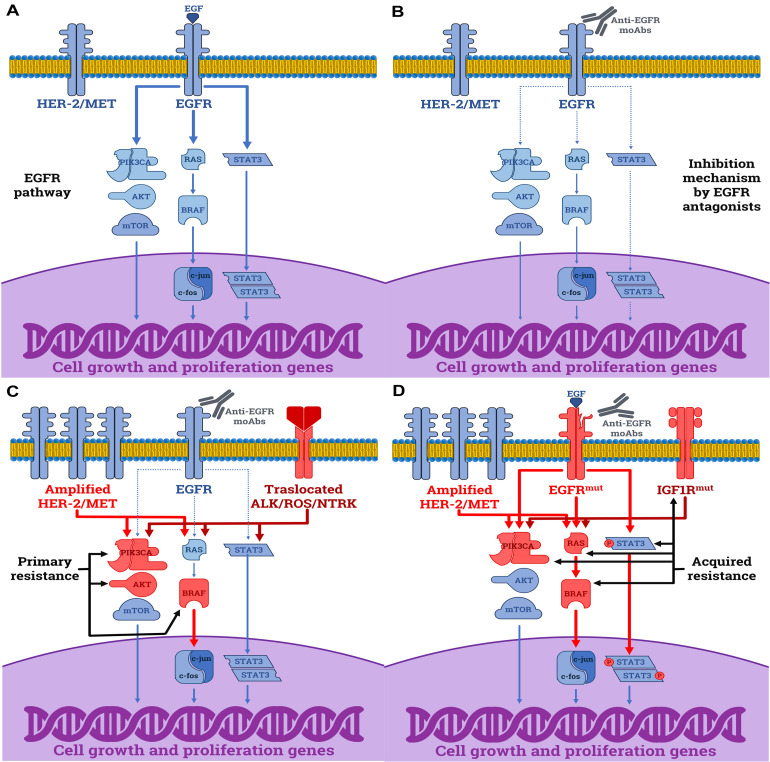
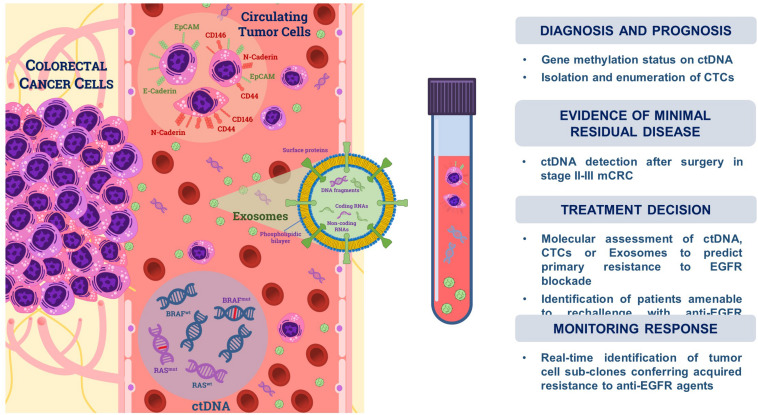
The treatment of metastatic colorectal cancer (mCRC) has improved since the introduction of the epithelial growth factor receptor (EGFR) inhibitors as cetuximab and panitumumab. However, only patients with peculiar genomic profiles benefit from these targeting therapies. In fact, the molecular integrity of genes is a predominant factor conditioning both primary and acquired resistance in non-responders although additional molecular derangements induced by selective anti-EGFR pressure may concur to the failure of those disease treatment, liquid biopsy (LB) appears as a surrogate of tissue biopsy, provides the genomic information to reveal tumor resistance to anti-EGFR agents, the detection of minimal residual disease before adjuvant therapies, and the discovery of tumor molecular status suitable for rechallenging treatments with EGFR antagonists. LB investigates circulating tumor cells (CTCs), cell-free tumor DNA (ctDNA), and tumor-derived exosomes. In mCRC, ctDNA analysis has been demonstrated as a useful method in the mutational tracking of defined genes as well as on tumor burden and detection of molecular alterations driving the resistance to anti-EGFR targeting treatments. However, despite their efficiency in molecular diagnosis and prognostic evaluation of mCRC, the affordability of these procedures is prevalently restricted to research centers, and the lack of consensus validation prevents their translation to clinical practice. Here, we revisit the major mechanisms responsible for resistance to EGFR blockade and review the different methods of LB potentially useful for treatment options in mCRC.
自从引入西妥昔单抗和帕尼单抗等上皮生长因子受体(EGFR)抑制剂以来,转移性结直肠癌(mCRC)的治疗有了改善。然而,只有具有特殊基因组特征的患者才能从这些靶向治疗中获益。事实上,基因的分子完整性是决定无反应者原发和获得性耐药的主要因素,尽管选择性抗EGFR压力诱导的其他分子紊乱可能也会导致这些疾病治疗的失败。液体活检(LB)似乎可替代组织活检,能提供基因组信息以揭示肿瘤对抗EGFR药物的耐药性、辅助治疗前检测微小残留病以及发现适合用EGFR拮抗剂再次进行治疗的肿瘤分子状态。LB可检测循环肿瘤细胞(CTC)、游离肿瘤DNA(ctDNA)和肿瘤来源的外泌体。在mCRC中,ctDNA分析已被证明是一种有用的方法,可用于特定基因的突变追踪以及肿瘤负荷和驱动抗EGFR靶向治疗耐药的分子改变的检测。然而,尽管这些方法在mCRC的分子诊断和预后评估方面有效,但这些检测方法的可及性普遍仅限于研究中心,并且缺乏共识性验证阻碍了它们转化为临床实践。在此,我们重新审视导致对EGFR阻断耐药的主要机制,并综述LB中可能对mCRC治疗选择有用的不同方法。