Ramesh Priyamvadha, Chauhan Ajay, Goyal Parul, Singh Akanksha
Department of Medicine, PGIMER, Dr. RMLH, New Delhi, India.
Professor of Medicine, PGIMER, Dr. RMLH, New Delhi, India.
J Family Med Prim Care. 2020 Jul 30;9(7):3421-3428. doi: 10.4103/jfmpc.jfmpc_296_20. eCollection 2020 Jul.
Prediabetes is increasingly being studied in the context of its association with cardiovascular disease (CVD). Besides raised HbA1c and sugar levels, the major underlying defect seems to be insulin resistance (IR). Subclinical atherosclerosis, measured by high sensitivity C reactive protein (hsCRP) and carotid artery intima media thickness (CIMT) underlies the pathogenesis of CVD in prediabetes. Heart-type fatty acid binding protein (H-FABP), a novel cardiac biomarker also might have a role in predictin prediabetic heart disease.
The aim of the study is to compare serum levels of H-FABP in prediabetics and controls and correlate them with the atherosclerotic markers, hsCRP and CIMT.
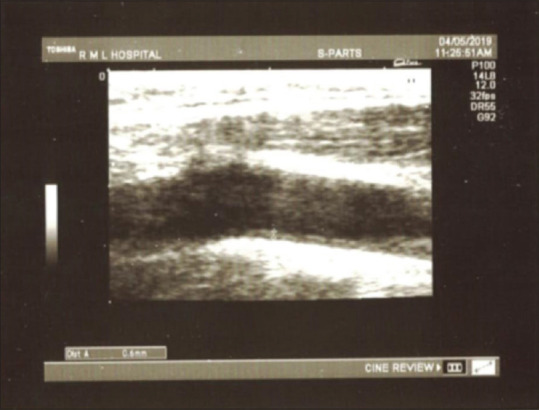
50 prediabetic patients and 50 age, sex and BMI matched controls were employed in the case control study. Serum F & PPBS, (HbA1c), fasting insulin levels were measured in cases and controls. Serum H-FABP was measured in both cases and controls. All cases and controls were subjected to bilateral CIMT measurements and Serum hsCRP levels. The values were compared between both the groups and subjected to appropriate statistical analysis.
Categorical variables were presented in number and percentage (%) and continuous variables were presented as mean ± SD and median. Normality of data was tested by Kolmogorov-Smirnov test. If the normality was rejected then non parametric test was used. Quantitative variables were compared using Independent t test/Mann-Whitney Test (when the data sets were not normally distributed) between the two groups. Qualitative variables were correlated using Chi-Square test/Fisher's Exact test. Spearman rank correlation coefficient was used to find out the correlation of various parameters with each other. Univariate linear regression was used to find out the cause and effect relationship between various parameters. A <0.05 was considered statistically significant. The data analysis was done using Statistical Package for Social Sciences (SPSS) version 21.0.
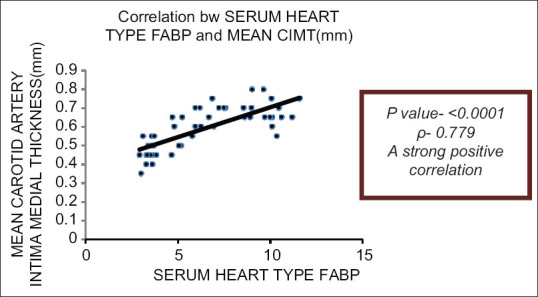
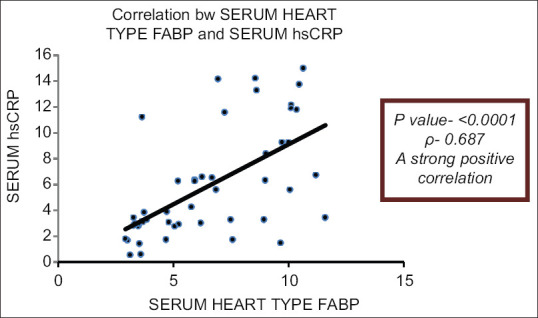
The mean serum levels of H-FABP among cases and controls were 6.38± 2.76ng/ml and 3.24 ± 2.47 ng/ml respectively ( <0.0001). Mean CIMT was found to be higher in prediabetics (0.59 ± 0.11 mm ) compared to controls (0.45 ± 0.07mm) (<0.0001). Serum hsCRP levels were also statistically higher in prediabetics (5.75± 4.16 mg/l) then that of controls (1.86± 1.67 mg/l) ( <0.0001). The correlations of the two variables, hsCRP and CIMT with H-FABP were both strongly positive ( = 0.687) & ( = 0.779) respectively [both cases ( < 0.0001)].
The novel cardiac biomarker H-FAPB might be a good predictor of cardiovascular risks in prediabetics.
糖尿病前期越来越多地在其与心血管疾病(CVD)关联的背景下进行研究。除了糖化血红蛋白(HbA1c)和血糖水平升高外,主要的潜在缺陷似乎是胰岛素抵抗(IR)。通过高敏C反应蛋白(hsCRP)和颈动脉内膜中层厚度(CIMT)测量的亚临床动脉粥样硬化是糖尿病前期CVD发病机制的基础。心脏型脂肪酸结合蛋白(H-FABP),一种新型心脏生物标志物,可能在预测糖尿病前期心脏病中也发挥作用。
本研究的目的是比较糖尿病前期患者和对照组血清H-FABP水平,并将其与动脉粥样硬化标志物hsCRP和CIMT进行关联分析。
在病例对照研究中纳入了50例糖尿病前期患者以及50名年龄、性别和体重指数(BMI)相匹配的对照。对病例组和对照组测量血清空腹血糖(FPG)、餐后血糖(PPBS)、(HbA1c)、空腹胰岛素水平。同时测量病例组和对照组的血清H-FABP。对所有病例和对照进行双侧CIMT测量及血清hsCRP水平检测。比较两组间的值并进行适当的统计分析。
分类变量以数量和百分比(%)呈现,连续变量以均值±标准差(SD)和中位数呈现。数据的正态性通过Kolmogorov-Smirnov检验进行测试。如果正态性被拒绝,则使用非参数检验。两组间定量变量采用独立t检验/曼-惠特尼检验(当数据集不呈正态分布时)进行比较。定性变量采用卡方检验/费舍尔精确检验进行关联分析。使用斯皮尔曼等级相关系数来找出各参数之间的相关性。采用单变量线性回归来找出各参数之间的因果关系。P<0.05被认为具有统计学意义。数据分析使用社会科学统计软件包(SPSS)21.0版完成。
病例组和对照组血清H-FABP的平均水平分别为6.38±2.76ng/ml和3.24±2.47ng/ml(P<0.0001)。发现糖尿病前期患者的平均CIMT(0.59±0.11mm)高于对照组(0.45±0.07mm)(P<0.0001)。糖尿病前期患者的血清hsCRP水平(5.75±4.16mg/l)在统计学上也高于对照组(1.86±1.67mg/l)(P<0.0001)。hsCRP和CIMT这两个变量与H-FABP的相关性均呈强正相关(分别为r = 0.687)和(r = 0.779)[病例组均为(P<0.0001)]。
新型心脏生物标志物H-FABP可能是糖尿病前期患者心血管风险的良好预测指标。