Chakravarthy Manu V, Neuschwander-Tetri Brent A
Axcella Health, Inc. Cambridge MA USA.
Saint Louis University Saint Louis MO USA.
Endocrinol Diabetes Metab. 2020 Feb 24;3(4):e00112. doi: 10.1002/edm2.112. eCollection 2020 Oct.
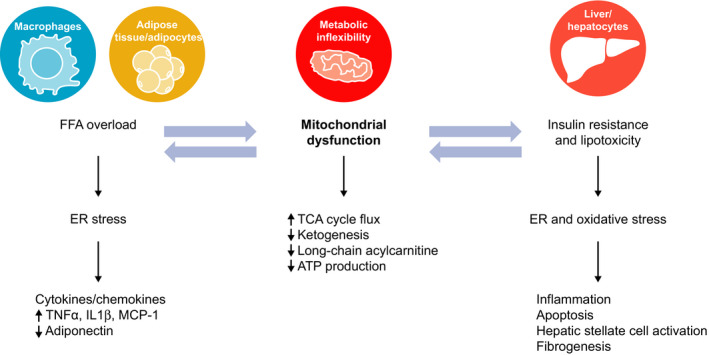
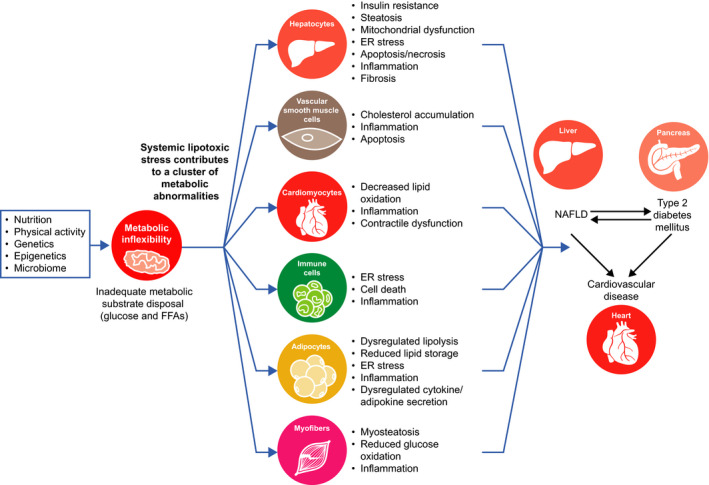
Nonalcoholic fatty liver disease (NAFLD) is a major cause of chronic liver disease and is associated with significant morbidity and mortality worldwide, with a high incidence in Western countries and non-Western countries that have adopted a Western diet. NAFLD is commonly associated with components of the metabolic syndrome, type 2 diabetes mellitus and cardiovascular disease, suggesting a common mechanistic basis. An inability to metabolically handle free fatty acid overload-metabolic inflexibility-constitutes a core node for NAFLD pathogenesis, with resulting lipotoxicity, mitochondrial dysfunction and cellular stress leading to inflammation, apoptosis and fibrogenesis. These responses can lead to the histological phenotype of nonalcoholic steatohepatitis (NASH) with varying degrees of fibrosis, which can progress to cirrhosis. This perspective review describes the key cellular and molecular mechanisms of NAFLD and NASH, namely an excessive burden of carbohydrates and fatty acids that contribute to lipotoxicity resulting in hepatocellular injury and fibrogenesis. Understanding the extrahepatic dysmetabolic contributors to NASH is crucial for the development of safe, effective and durable treatment approaches for this increasingly common disease.
非酒精性脂肪性肝病(NAFLD)是慢性肝病的主要病因,在全球范围内与显著的发病率和死亡率相关,在西方国家以及采用西方饮食的非西方国家中发病率较高。NAFLD通常与代谢综合征、2型糖尿病和心血管疾病的组成部分相关,提示存在共同的机制基础。无法代谢性处理游离脂肪酸过载——代谢灵活性受损——构成了NAFLD发病机制的核心节点,由此产生的脂毒性、线粒体功能障碍和细胞应激会导致炎症、细胞凋亡和纤维化。这些反应可导致不同程度纤维化的非酒精性脂肪性肝炎(NASH)的组织学表型,进而可发展为肝硬化。这篇观点性综述描述了NAFLD和NASH的关键细胞和分子机制,即碳水化合物和脂肪酸负担过重导致脂毒性,进而引起肝细胞损伤和纤维化。了解NASH的肝外代谢异常促成因素对于开发针对这种日益常见疾病的安全、有效和持久的治疗方法至关重要。