Jiang Yu, Schmidt Jürgen
State Key Laboratory of Astronautic Dynamics, Xi'an Satellite Control Center, Xi'an, China.
School of Aerospace Engineering, Tsinghua University, Beijing 100084, China.
Heliyon. 2020 Oct 15;6(10):e05275. doi: 10.1016/j.heliyon.2020.e05275. eCollection 2020 Oct.
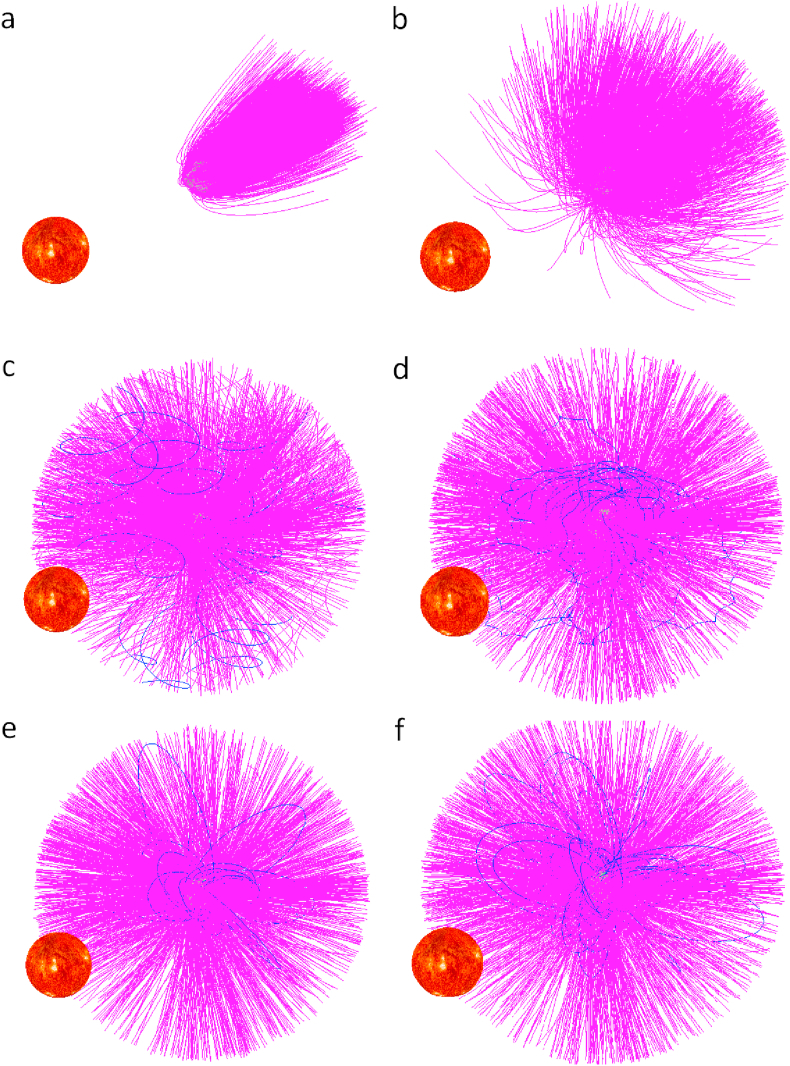
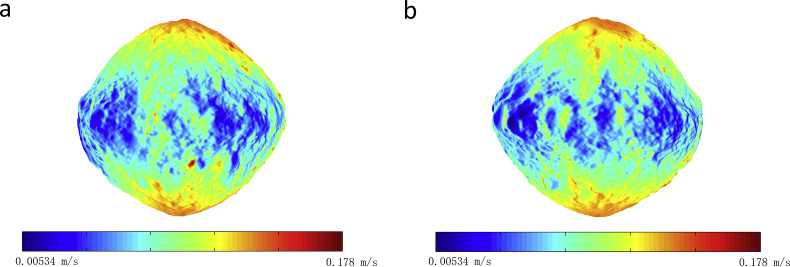
From Jan. 6, 2019 to Feb. 18, 2019, OSIRIS-REx observed asteroid (101955) Bennu ejecting 11 plumes of dust, of which part is escaping and another part is re-captured by the asteroid. The relative magnitudes of the typical forces acting on the emitted dust are quite different from the environments of the planets and other minor planets in the solar system. Here we show that ejected dust grains from the surface of Bennu can be caught in the gravitational field of Bennu. To this end, we calculated numerically the trajectories of dust grains of various sizes, from the 0.1μm to the ten millimeter range. The shape and the fate of an emitted cloud of particles depend on the size of the grains: smaller grains form a more narrowly confined dust trail while trails formed by larger grains disperse more rapidly. Four different fates are possible for ejected dust. All grains with radius less than 1.0μm, directly re-impact on Bennu or they escape directly. In contrast, a fraction of grains with a radius larger than 10.0 μm will impact or escape only after performing a number of non-Keplerian revolutions around Bennu. Our findings show how dust grains may populate the vicinity of Bennu and other active asteroids and that they can reach interplanetary space and other celestial bodies, implying that organic matter can be transported from carbonaceous asteroids to other celestial bodies, including Earth.
2019年1月6日至2019年2月18日,奥西里斯-雷克斯号观测到小行星(101955)贝努喷射出11股尘埃羽流,其中一部分正在逃逸,另一部分则被小行星重新捕获。作用于喷出尘埃的典型力的相对大小与太阳系中行星和其他小行星的环境截然不同。在此,我们表明从贝努表面喷出的尘埃颗粒能够被贝努的引力场捕获。为此,我们对半径从0.1微米到10毫米范围内各种大小尘埃颗粒的轨迹进行了数值计算。喷出的粒子云的形状和归宿取决于颗粒的大小:较小的颗粒形成的尘埃轨迹限制更窄,而较大颗粒形成的轨迹扩散得更快。喷出的尘埃可能有四种不同的归宿。所有半径小于1.0微米的颗粒,要么直接重新撞击贝努,要么直接逃逸。相比之下,一部分半径大于10.0微米的颗粒在围绕贝努进行多次非开普勒轨道运行后才会撞击或逃逸。我们的研究结果表明尘埃颗粒可能如何分布在贝努和其他活跃小行星的附近区域,以及它们如何能够到达行星际空间和其他天体,这意味着有机物质可以从碳质小行星传输到包括地球在内的其他天体。