Leonard J M, Adam C D, Pelgrift J Y, Lessac-Chenen E J, Nelson D S, Antreasian P G, Liounis A J, Moreau M C, Hergenrother C W, Chesley S R, Nolan M C, Lauretta D S
KinetX Aerospace Simi Valley CA USA.
Goddard Space Flight Center Greenbelt MD USA.
Earth Space Sci. 2020 Sep;7(9):e2019EA000937. doi: 10.1029/2019EA000937. Epub 2020 Sep 19.
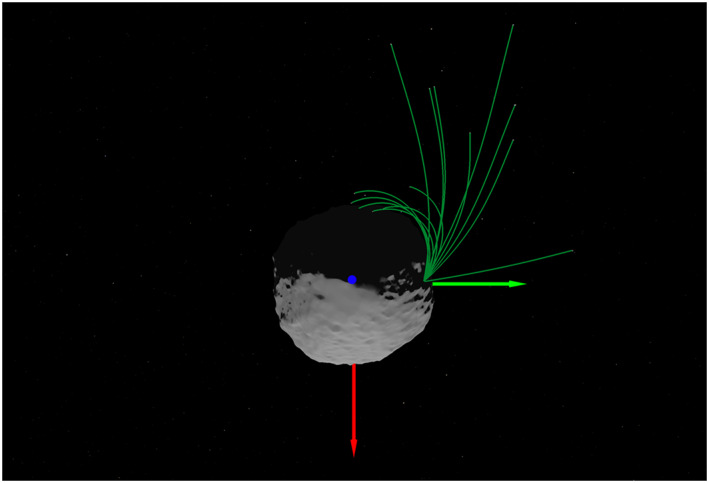
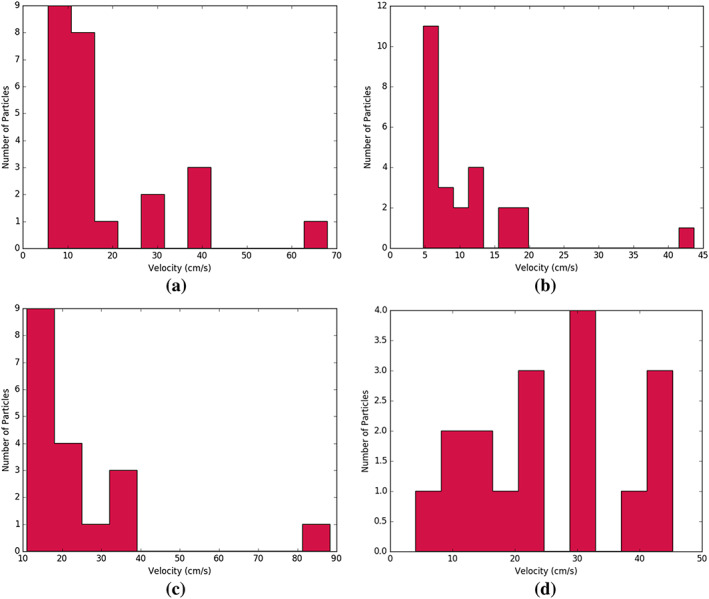
The OSIRIS-REx mission has observed multiple instances of particles being ejected from the surface of near-Earth asteroid (101955) Bennu. The ability to quickly identify the particle trajectories and origins is necessary following a particle ejection event. Using proven initial orbit determination techniques, we can rapidly estimate particle trajectories and ejection locations. We present current results pertaining to the identification of particle tracks, an evaluation of the estimated orbits and the excess velocity necessary to induce the particle ejection from the surface, and the uncertainty quantification of the ejection location. We estimate energies per particle ranging from 0.03 to 11.03 mJ for the largest analyzed events and velocities ranging from 5 to 90 cm/s, though we exclude the highest-velocity particles in this technique. We estimate ejection times for eight events and constrain six of the analyzed ejection events to have occurred between about 16:30 and 19:00 local solar time, with the largest events occurring between 16:30 and 18:05.
奥西里斯-雷克斯任务已经观测到多个从近地小行星(101955)贝努表面喷射出粒子的实例。在粒子喷射事件发生后,快速识别粒子轨迹和起源的能力是必要的。使用经过验证的初始轨道确定技术,我们可以快速估计粒子轨迹和喷射位置。我们展示了与粒子轨迹识别、估计轨道评估以及从表面诱导粒子喷射所需的过剩速度相关的当前结果,以及喷射位置的不确定性量化。对于分析的最大事件,我们估计每个粒子的能量范围为0.03至11.03毫焦,速度范围为5至90厘米/秒,不过在这项技术中我们排除了最高速度的粒子。我们估计了8个事件的喷射时间,并将6个分析的喷射事件限制在当地太阳时间约16:30至19:00之间发生,最大的事件发生在16:30至18:05之间。