Department of Neurology, Tianjin Neurological Institute, Tianjin Medical University General Hospital, Tianjin Medical University, Tianjin, China.
National Clinical Research Center for Neurological Diseases of China, Jing-Jin Center for Neuroinflammation, Beijing Tiantan Hospital, Capital Medical University, Beijing, China.
CNS Neurosci Ther. 2020 Dec;26(12):1241-1254. doi: 10.1111/cns.13468. Epub 2020 Oct 26.
To compare long-term efficacy and safety of immunotherapeutic strategies as maintenance to prevent disease relapses of generalized myasthenia gravis (MG) in real-world settings.
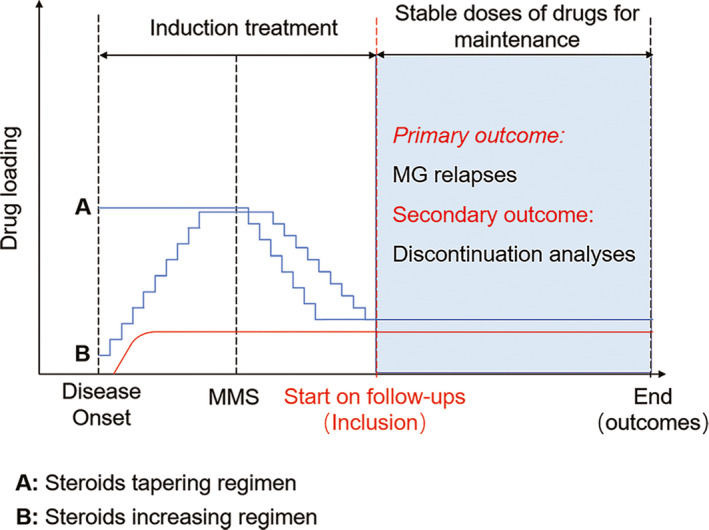
This is a retrospective cohort study on generalized MG conducted in seven major neurological centers across China. Eligible participants were patients with generalized MG who were under minimal manifestation status or better. Main outcome measures were probability of patients free of relapses and causes of drug discontinuation.
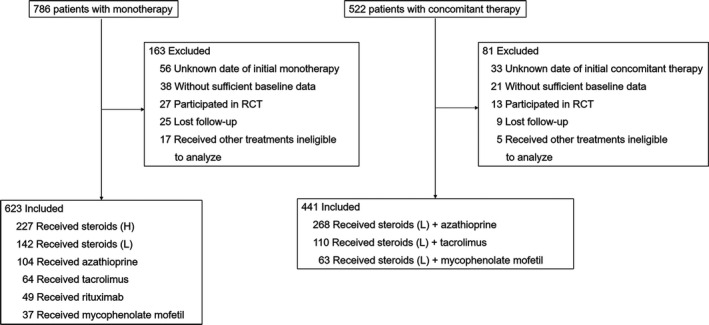
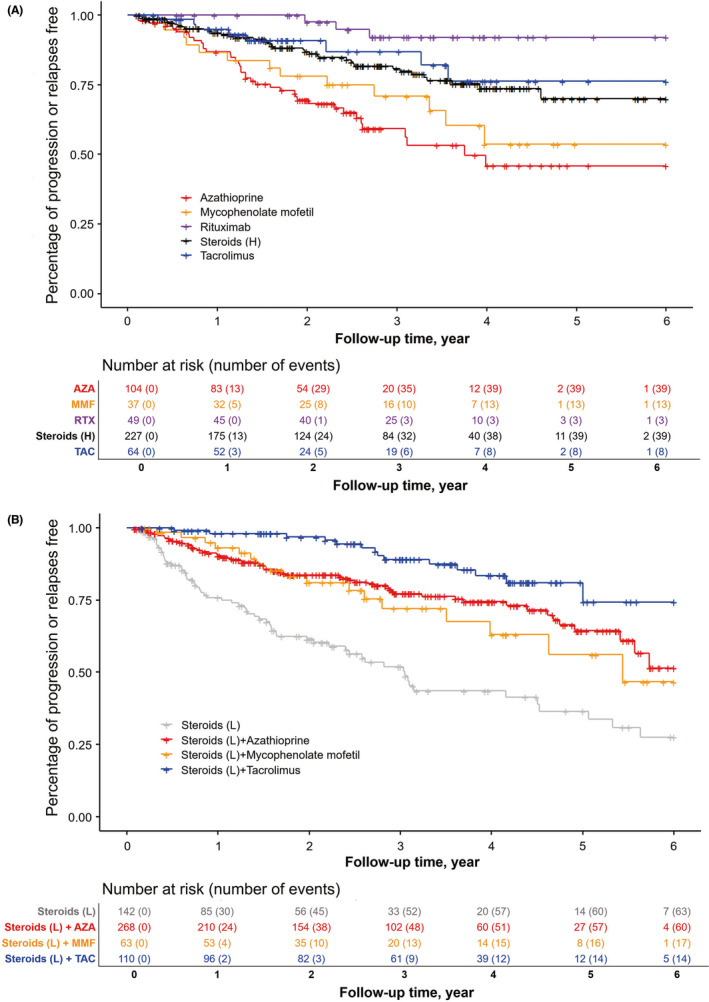
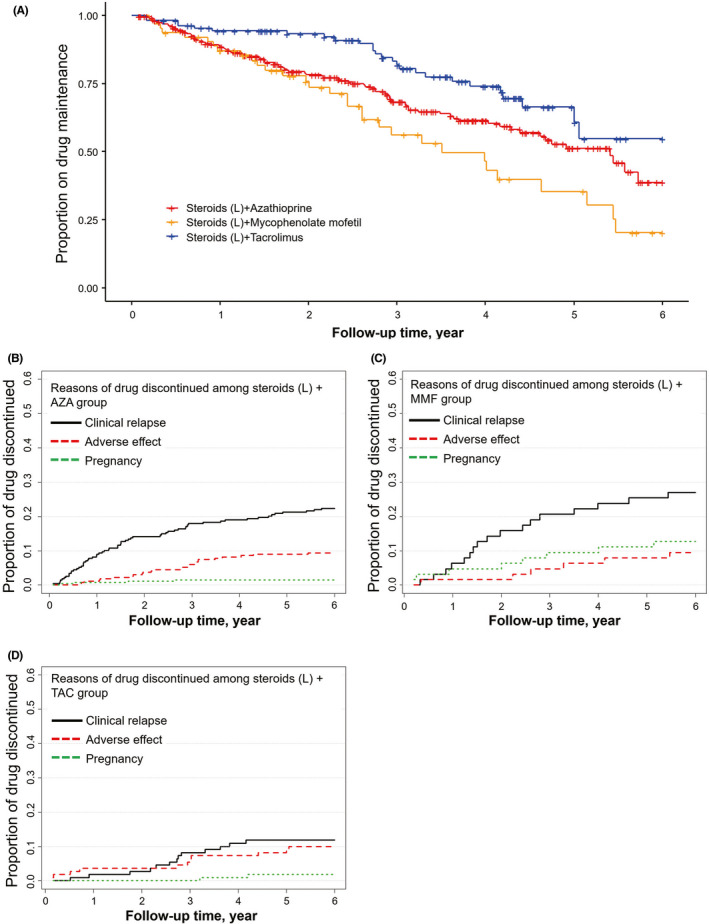
Among 1064 patients enrolled, the median (interquartile range) age was 50.3 (37.0-62.5) years and 641 (60.2%) were women. Disease relapse was significantly lower for rituximab (6.1%) compared with all the other monotherapies (hazard ratio [HR] = 0.18, 95% confidence interval [CI] 0.06 to 0.56, P = .0030). As combination therapies, tacrolimus in combination with corticosteroids reduced risk of disease relapses compared with azathioprine with corticosteroids (HR = 0.45, 95% CI 0.25 to 0.81, P = .0077) or mycophenolate mofetil with corticosteroids (HR = 0.32, 95% CI 0.15 to 0.67, P = .0020). Otherwise, lower-dose corticosteroids or azathioprine as monotherapy significantly increased risk of disease relapses (HR = 2.78, 95% CI 1.94 to 3.99, P < .0001; HR = 2.14, 95% CI 1.42 to 3.23, P = .0003, respectively). The proportion of discontinuation was lowest in patients with rituximab (20.4%) as monotherapy and tacrolimus with corticosteroids (23.6%). Overall, combination treatment of immunosuppressants with corticosteroids had a lower rate of discontinuation compared with corresponding monotherapy (HR = 0.51, 95% CI 0.36 to 0.71, P < .0001).
Rituximab as monotherapy and tacrolimus with corticosteroids displayed better clinical efficacy as well as drug maintenance to prevent disease relapses in patients with generalized MG.
比较免疫治疗策略作为维持治疗以预防广义重症肌无力(MG)疾病复发的长期疗效和安全性,在真实世界环境中。
这是一项在中国 7 个主要神经中心进行的广义 MG 的回顾性队列研究。合格的参与者是处于最小表现状态或更好状态的广义 MG 患者。主要观察指标是患者无复发的概率和停药原因。
在纳入的 1064 名患者中,中位(四分位间距)年龄为 50.3(37.0-62.5)岁,641 名(60.2%)为女性。与所有其他单药治疗相比,利妥昔单抗(6.1%)的疾病复发率显著降低(风险比[HR] 0.18,95%置信区间 0.06 至 0.56,P 0.0030)。作为联合疗法,与环孢素与皮质类固醇联合相比,他克莫司与皮质类固醇联合降低了疾病复发的风险(HR 0.45,95%置信区间 0.25 至 0.81,P 0.0077)或吗替麦考酚酯与皮质类固醇(HR 0.32,95%置信区间 0.15 至 0.67,P 0.0020)。否则,低剂量皮质类固醇或硫唑嘌呤作为单药治疗显著增加疾病复发的风险(HR 2.78,95%置信区间 1.94 至 3.99,P < 0.0001;HR 2.14,95%置信区间 1.42 至 3.23,P 0.0003)。单药利妥昔单抗(20.4%)和他克莫司与皮质类固醇(23.6%)的停药比例最低。总体而言,与相应的单药治疗相比,免疫抑制剂联合皮质类固醇的联合治疗停药率较低(HR 0.51,95%置信区间 0.36 至 0.71,P < 0.0001)。
利妥昔单抗作为单药治疗和他克莫司联合皮质类固醇在预防广义 MG 患者疾病复发方面显示出更好的临床疗效和药物维持作用。