Department of Chemistry, Memorial University of Newfoundland, St. John's, Canada.
Department of Chemistry, University Institute of Engineering and Technology, Chhatrapati Shahu Ji Maharaj University, Kanpur, India.
J Biomol Struct Dyn. 2022 Mar;40(5):2099-2112. doi: 10.1080/07391102.2020.1835721. Epub 2020 Oct 25.
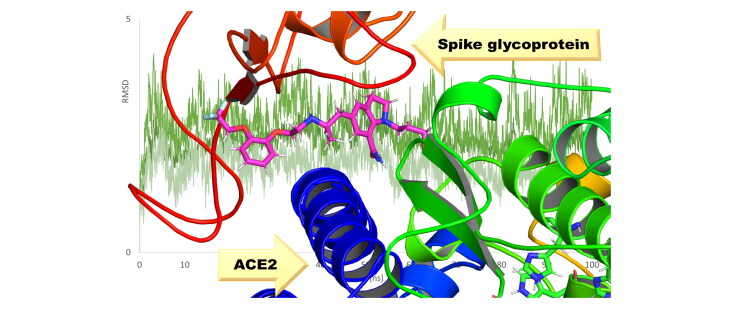
COVID-19, which is caused by a novel coronavirus known as SARS-CoV-2, has spread rapidly around the world, and it has infected more than 29 million individuals as recorded on 16 September 2020. Much effort has been made to stop the virus from spreading, and there are currently no approved pharmaceutical products to treat COVID-19. Here, we apply an approach to investigate more than 3800 FDA approved drugs on the viral RBD S-ACE2 interface as a target. The compounds were investigated through flexible ligand docking, ADME property calculations and protein-ligand interaction maps. Molecular dynamics (MD) simulations were also performed on eleven compounds to study the stability and the interactions of the protein-ligand complexes. The MD simulations show that bagrosin, chidamide, ebastine, indacaterol, regorafenib, salazosulfadimidine, silodosin and tasosartan are relatively stable near the C terminal domain (CTD1) of the S subunit of the viral S protein. The relative MMGBSA binding energies show that silodosin has the best binding to the target. The constant velocity steered molecular dynamics (SMD) simulations show that silodosin preferentially interacts with the RBD S and has potential to act as an interfering compound between viral spike-host ACE2 interactions. Communicated by Ramaswamy H. Sarma.
新型冠状病毒(SARS-CoV-2)引发的 COVID-19 在全球迅速传播,截至 2020 年 9 月 16 日,已记录超过 2900 万人感染。人们付出了巨大努力来阻止病毒传播,但目前尚无治疗 COVID-19 的经批准的医药产品。在这里,我们采用一种方法来研究超过 3800 种 FDA 批准的药物,以病毒的 RBD-S-ACE2 界面为靶点。通过柔性配体对接、ADME 性质计算和蛋白-配体相互作用图对化合物进行了研究。还对 11 种化合物进行了分子动力学(MD)模拟,以研究蛋白-配体复合物的稳定性和相互作用。MD 模拟表明,在病毒 S 蛋白的 S 亚单位的 C 末端结构域(CTD1)附近,巴罗斯因、chidamide、依巴斯汀、茚达特罗、regorafenib、柳氮磺胺吡啶、西洛多辛和塔索沙坦相对稳定。相对 MMGBSA 结合能表明西洛多辛与靶标具有最佳结合。恒速推进分子动力学(SMD)模拟表明,西洛多辛优先与 RBD-S 相互作用,并有潜力成为一种干扰病毒刺突-宿主 ACE2 相互作用的化合物。由 Ramaswamy H. Sarma 传达。