Department of Anatomy and Neurosciences, MS Center Amsterdam, Amsterdam Neuroscience, Amsterdam UMC, Vrije Universiteit Amsterdam, Amsterdam, The Netherlands/Department of Radiology and Medicine, The University of Melbourne, Melbourne, VIC, Australia.
NMR Research Unit, Queen Square MS Centre, Department of Neuroinflammation, UCL Institute of Neurology, London, UK/National Institute for Health Research, University College London Hospitals Biomedical Research Centre, London, UK.
Mult Scler. 2021 Aug;27(9):1364-1373. doi: 10.1177/1352458520966292. Epub 2020 Oct 26.
Network abnormalities could help explain physical disability in multiple sclerosis (MS), which remains poorly understood.
This study investigates functional network efficiency changes in the sensorimotor system.
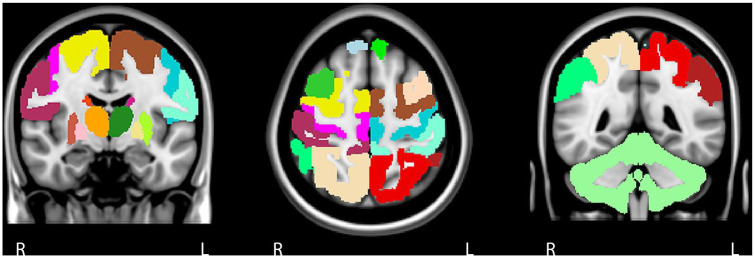
We included 222 MS patients, divided into low disability (LD, Expanded Disability Status Scale (EDSS) ⩽3.5, = 185) and high disability (HD, EDSS ⩾6, = 37), and 82 healthy controls (HC). Functional connectivity was assessed between 23 sensorimotor regions. Measures of efficiency were computed and compared between groups using general linear models corrected for age and sex. Binary logistic regression models related disability status to local functional network efficiency (LE), brain volumes and demographics. Functional connectivity patterns of regions important for disability were explored.
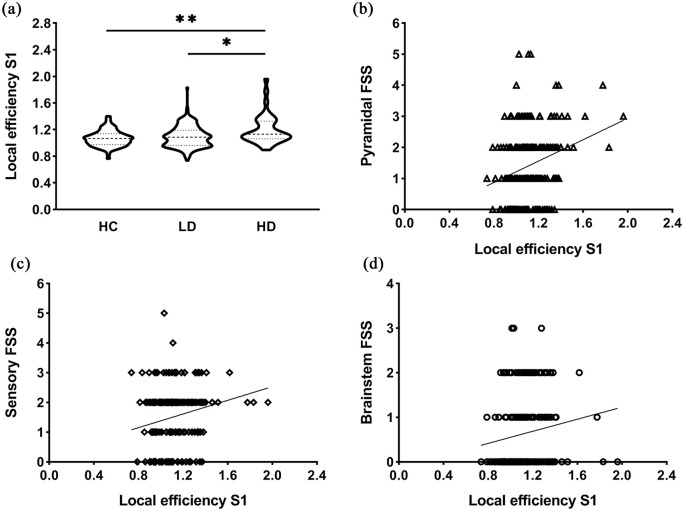
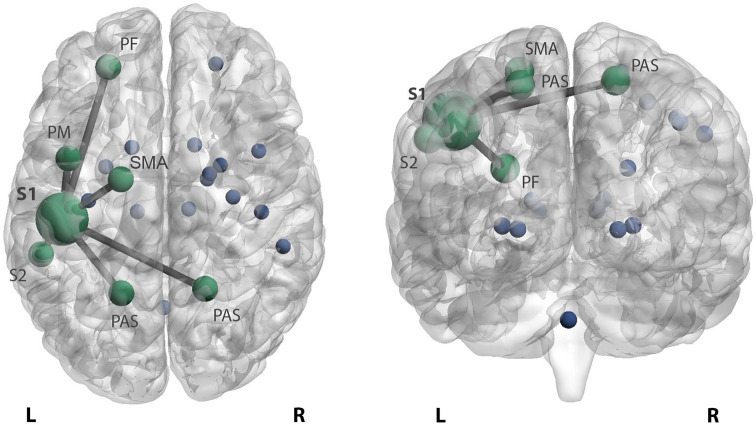
HD patients demonstrated significantly higher LE of the left primary somatosensory cortex (S1) and right pallidum compared to LD and HC, and left premotor cortex compared to HC only. The logistic regression model for disability ( = 0.38) included age, deep grey matter volume and left S1 LE. S1 functional connectivity was increased with prefrontal and secondary sensory areas in HD patients, compared to LD and HC.
Clinical disability in MS associates with functional sensorimotor increases in efficiency and connectivity, centred around S1, independent of structural damage.
网络异常可能有助于解释多发性硬化症(MS)的身体残疾,而这一现象仍未得到很好的理解。
本研究旨在调查感觉运动系统中功能网络效率的变化。
我们纳入了 222 名 MS 患者,分为低残疾(EDSS ⩽3.5,n = 185)和高残疾(EDSS ⩾6,n = 37)组,并纳入 82 名健康对照(HC)。评估了 23 个感觉运动区域之间的功能连接。使用校正年龄和性别的一般线性模型比较组间效率的测量值。二元逻辑回归模型将残疾状况与局部功能网络效率(LE)、脑体积和人口统计学相关联。探索了与残疾相关的重要区域的功能连接模式。
HD 患者的左侧初级体感皮层(S1)和右侧苍白球的 LE 明显高于 LD 和 HC,且左侧前运动皮层的 LE 仅高于 HC。残疾的逻辑回归模型( = 0.38)包括年龄、深部灰质体积和左侧 S1 LE。与 LD 和 HC 相比,HD 患者的 S1 功能连接增加了与前额叶和次级感觉区的连接。
MS 患者的临床残疾与 S1 为中心的感觉运动效率和连接的功能性增加有关,独立于结构损伤。