Department of Electrical Communication Engineering, Indian Institute of Science, Bangalore.
Centre for Neuroscience, Indian Institute of Science, Bangalore.
J Vis. 2020 Oct 1;20(10):20. doi: 10.1167/jov.20.10.20.
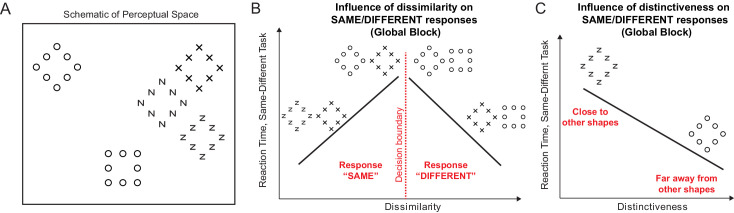
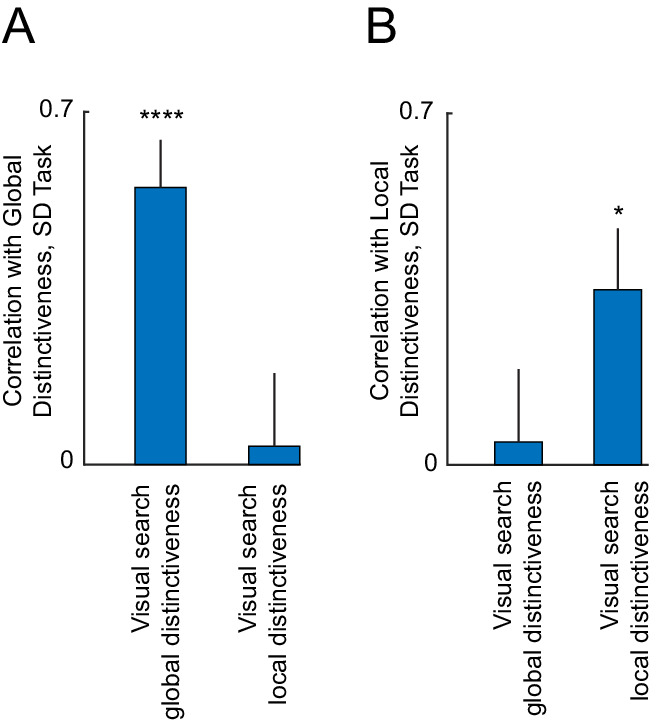
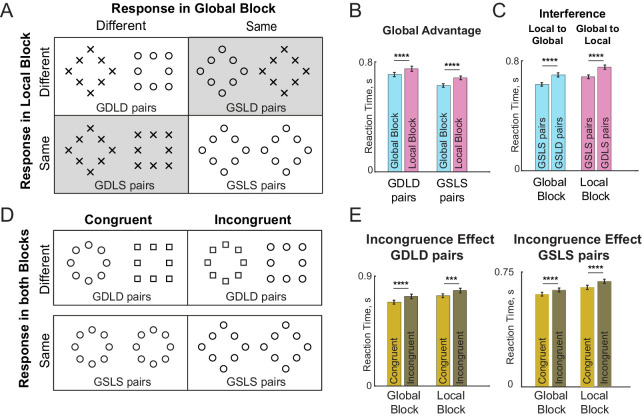
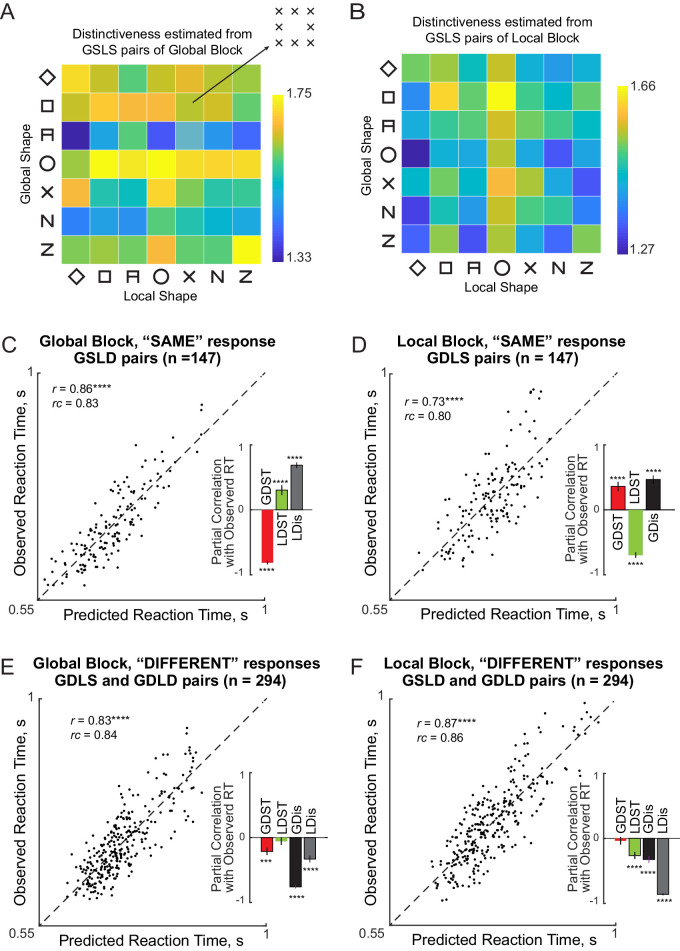
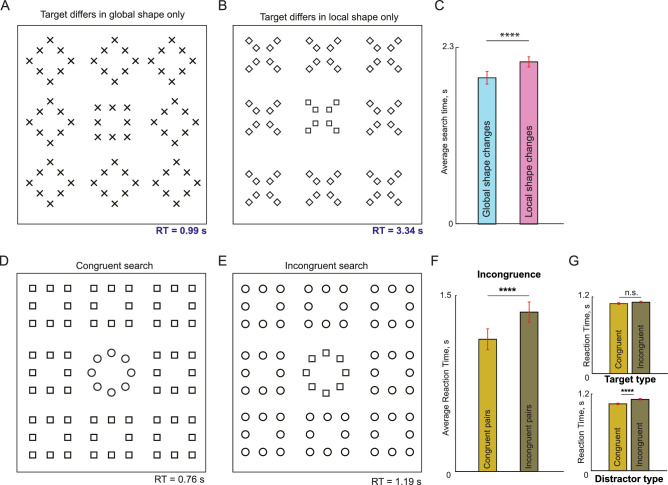
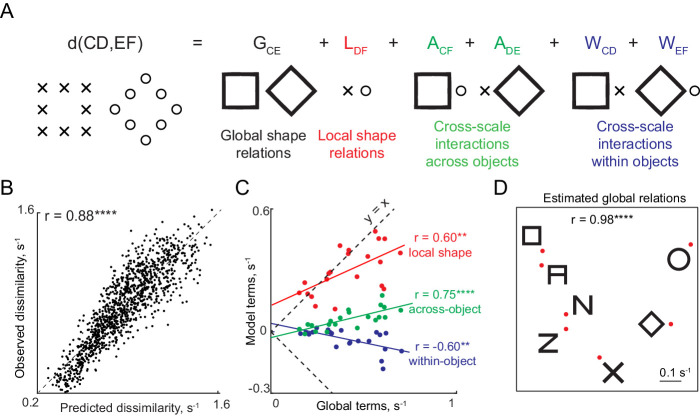
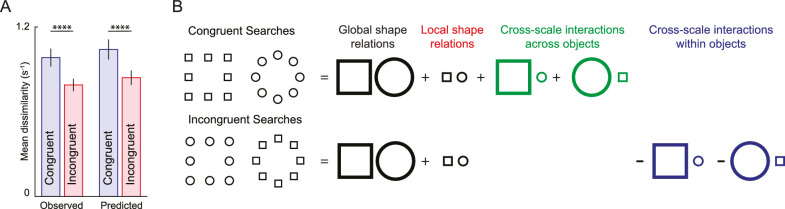
Hierarchical stimuli have been widely used to study global and local processing. Two classic phenomena have been observed using these stimuli: the global advantage effect (we identify the global shape faster) and an interference effect (we identify shape slower when the global and local shapes are different). Because these phenomena have been observed during shape categorization tasks, it is unclear whether they reflect the categorical judgment or the underlying shape representation. Understanding the underlying shape representation is also critical because both global and local processing are modulated by stimulus properties. We performed two experiments to investigate these issues. In Experiment 1, we show that these phenomena can be observed in a same-different task, and that participants show systematic variation in response times across image pairs. We show that the response times to any pair of images can be accurately predicted using two factors: their dissimilarity and their distinctiveness relative to other images. In Experiment 2, we show that these phenomena can also be observed in a visual search task where participant did not have to make any categorical shape judgments. Here too, participants showed highly systematic variations in response time that could be explained as a linear sum of shape comparisons across global and local scales. Finally, the dissimilarity and distinctiveness factors estimated from the same-different task were systematically related to the search dissimilarities observed during visual search. In sum, our results show that global and local processing phenomena are properties of a systematic shape representation governed by simple rules.
层级刺激已被广泛用于研究整体和局部加工。使用这些刺激观察到了两个经典现象:全局优势效应(我们更快地识别全局形状)和干扰效应(当全局和局部形状不同时,我们识别形状的速度会变慢)。由于这些现象在形状分类任务中被观察到,因此尚不清楚它们是否反映了类别判断还是基础形状表示。理解基础形状表示也很关键,因为全局和局部处理都受到刺激属性的调节。我们进行了两项实验来研究这些问题。在实验 1 中,我们表明这些现象可以在相同-不同任务中观察到,并且参与者在图像对之间的反应时间上表现出系统变化。我们表明,使用两个因素可以准确预测任何一对图像的反应时间:它们的相似度和相对于其他图像的独特性。在实验 2 中,我们表明这些现象也可以在视觉搜索任务中观察到,在该任务中,参与者不必进行任何类别形状判断。在这里,参与者的反应时间也表现出高度系统的变化,可以解释为全局和局部尺度上的形状比较的线性总和。最后,从相同-不同任务中估计的相似度和独特性因素与视觉搜索过程中观察到的搜索相似度呈系统关系。总之,我们的结果表明,全局和局部加工现象是受简单规则支配的系统形状表示的属性。