
内镜超声引导下顺行射频消融联合肝胆肠吻合术治疗恶性胆道梗阻:一项前瞻性初步研究。
Endoscopic Ultrasound-Guided Antegrade Radiofrequency Ablation and Metal Stenting With Hepaticoenterostomy for Malignant Biliary Obstruction: A Prospective Preliminary Study.
机构信息
Department of Gastroenterology, Aichi Medical University, Nagakute, Japan.
出版信息
Clin Transl Gastroenterol. 2020 Oct;11(10):e00250. doi: 10.14309/ctg.0000000000000250.
OBJECTIVES
Endobiliary radiofrequency ablation (RFA) for malignant biliary obstruction is a promising option for improving biliary stent patency, but its efficacy and safety with endoscopic ultrasound (EUS)-guided biliary drainage are uncertain. We examined the feasibility of EUS-guided hepaticoenterostomy with antegrade stenting (EUS-HEAS) and RFA in patients with unresectable malignant biliary obstruction.
METHODS
This was a prospective, single-center, single-arm, preliminary study. Twenty patients who met the eligibility criteria for inclusion between August 2018 and January 2020 were enrolled. We evaluated the technical success, functional success, recurrent biliary obstruction (RBO), and adverse events other than RBO associated with EUS-HEAS with RFA.
RESULTS
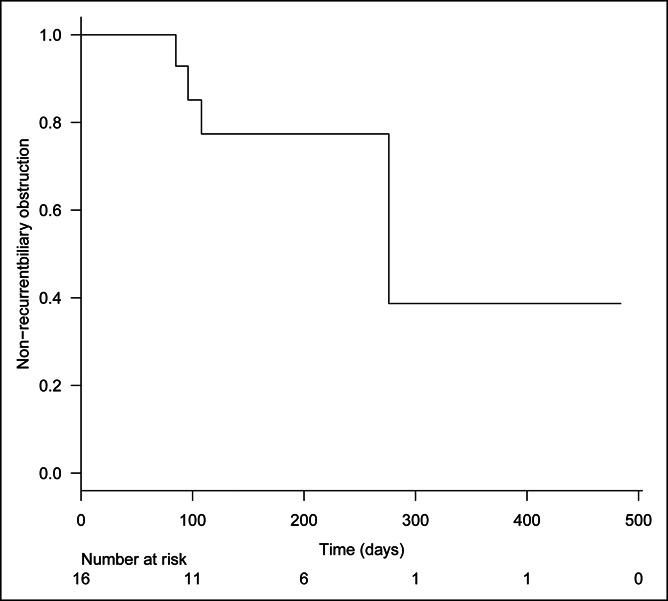
The technical and functional success rates were both 80% (16/20). The procedure was unsuccessful in a total of 4 patients due to failure to insert the RFA catheter through the fistula (2 patients) or failure to pass the RFA catheter through the stricture (2 patients). Early and late adverse events other than RBO occurred in 10% (2/20) and 13% (2/16) of subjects, respectively. The RBO rate was 25% (4/16), and the median time to RBO was 276 days. The success rate of endoscopic reintervention using hepaticoenterostomy was 100% (4/4).
DISCUSSION
This preliminary study showed that EUS-HEAS with RFA achieves good results but RFA catheter insertion can be difficult. Further evaluation and device improvements are warranted.
目的
针对恶性胆道梗阻,经内镜下胆管内射频消融(RFA)是一种提高胆道支架通畅率的有前途的选择,但在超声内镜(EUS)引导下胆道引流中的疗效和安全性尚不确定。我们研究了不可切除恶性胆道梗阻患者行 EUS 引导下肝肠吻合术联合顺行支架置入(EUS-HEAS)和 RFA 的可行性。
方法
这是一项前瞻性、单中心、单臂、初步研究。2018 年 8 月至 2020 年 1 月期间符合纳入标准的 20 名患者入组。我们评估了 EUS-HEAS 联合 RFA 治疗的技术成功率、功能成功率、复发性胆道梗阻(RBO)以及 RBO 以外的不良事件。
结果
技术成功率和功能成功率均为 80%(16/20)。共有 4 名患者因无法通过瘘管插入 RFA 导管(2 名患者)或无法通过狭窄部位插入 RFA 导管(2 名患者),导致手术不成功,总成功率为 80%(16/20)。EUS-HEAS 联合 RFA 术后早期和晚期 RBO 以外的不良事件发生率分别为 10%(2/20)和 13%(2/16)。RBO 发生率为 25%(4/16),RBO 中位时间为 276 天。肝肠吻合术内镜再介入的成功率为 100%(4/4)。
讨论
这项初步研究表明,EUS-HEAS 联合 RFA 可获得良好的效果,但 RFA 导管插入可能较为困难。需要进一步评估和器械改进。


 Zotero 插件