
中国大陆 COVID-19 疫情传播网络分析:K-核分解研究。
Analysis of the COVID-19 Epidemic Transmission Network in Mainland China: K-Core Decomposition Study.
机构信息
School of Statistics, University of International Business and Economics, Beijing, China.
Graduate Institute of Business Administration, College of Management, Fu Jen Catholic University, New Taipei City, Taiwan.
出版信息
JMIR Public Health Surveill. 2020 Nov 13;6(4):e24291. doi: 10.2196/24291.
BACKGROUND
Since the outbreak of COVID-19 in December 2019 in Wuhan, Hubei Province, China, frequent interregional contacts and the high rate of infection spread have catalyzed the formation of an epidemic network.
OBJECTIVE
The aim of this study was to identify influential nodes and highlight the hidden structural properties of the COVID-19 epidemic network, which we believe is central to prevention and control of the epidemic.
METHODS
We first constructed a network of the COVID-19 epidemic among 31 provinces in mainland China; after some basic characteristics were revealed by the degree distribution, the k-core decomposition method was employed to provide static and dynamic evidence to determine the influential nodes and hierarchical structure. We then exhibited the influence power of the above nodes and the evolution of this power.
RESULTS
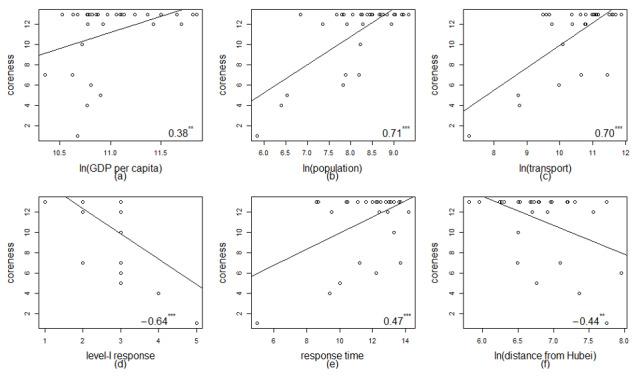
Only a small fraction of the provinces studied showed relatively strong outward or inward epidemic transmission effects. The three provinces of Hubei, Beijing, and Guangzhou showed the highest out-degrees, and the three highest in-degrees were observed for the provinces of Beijing, Henan, and Liaoning. In terms of the hierarchical structure of the COVID-19 epidemic network over the whole period, more than half of the 31 provinces were located in the innermost core. Considering the correlation of the characteristics and coreness of each province, we identified some significant negative and positive factors. Specific to the dynamic transmission process of the COVID-19 epidemic, three provinces of Anhui, Beijing, and Guangdong always showed the highest coreness from the third to the sixth week; meanwhile, Hubei Province maintained the highest coreness until the fifth week and then suddenly dropped to the lowest in the sixth week. We also found that the out-strengths of the innermost nodes were greater than their in-strengths before January 27, 2020, at which point a reversal occurred.
CONCLUSIONS
Increasing our understanding of how epidemic networks form and function may help reduce the damaging effects of COVID-19 in China as well as in other countries and territories worldwide.
背景
自 2019 年 12 月中国湖北省武汉市爆发 COVID-19 以来,频繁的区域间接触和高感染传播率促使疫情网络形成。
目的
本研究旨在确定有影响力的节点,并强调 COVID-19 疫情网络的隐藏结构特性,我们认为这是疫情防控的核心。
方法
我们首先构建了中国大陆 31 个省份之间的 COVID-19 疫情网络;在揭示了度分布等基本特征后,采用 k-核分解方法提供静态和动态证据,以确定有影响力的节点和层次结构。然后展示了上述节点的影响力及其演变。
结果
研究的少数省份表现出相对较强的外向或内向疫情传播效应。湖北、北京和广东三省的出度最高,而北京、河南和辽宁三省的入度最高。就整个时期 COVID-19 疫情网络的层次结构而言,31 个省份中有一半以上位于最内层核心。考虑到每个省份的特征和核心度的相关性,我们确定了一些显著的负相关和正相关因素。具体到 COVID-19 疫情的动态传播过程,安徽、北京和广东三省从第三周到第六周始终显示出最高的核心度;同时,湖北省的核心度一直保持到第五周,然后在第六周突然降至最低。我们还发现,最内层节点的出力度在 2020 年 1 月 27 日之前大于其入力度,在此之后发生了反转。
结论
加深对疫情网络形成和功能的理解,可能有助于减轻 COVID-19 在中国乃至全球其他国家和地区的破坏性影响。




 Zotero 插件