Department of Demography and Social Statistics, University of Southampton, Highfield Campus Building 58, Southampton, SO17 1BJ, UK.
Health Research and Social Development Forum-International, Kathmandu, Nepal.
J Urban Health. 2021 Feb;98(1):111-129. doi: 10.1007/s11524-020-00485-z. Epub 2020 Oct 27.
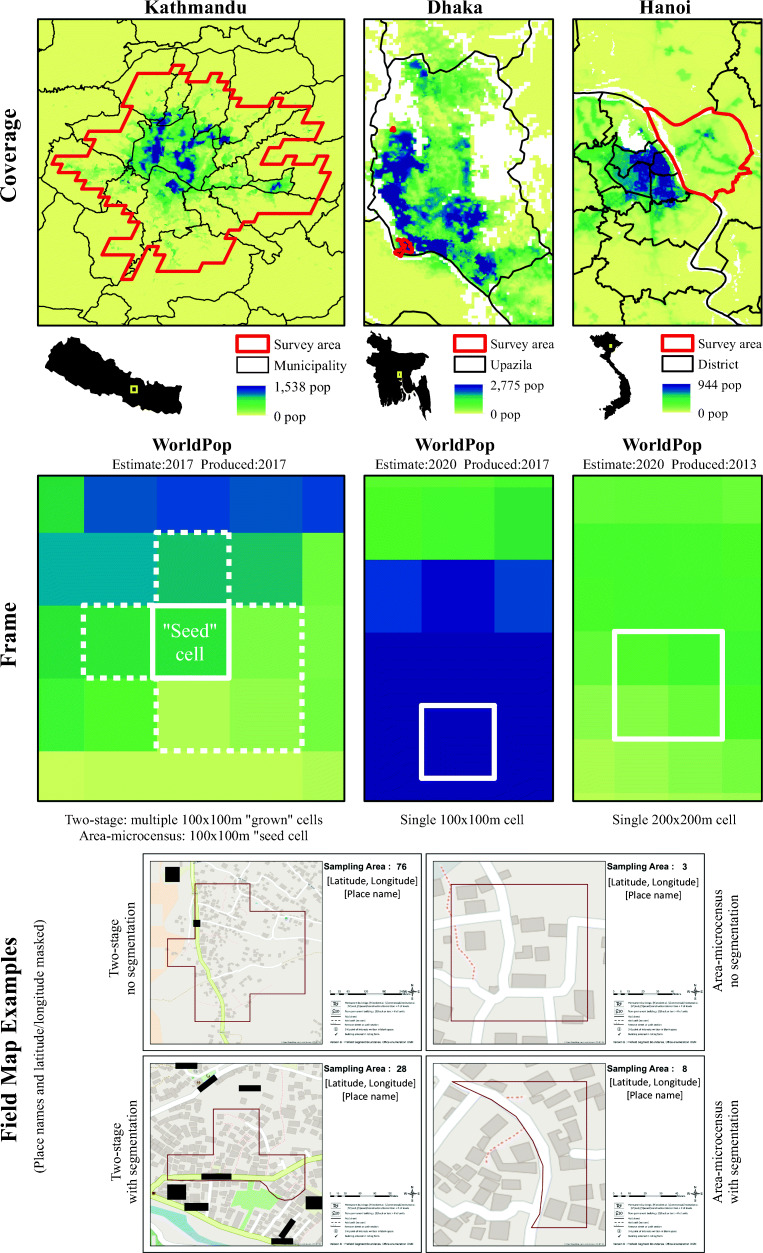
The methods used in low- and middle-income countries' (LMICs) household surveys have not changed in four decades; however, LMIC societies have changed substantially and now face unprecedented rates of urbanization and urbanization of poverty. This mismatch may result in unintentional exclusion of vulnerable and mobile urban populations. We compare three survey method innovations with standard survey methods in Kathmandu, Dhaka, and Hanoi and summarize feasibility of our innovative methods in terms of time, cost, skill requirements, and experiences. We used descriptive statistics and regression techniques to compare respondent characteristics in samples drawn with innovative versus standard survey designs and household definitions, adjusting for sample probability weights and clustering. Feasibility of innovative methods was evaluated using a thematic framework analysis of focus group discussions with survey field staff, and via survey planner budgets. We found that a common household definition excluded single adults (46.9%) and migrant-headed households (6.7%), as well as non-married (8.5%), unemployed (10.5%), disabled (9.3%), and studying adults (14.3%). Further, standard two-stage sampling resulted in fewer single adult and non-family households than an innovative area-microcensus design; however, two-stage sampling resulted in more tent and shack dwellers. Our survey innovations provided good value for money, and field staff experiences were neutral or positive. Staff recommended streamlining field tools and pairing technical and survey content experts during fieldwork. This evidence of exclusion of vulnerable and mobile urban populations in LMIC household surveys is deeply concerning and underscores the need to modernize survey methods and practices.
在过去的四十年中,中低收入国家(LMICs)的家庭调查方法并没有改变;然而,LMIC 社会发生了巨大变化,现在面临着前所未有的城市化和贫困城市化的速度。这种不匹配可能导致弱势和流动的城市人口被无意排斥在外。我们将三种调查方法创新与标准调查方法在加德满都、达卡和河内进行了比较,并根据时间、成本、技能要求和经验总结了我们创新方法的可行性。我们使用描述性统计和回归技术比较了使用创新与标准调查设计和家庭定义抽取的样本中的受访者特征,同时调整了样本概率权重和聚类。通过对调查规划者预算的主题框架分析以及与调查现场工作人员的焦点小组讨论,评估了创新方法的可行性。我们发现,一个共同的家庭定义排除了单身成年人(46.9%)和移民家庭(6.7%),以及未婚(8.5%)、失业(10.5%)、残疾(9.3%)和正在学习的成年人(14.3%)。此外,标准的两阶段抽样导致单身成年人和非家庭住户的数量少于创新的区域微观普查设计;然而,两阶段抽样导致了更多的帐篷和棚屋居民。我们的调查创新具有良好的成本效益,现场工作人员的经验是中性或积极的。工作人员建议在实地工作期间简化实地工具,并将技术和调查内容专家配对。这种在 LMIC 家庭调查中排斥弱势和流动的城市人口的证据令人深感关切,这突显了需要使调查方法和实践现代化。