Department of Thoracic Oncology, National Cancer Center Hospital, Tokyo, Japan.
Thorac Cancer. 2020 Dec;11(12):3585-3595. doi: 10.1111/1759-7714.13721. Epub 2020 Oct 27.
Programmed cell death ligand 1 (PD-L1) is known to have soluble forms aside from its membrane-bound forms. The aim of this study was to evaluate the predictive and prognostic values of serum soluble PD-L1 (sPD-L1) in patients with non-small cell lung cancer (NSCLC) who were treated with anti-PD-1 antibody.
A total of 233 patients were enrolled in this study. We assessed the level of serum sPD-L1 before anti-PD-1 antibody treatment (pembrolizumab or nivolumab) and evaluated the correlation with PD-L1 expression on tumor cells, the response to anti-PD-1 antibody treatment, and patient outcome.
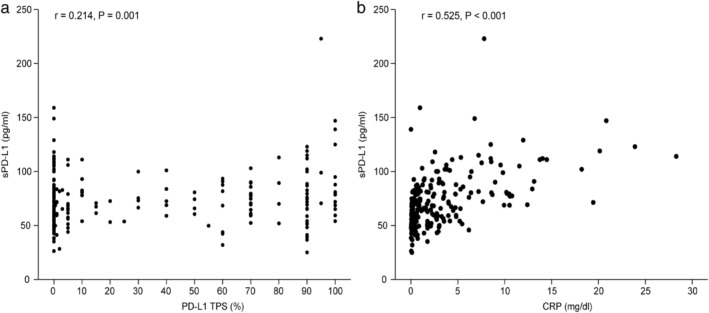
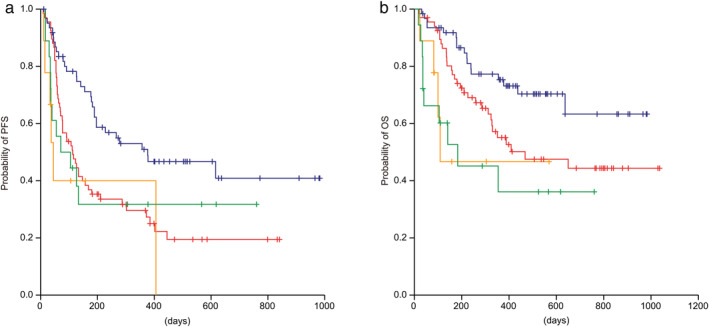
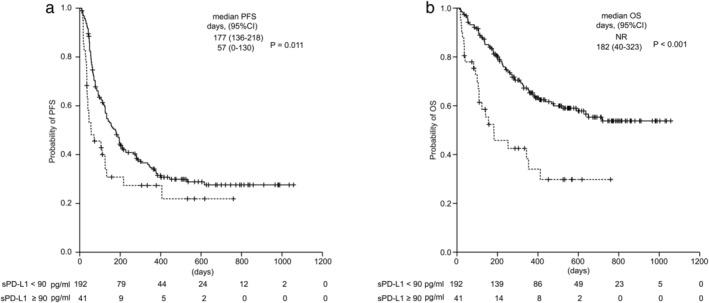
The median serum sPD-L1 concentration was 67.7 (range, 25 to 223) pg/mL. A weak correlation between serum sPD-L1 and tumor PD-L1 expression was observed. The disease control rate in the high sPD-L1 group (≥90 pg/mL) was significantly lower than that in the low sPD-L1 group (<90 pg/mL) (37% vs. 57%, P = 0.0158). The progression-free survival (PFS) and overall survival (OS) in the high sPD-L1 group were significantly shorter than those in the low sPD-L1 group (median PFS, 57 days vs. 177 days, P = 0.011; median OS, 182 days vs. not reached, P < 0.001). The high level of serum sPD-L1 was independently associated with a shorter PFS (hazard ratio [HR], 1.910; P = 0.061) and OS (HR, 2.073; P = 0.034) in multivariate analysis.
The serum sPD-L1 level, which was only weakly correlated with the tumor PD-L1 expression level, was an independent predictive and prognostic biomarker for NSCLC patients receiving anti-PD-1 antibody.
SIGNIFICANT FINDINGS OF THE STUDY: The disease control rate in the high sPD-L1 group was significantly lower than that in the low sPD-L1 group. The progression-free survival (PFS) and overall survival (OS) in the high sPD-L1 group were significantly shorter than those in the low sPD-L1 group. The high level of serum sPD-L1 was independently associated with a shorter PFS and OS in multivariate analysis.
This study demonstrated that serum sPD-L1 level was an independent predictive and prognostic biomarker for NSCLC patients receiving anti-PD-1 antibody.
除了膜结合形式外,程序性细胞死亡配体 1(PD-L1)已知还有可溶性形式。本研究的目的是评估血清可溶性 PD-L1(sPD-L1)在接受抗 PD-1 抗体治疗的非小细胞肺癌(NSCLC)患者中的预测和预后价值。
本研究共纳入 233 例患者。我们评估了抗 PD-1 抗体治疗(pembrolizumab 或 nivolumab)前血清 sPD-L1 水平,并评估了其与肿瘤细胞 PD-L1 表达、对抗 PD-1 抗体治疗的反应以及患者结局的相关性。
血清 sPD-L1 浓度的中位数为 67.7(范围 25 至 223)pg/mL。血清 sPD-L1 与肿瘤 PD-L1 表达之间存在弱相关性。高 sPD-L1 组(≥90 pg/mL)的疾病控制率明显低于低 sPD-L1 组(<90 pg/mL)(37%比 57%,P=0.0158)。高 sPD-L1 组的无进展生存期(PFS)和总生存期(OS)明显短于低 sPD-L1 组(中位 PFS,57 天比 177 天,P=0.011;中位 OS,182 天比未达到,P<0.001)。多变量分析显示,高血清 sPD-L1 水平与较短的 PFS(风险比 [HR],1.910;P=0.061)和 OS(HR,2.073;P=0.034)独立相关。
血清 sPD-L1 水平与肿瘤 PD-L1 表达水平仅呈弱相关性,是接受抗 PD-1 抗体治疗的 NSCLC 患者的独立预测和预后生物标志物。