Vecchiarelli Silvia, Passiglia Francesco, D'Incecco Armida, Gallo Marianna, De Luca Antonella, Rossi Elisa, D'Incà Federica, Minuti Gabriele, Landi Lorenza, Bennati Chiara, Spreafico Michela, D'Arcangelo Manolo, Mazza Valentina, Normanno Nicola, Cappuzzo Federico
Department of Oncology and Hematology, AUSL della Romagna, Ravenna, Italy.
Department of Surgical, Oncological and Stomatological Disciplines, University of Palermo, Palermo, Italy.
Oncotarget. 2018 Apr 3;9(25):17554-17563. doi: 10.18632/oncotarget.24785.
This study aimed at investigating feasibility of programmed death ligand-1 (PD-L1) testing in plasma samples of advanced NSCLC patients receiving first-line treatment, assessing whether circulating (c)PD-L1 levels were modified by the therapy and whether baseline cPD-L1 levels were associated with patients' clinical responses and survival outcome.
Peripheral blood samples were collected from 16 healthy volunteers and 56 newly diagnosed NSCLC patients before and at 12th week during the course of first-line therapy. The level of PD-L1 was measured in plasma samples using the human (PD-L1/CD274) ELISA kit (CUSABIO, MD, USA). The Mann Whitney test or Fisher's test were used for comparisons. Survival analysis was performed using Kaplan Meyer method, providing median and -value.
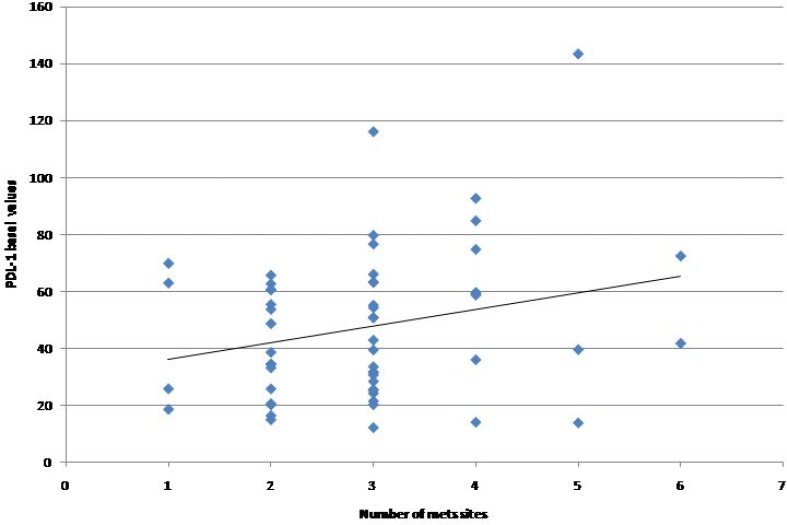
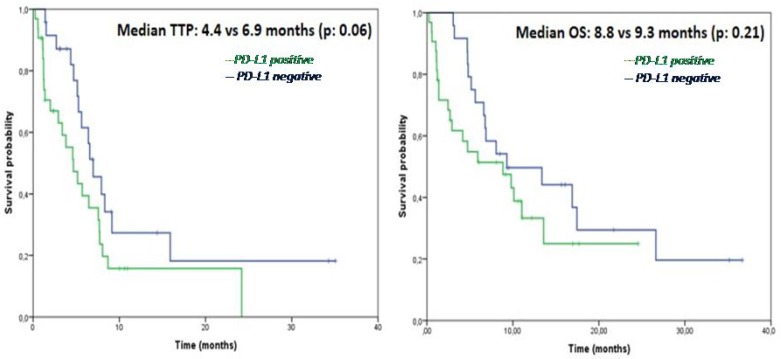
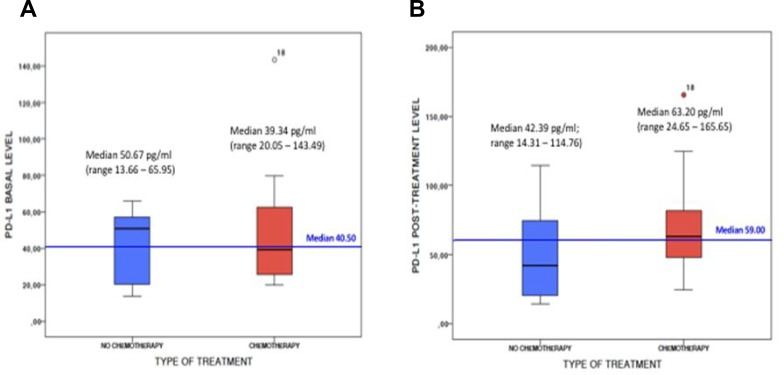
Baseline median cPD-L1 was 42.21 pg/ml (range 12.00-143.49) in NSCLC patients and 37.81 pg/ml (range 9.73-90.21) in healthy control cohort ( = 0.78). Median cPD-L1 increased in patients treated with first-line chemotherapy (63.20 pg/ml vs 39.34 pg/ml; = 0.002), with no changes in patients exposed to non-chemotherapy drugs (42.39 pg/ml vs 50.67 pg/ml; = 0.398). Time to progression and overall survival were 4.4 vs 6.9 months ( = 0.062) and 8.8 vs 9.3 months ( = 0.216) in cPD-L1 positive vs cPD-L1 negative patients. Baseline cPD-L1 levels increased with the ascending number of metastatic sites, even if the association was not statistically significant ( = 0.063).
This study showed that cPD-L1 testing is feasible, with chemotherapy influencing PD-L1 plasma levels. The possibility of using such test for predicting or monitoring the effect of immunotherapy or combination of chemotherapy and immunotherapy warrant further investigations.
本研究旨在探讨程序性死亡配体1(PD-L1)检测在接受一线治疗的晚期非小细胞肺癌(NSCLC)患者血浆样本中的可行性,评估循环(c)PD-L1水平是否因治疗而改变,以及基线cPD-L1水平是否与患者的临床反应和生存结果相关。
在一线治疗过程中,于治疗前及第12周采集了16名健康志愿者和56名新诊断的NSCLC患者的外周血样本。使用人(PD-L1/CD274)ELISA试剂盒(CUSABIO,美国马里兰州)检测血浆样本中PD-L1的水平。采用Mann Whitney检验或Fisher检验进行比较。使用Kaplan Meyer方法进行生存分析,给出中位数和P值。
NSCLC患者基线cPD-L1中位数为42.21 pg/ml(范围12.00 - 143.49),健康对照队列中为37.81 pg/ml(范围9.73 - 90.21)(P = 0.78)。一线化疗患者的cPD-L1中位数升高(63.20 pg/ml对39.34 pg/ml;P = 0.002),接受非化疗药物治疗的患者无变化(42.39 pg/ml对50.67 pg/ml;P = 0.398)。cPD-L1阳性患者与cPD-L1阴性患者的疾病进展时间分别为4.4个月对6.9个月(P = 0.062),总生存期分别为8.8个月对9.3个月(P = 0.216)。即使相关性无统计学意义(P = 0.063),基线cPD-L1水平也随转移部位数量的增加而升高。
本研究表明cPD-L1检测是可行的,化疗会影响PD-L1血浆水平。使用此类检测来预测或监测免疫治疗或化疗与免疫治疗联合效果的可能性值得进一步研究。