Department of Medical Oncology, National Cancer Center/National Clinical Research Center for Cancer/Cancer Hospital, Chinese Academy of Medical Sciences & Peking Union Medical College, Beijing Key Laboratory of Clinical Study On Anticancer Molecular Targeted Drugs, No. 17 Panjiayuan Nanli, Chaoyang District, Beijing, 100021, China.
J Hematol Oncol. 2020 Oct 27;13(1):143. doi: 10.1186/s13045-020-00977-0.
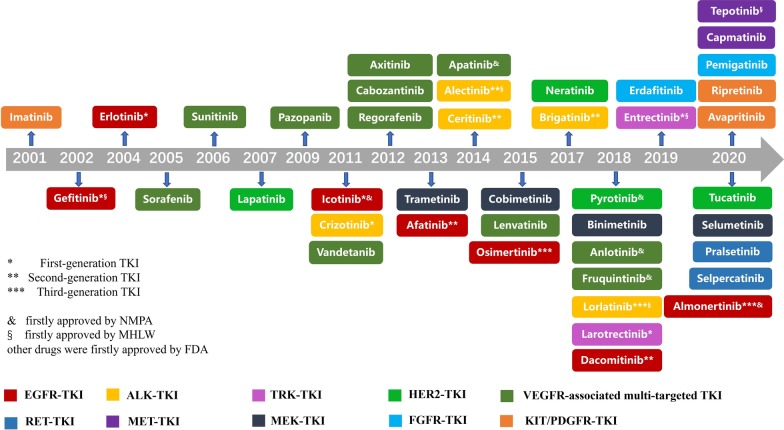
Tyrosine kinases are implicated in tumorigenesis and progression, and have emerged as major targets for drug discovery. Tyrosine kinase inhibitors (TKIs) inhibit corresponding kinases from phosphorylating tyrosine residues of their substrates and then block the activation of downstream signaling pathways. Over the past 20 years, multiple robust and well-tolerated TKIs with single or multiple targets including EGFR, ALK, ROS1, HER2, NTRK, VEGFR, RET, MET, MEK, FGFR, PDGFR, and KIT have been developed, contributing to the realization of precision cancer medicine based on individual patient's genetic alteration features. TKIs have dramatically improved patients' survival and quality of life, and shifted treatment paradigm of various solid tumors. In this article, we summarized the developing history of TKIs for treatment of solid tumors, aiming to provide up-to-date evidence for clinical decision-making and insight for future studies.
酪氨酸激酶在肿瘤的发生和发展中起作用,已成为药物发现的主要靶点。酪氨酸激酶抑制剂(TKI)抑制相应的激酶使底物的酪氨酸残基磷酸化,然后阻断下游信号通路的激活。在过去的 20 年中,已经开发出多种具有单靶点或多靶点的、疗效确切且耐受性良好的 TKI,包括 EGFR、ALK、ROS1、HER2、NTRK、VEGFR、RET、MET、MEK、FGFR、PDGFR 和 KIT,推动了基于个体患者遗传改变特征的精准肿瘤医学的实现。TKI 显著提高了患者的生存率和生活质量,改变了各种实体瘤的治疗模式。本文总结了 TKI 治疗实体瘤的发展历程,旨在为临床决策提供最新证据,并为未来的研究提供思路。