Department of Epidemiology and Biostatistics, University of California San Francisco, San Francisco, CA, USA.
Department of Neurological Surgery, University of California San Francisco, San Francisco, CA, USA.
Genome Med. 2020 Oct 27;12(1):93. doi: 10.1186/s13073-020-00790-x.
Humans and viruses have co-evolved for millennia resulting in a complex host genetic architecture. Understanding the genetic mechanisms of immune response to viral infection provides insight into disease etiology and therapeutic opportunities.
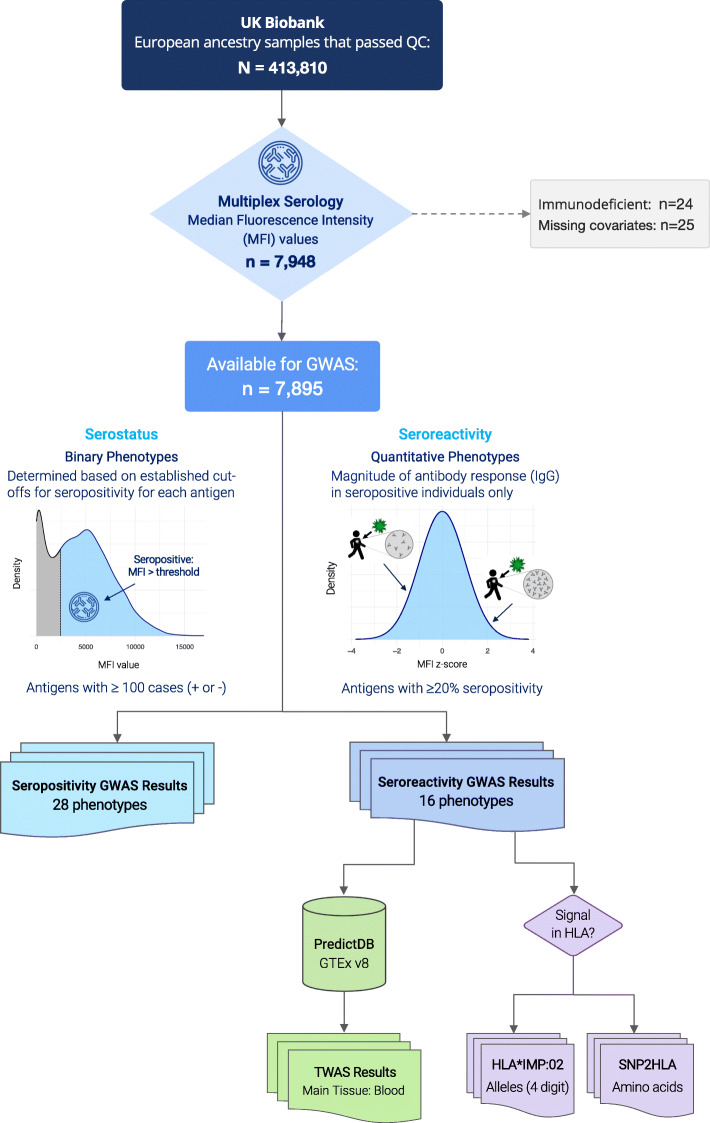
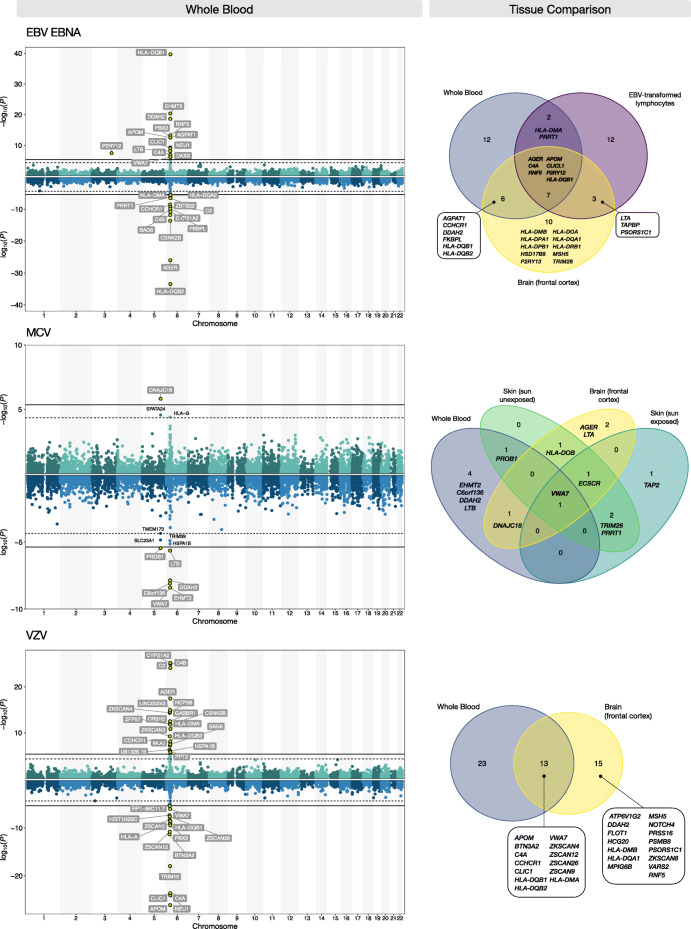
We conducted a comprehensive study including genome-wide and transcriptome-wide association analyses to identify genetic loci associated with immunoglobulin G antibody response to 28 antigens for 16 viruses using serological data from 7924 European ancestry participants in the UK Biobank cohort.
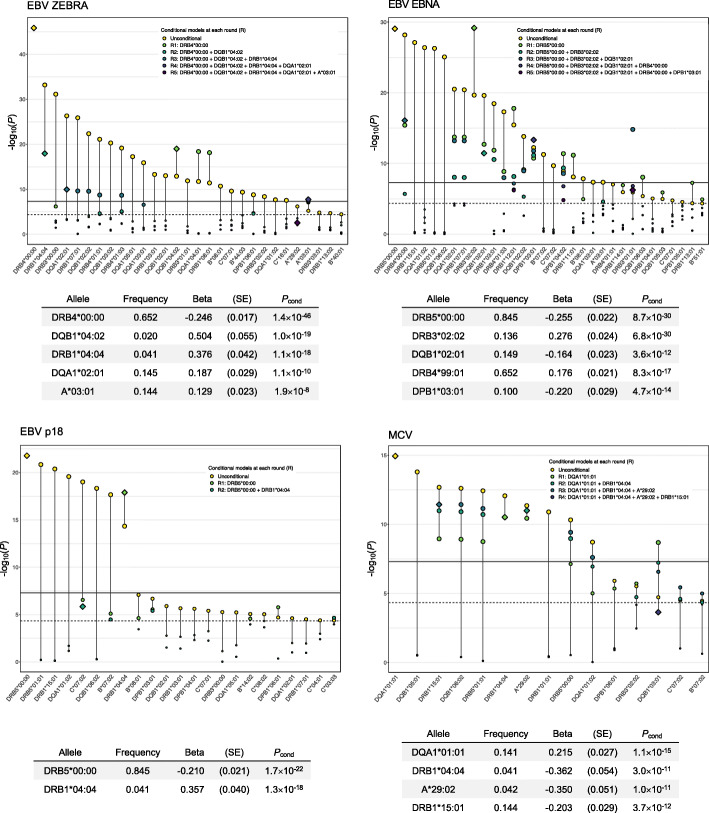
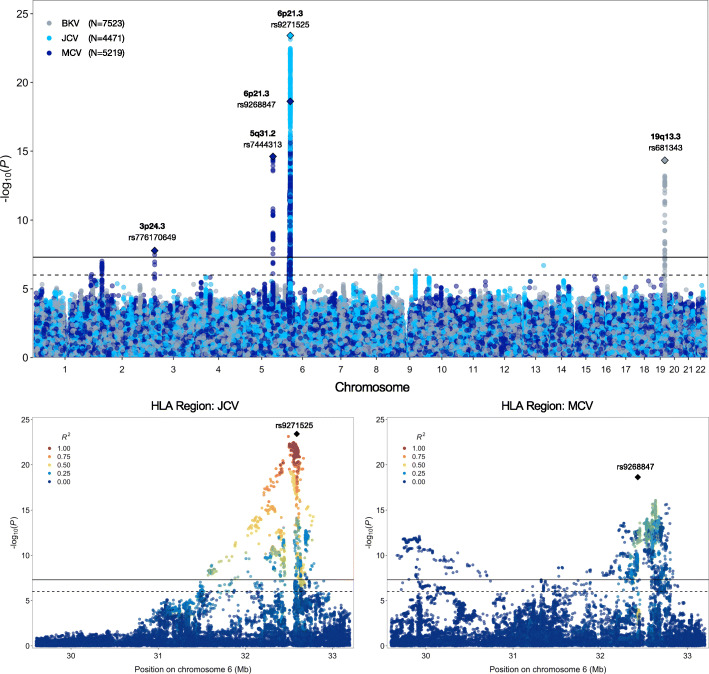
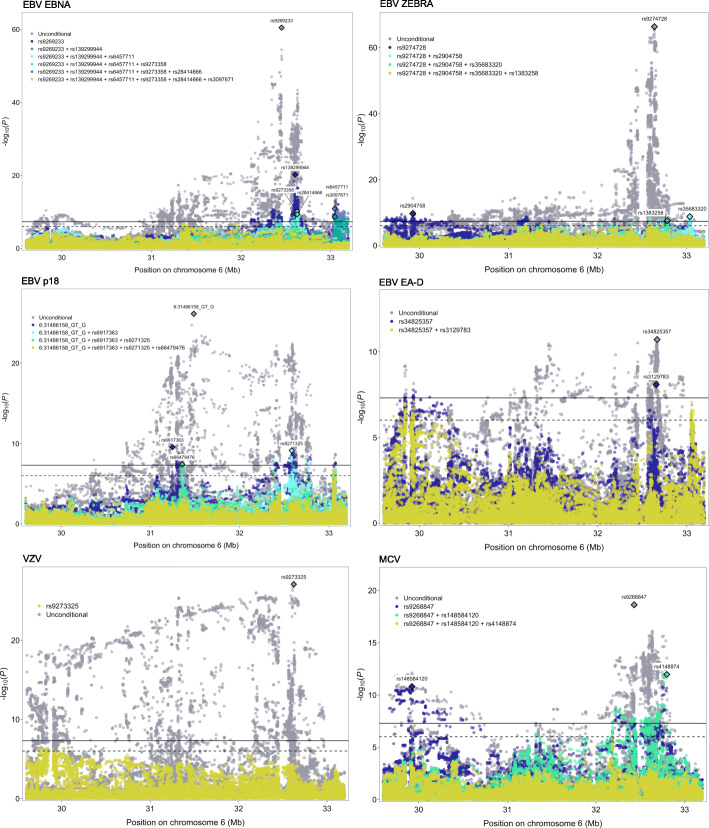
Signals in human leukocyte antigen (HLA) class II region dominated the landscape of viral antibody response, with 40 independent loci and 14 independent classical alleles, 7 of which exhibited pleiotropic effects across viral families. We identified specific amino acid (AA) residues that are associated with seroreactivity, the strongest associations presented in a range of AA positions within DRβ1 at positions 11, 13, 71, and 74 for Epstein-Barr virus (EBV), Varicella zoster virus (VZV), human herpesvirus 7, (HHV7), and Merkel cell polyomavirus (MCV). Genome-wide association analyses discovered 7 novel genetic loci outside the HLA associated with viral antibody response (P < 5.0 × 10), including FUT2 (19q13.33) for human polyomavirus BK (BKV), STING1 (5q31.2) for MCV, and CXCR5 (11q23.3) and TBKBP1 (17q21.32) for HHV7. Transcriptome-wide association analyses identified 114 genes associated with response to viral infection, 12 outside of the HLA region, including ECSCR: P = 5.0 × 10 (MCV), NTN5: P = 1.1 × 10 (BKV), and P2RY13: P = 1.1 × 10 EBV nuclear antigen. We also demonstrated pleiotropy between viral response genes and complex diseases, from autoimmune disorders to cancer to neurodegenerative and psychiatric conditions.
Our study confirms the importance of the HLA region in host response to viral infection and elucidates novel genetic determinants beyond the HLA that contribute to host-virus interaction.
人类和病毒已经共同进化了几千年,从而形成了复杂的宿主遗传结构。了解免疫反应对病毒感染的遗传机制可以深入了解疾病的病因和治疗机会。
我们进行了一项全面的研究,包括全基因组和转录组关联分析,以使用来自英国生物库队列的 7924 名欧洲血统参与者的血清学数据,鉴定与 16 种病毒的 28 种抗原的免疫球蛋白 G 抗体反应相关的遗传位点。
人类白细胞抗原(HLA)Ⅱ类区域的信号主导了病毒抗体反应的格局,有 40 个独立的位点和 14 个独立的经典等位基因,其中 7 个在病毒家族之间表现出多效性。我们确定了与血清反应性相关的特定氨基酸(AA)残基,最强的关联出现在 EBV、VZV、HHV7 和 MCV 的 DRβ1 中 11、13、71 和 74 位的一系列 AA 位置。全基因组关联分析发现了与病毒抗体反应相关的 HLA 之外的 7 个新的遗传位点(P < 5.0 × 10),包括 19q13.33 上的 FUT2(BKV)、5q31.2 上的 STING1(MCV)、11q23.3 上的 CXCR5 和 17q21.32 上的 TBKBP1(HHV7)。转录组关联分析确定了 114 个与病毒感染反应相关的基因,其中 12 个位于 HLA 区域之外,包括 ECSCR:P = 5.0 × 10(MCV)、NTN5:P = 1.1 × 10(BKV)和 P2RY13:P = 1.1 × 10 EBV 核抗原。我们还证明了病毒反应基因与自身免疫性疾病、癌症、神经退行性疾病和精神疾病等复杂疾病之间的多效性。
我们的研究证实了 HLA 区域在宿主对病毒感染的反应中的重要性,并阐明了 HLA 以外参与宿主-病毒相互作用的新遗传决定因素。