Werth Annette, Gravino Pietro, Prevedello Giulio
Sony Computer Science Laboratories, 6 Rue Amyot, 75005 Paris, France.
Appl Energy. 2021 Jan 1;281:116045. doi: 10.1016/j.apenergy.2020.116045. Epub 2020 Oct 22.
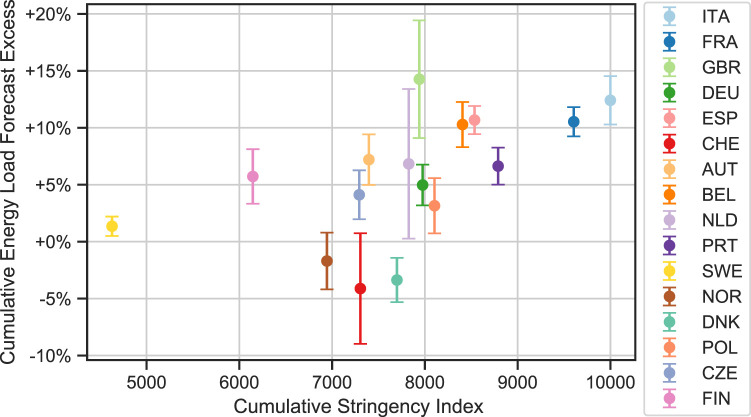
When COVID-19 pandemic spread in Europe, governments imposed unprecedented confinement measures with mostly unknown repercussions on contemporary societies. In some cases, a considerable drop in energy consumption was observed, anticipating a scenario of sizable low-cost energy generation, from renewable sources, expected only for years later. In this paper, the impact of governmental restrictions on electrical load, generation and transmission was investigated in 16 European countries. Using the indices provided by the Oxford COVID-19 Government Response Tracker, precise restriction types were found to correlate with the load drop. Then the European grid was analysed to assess how the load drop was balanced by the change in generation and transmission patterns. The same restriction period from 2020 was compared to previous years, accounting for yearly variability with ad hoc statistical technique. As a result, generation was found to be heavily impacted in most countries with significant load drop. Overall, generation from nuclear, and fossil coal and gas sources was reduced, in favour of renewables and, in some countries, fossil gas. Moreover, intermittent renewables generation increased in most countries without indicating an exceptional amount of curtailments. Finally, the European grid helped balance those changes with an increase in both energy exports and imports, with some net exporting countries becoming net importers, notably Germany, and vice versa. Together, these findings show the far reaching implications of the COVID-19 crisis, and contribute to the understanding and planning of higher renewables share scenarios, which will become more prevalent in the battle against climate change.
当新冠疫情在欧洲蔓延时,各国政府实施了前所未有的封锁措施,其对当代社会的影响大多未知。在某些情况下,人们观察到能源消耗大幅下降,预计这将带来大规模低成本可再生能源发电的局面,而这种局面原本预计要数年之后才会出现。本文研究了16个欧洲国家政府限制措施对电力负荷、发电和输电的影响。利用牛津新冠疫情政府应对追踪器提供的指数,发现精确的限制类型与负荷下降相关。然后对欧洲电网进行分析,以评估负荷下降是如何通过发电和输电模式的变化来平衡的。将2020年相同的限制期与前几年进行比较,采用专门的统计技术来考虑年度变化。结果发现,在大多数负荷大幅下降的国家,发电受到了严重影响。总体而言,核能、化石煤和天然气发电减少,转而有利于可再生能源,在一些国家则有利于化石天然气。此外,大多数国家间歇性可再生能源发电量增加,且没有出现大量削减的情况。最后,欧洲电网通过增加能源出口和进口来帮助平衡这些变化,一些净出口国变成了净进口国,尤其是德国,反之亦然。这些发现共同表明了新冠疫情危机的深远影响,并有助于理解和规划更高比例可再生能源的情景,这在应对气候变化的斗争中将变得更加普遍。