Krajnik Bartosz, Golacki Lukasz W, Kostiv Uliana, Horák Daniel, Podhorodecki Artur
Department of Experimental Physics, Wroclaw University of Science and Technology, Wybrzeże Wyspiańskiego 27, 50-370 Wroclaw, Poland.
Institute of Macromolecular Chemistry, Czech Academy of Sciences, Heyrovského nám. 2, 162 06 Prague 6, Czech Republic.
ACS Omega. 2020 Oct 6;5(41):26537-26544. doi: 10.1021/acsomega.0c03252. eCollection 2020 Oct 20.
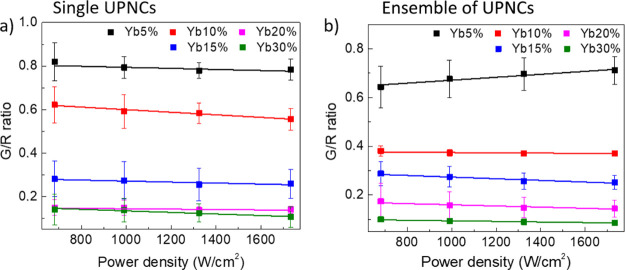
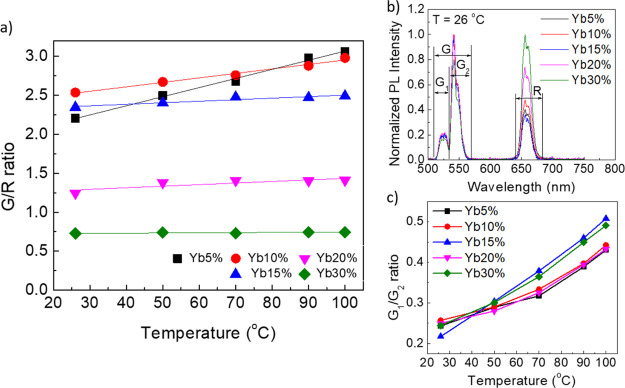
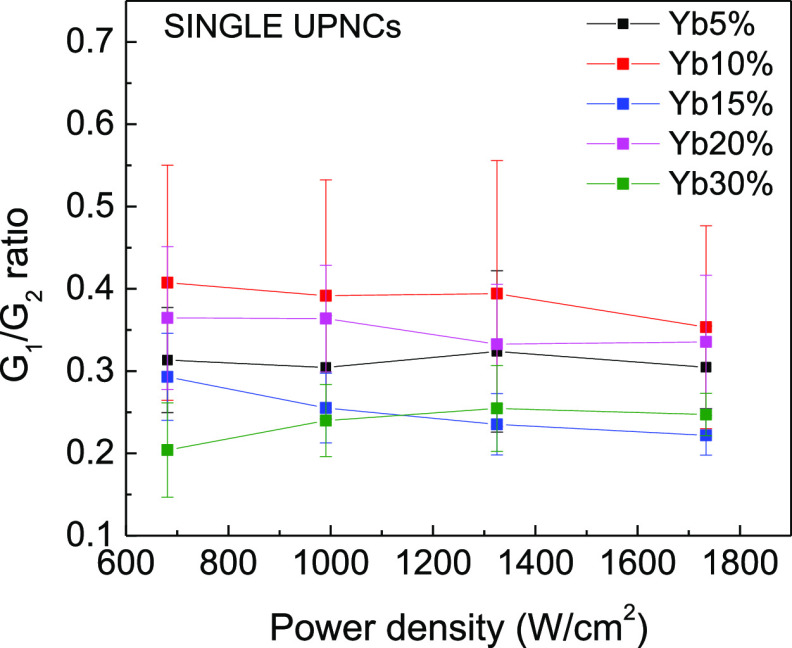
Development of upconverting nanomaterials which are able to emit visible light upon near-infrared excitation opens a wide range of potential applications. Because of their remarkable photostability, they are widely used in bioimaging, optogenetics, and optoelectronics. In this work, we demonstrate the influence of several experimental conditions as well as a dopant concentration on the luminescence properties of upconverting nanocrystals (UPNCs) that need to be taken into account for their efficient use in the practical applications. We found that not only nanoparticle architecture affects the optical properties of UPNCs, but also factors such as sample concentration, excitation light power density, and temperature may influence the green-to-red emission ratio. We performed studies on both the single-nanoparticle and ensemble levels over a broad concentration range and found the heterogeneity in the optical properties of UPNCs with low dopant concentrations.
能够在近红外激发下发射可见光的上转换纳米材料的开发开启了广泛的潜在应用。由于其卓越的光稳定性,它们被广泛应用于生物成像、光遗传学和光电子学领域。在这项工作中,我们展示了几个实验条件以及掺杂剂浓度对上转换纳米晶体(UPNCs)发光特性的影响,在其实际应用中高效使用时需要考虑这些影响。我们发现不仅纳米颗粒结构会影响UPNCs的光学性质,而且诸如样品浓度、激发光功率密度和温度等因素也可能影响绿到红的发射比率。我们在很宽的浓度范围内对单纳米颗粒和整体水平都进行了研究,并且发现了低掺杂浓度的UPNCs光学性质的异质性。