Department of Computational Medicine and Bioinformatics, University of Michigan, Ann Arbor, Michigan, USA.
Department of Biostatistics, School of Public Health, University of Michigan, Ann Arbor, Michigan, USA.
Reproduction. 2020 Dec;160(6):R155-R167. doi: 10.1530/REP-20-0231.
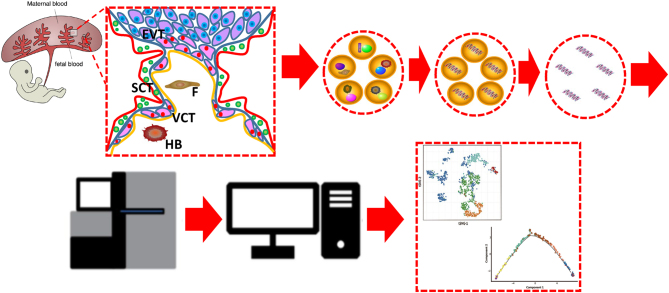
Human placenta is a complex and heterogeneous organ interfacing between the mother and the fetus that supports fetal development. Alterations to placental structural components are associated with various pregnancy complications. To reveal the heterogeneity among various placenta cell types in normal and diseased placentas, as well as elucidate molecular interactions within a population of placental cells, a new genomics technology called single cell RNA-seq (or scRNA-seq) has been employed in the last couple of years. Here we review the principles of scRNA-seq technology, and summarize the recent human placenta studies at scRNA-seq level across gestational ages as well as in pregnancy complications, such as preterm birth and preeclampsia. We list the computational analysis platforms and resources available for the public use. Lastly, we discuss the future areas of interest for placenta single cell studies, as well as the data analytics needed to accomplish them.
人类胎盘是一种复杂的异质器官,位于母体和胎儿之间,为胎儿发育提供支持。胎盘结构成分的改变与各种妊娠并发症有关。为了揭示正常和患病胎盘各种胎盘细胞类型之间的异质性,以及阐明胎盘细胞群体内的分子相互作用,一种新的基因组学技术,即单细胞 RNA 测序(或 scRNA-seq),在过去几年中得到了应用。在这里,我们回顾了 scRNA-seq 技术的原理,并总结了最近在单细胞 RNA 测序水平上对人类胎盘的研究,包括妊娠年龄以及早产和子痫前期等妊娠并发症。我们列出了可用于公共使用的计算分析平台和资源。最后,我们讨论了胎盘单细胞研究的未来感兴趣领域,以及完成这些研究所需的数据分析。