Department of Psychology, St. Louis Children's Hospital, St Louis, Missouri, USA.
Department of Pediatrics, Washington University School of Medicine, St Louis, Missouri, USA.
Psychooncology. 2021 Mar;30(3):349-360. doi: 10.1002/pon.5584. Epub 2020 Nov 9.
To delineate the impact of treatment exposures and chronic health conditions on psychological, educational, and social outcomes in adolescent survivors of Wilms tumor.
Parent reports from the Childhood Cancer Survivor Study were analyzed for 666 adolescent survivors of Wilms tumor and 698 adolescent siblings. Adjusting for race and household income, survivors were compared to siblings on the Behavior Problems Index and educational outcomes. Multivariable modified Poisson regression estimated relative risks (RR) for therapeutic exposures and chronic health conditions (CTCAE 4.03 graded) among survivors, adjusting for sex, race, income, and age at diagnosis.
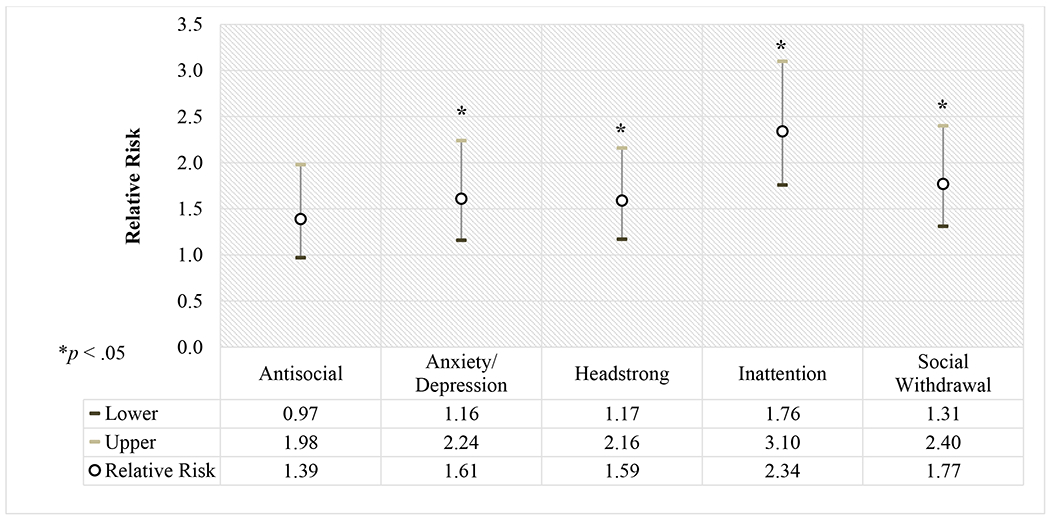
Compared to siblings, adolescent survivors of Wilms tumor were more likely to take psychoactive medication (9.4% vs. 5.1%, p < 0.001) and utilize special education services (25.5% vs. 12.6%, p < 0.001) but did not differ significantly in emotional and behavioral problems. Survivors were less likely to be friendless (7.2% vs. 10.1%, p = 0.04) but were more likely to have difficulty getting along with friends (14.5% vs. 7.8%, p < 0.001). Among survivors, use of special education services was associated with abdomen plus chest radiation (RR = 1.98, CI:1.18-3.34). Those with grade 2-4 cardiovascular conditions had higher risk for anxiety/depression (RR = 1.95, CI:1.19-3.19), headstrong behaviors (RR = 1.91, CI:1.26-2.89), and inattention (RR = 1.56, CI:1.02-2.40).
Adolescent survivors of Wilms tumor were similar to siblings with respect to mental health concerns overall but were more likely to require special education. Monitoring of psychosocial and academic problems through adolescence is warranted, especially among those treated with radiation to the abdomen plus chest or with cardiac conditions.
描绘治疗暴露和慢性健康状况对青少年 Wilms 肿瘤幸存者心理、教育和社会结果的影响。
对童年癌症幸存者研究中的 666 名青少年 Wilms 肿瘤幸存者和 698 名青少年同胞的家长报告进行了分析。在调整种族和家庭收入后,将幸存者与同胞的行为问题指数和教育结果进行了比较。多变量修正泊松回归估计了幸存者中治疗暴露和慢性健康状况(CTCAE 4.03 分级)的相对风险(RR),调整了性别、种族、收入和诊断时的年龄。
与同胞相比,青少年 Wilms 肿瘤幸存者更有可能服用精神药物(9.4%比 5.1%,p<0.001)和接受特殊教育服务(25.5%比 12.6%,p<0.001),但在情绪和行为问题上无显著差异。幸存者不太可能没有朋友(7.2%比 10.1%,p=0.04),但更有可能与朋友相处困难(14.5%比 7.8%,p<0.001)。在幸存者中,特殊教育服务的使用与腹部加胸部放疗相关(RR=1.98,CI:1.18-3.34)。患有 2-4 级心血管疾病的患者焦虑/抑郁风险更高(RR=1.95,CI:1.19-3.19)、倔强行为(RR=1.91,CI:1.26-2.89)和注意力不集中(RR=1.56,CI:1.02-2.40)。
青少年 Wilms 肿瘤幸存者在总体心理健康方面与同胞相似,但更有可能需要特殊教育。需要通过青春期监测心理社会和学业问题,尤其是那些接受腹部加胸部放疗或患有心脏疾病的患者。