Hesse Janina, Malhan Deeksha, Yalҫin Müge, Aboumanify Ouda, Basti Alireza, Relógio Angela
Institute for Theoretical Biology (ITB), Charité-Universitätsmedizin Berlin, corporate member of Freie Universität Berlin, Humboldt-Universität zu Berlin and Berlin Institute of Health, 10117 Berlin, Germany.
Molecular Cancer Research Center (MKFZ), Medical Department of Hematology, Oncology and Tumor Immunology, Charité-Universitätsmedizin Berlin, corporate member of Freie Universität Berlin Humboldt-Universität zu Berlin and Berlin Institute of Health, 10117 Berlin, Germany.
Cancers (Basel). 2020 Oct 23;12(11):3103. doi: 10.3390/cancers12113103.
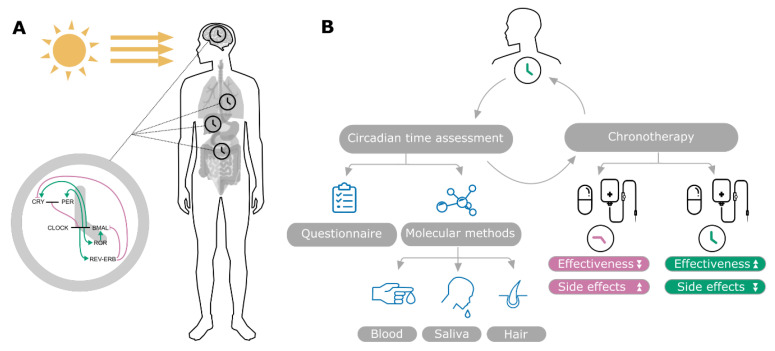
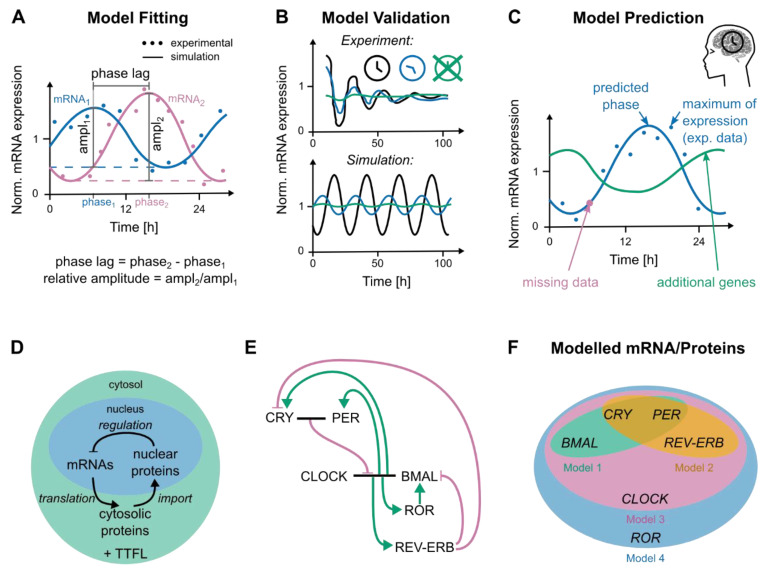
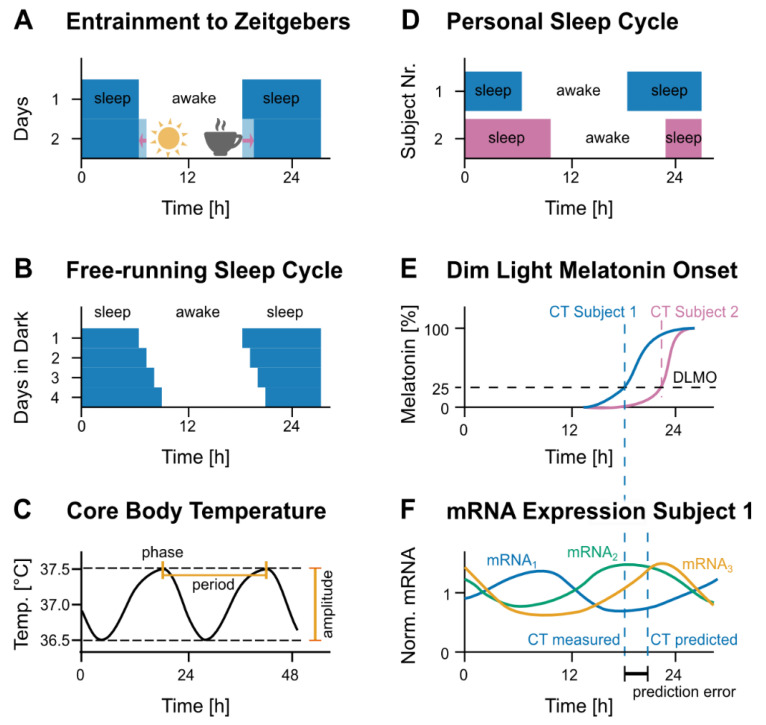
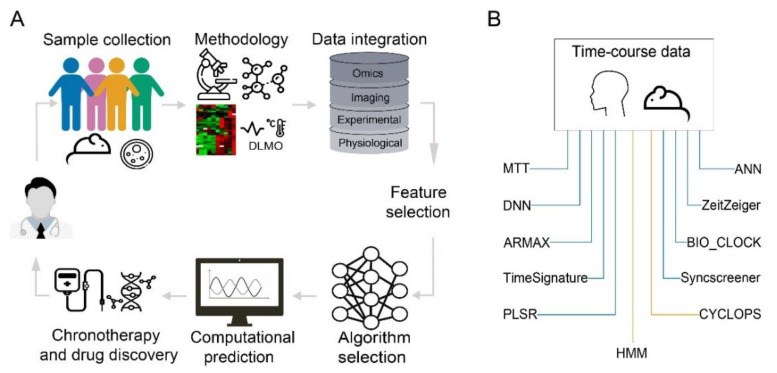
Tailoring medical interventions to a particular patient and pathology has been termed personalized medicine. The outcome of cancer treatments is improved when the intervention is timed in accordance with the patient's internal time. Yet, one challenge of personalized medicine is how to consider the biological time of the patient. Prerequisite for this so-called chronotherapy is an accurate characterization of the internal circadian time of the patient. As an alternative to time-consuming measurements in a sleep-laboratory, recent studies in chronobiology predict circadian time by applying machine learning approaches and mathematical modelling to easier accessible observables such as gene expression. Embedding these results into the mathematical dynamics between clock and cancer in mammals, we review the precision of predictions and the potential usage with respect to cancer treatment and discuss whether the patient's internal time and circadian observables, may provide an additional indication for individualized treatment timing. Besides the health improvement, timing treatment may imply financial advantages, by ameliorating side effects of treatments, thus reducing costs. Summarizing the advances of recent years, this review brings together the current clinical standard for measuring biological time, the general assessment of circadian rhythmicity, the usage of rhythmic variables to predict biological time and models of circadian rhythmicity.
根据特定患者和病理情况量身定制医疗干预措施被称为个性化医疗。当干预措施与患者的内在时间同步时,癌症治疗的效果会得到改善。然而,个性化医疗面临的一个挑战是如何考虑患者的生物时间。这种所谓的时间疗法的前提是准确表征患者的内在昼夜节律时间。作为在睡眠实验室进行耗时测量的替代方法,近年来生物钟学的研究通过将机器学习方法和数学模型应用于更容易获取的可观测指标(如基因表达)来预测昼夜节律时间。将这些结果融入哺乳动物生物钟与癌症之间的数学动态关系中,我们回顾了预测的精度以及在癌症治疗方面的潜在用途,并讨论患者的内在时间和昼夜节律可观测指标是否可以为个性化治疗时机提供额外的指示。除了改善健康状况外,适时治疗还可能带来经济优势,因为它可以减轻治疗的副作用,从而降低成本。总结近年来的进展,本综述汇集了当前测量生物时间的临床标准、昼夜节律性的总体评估、使用节律变量预测生物时间以及昼夜节律模型。