University of Lille, Inserm, CHU Lille, Institut Pasteur de Lille, U1011-EGID, Lille, France.
Front Immunol. 2020 Jul 31;11:1630. doi: 10.3389/fimmu.2020.01630. eCollection 2020.
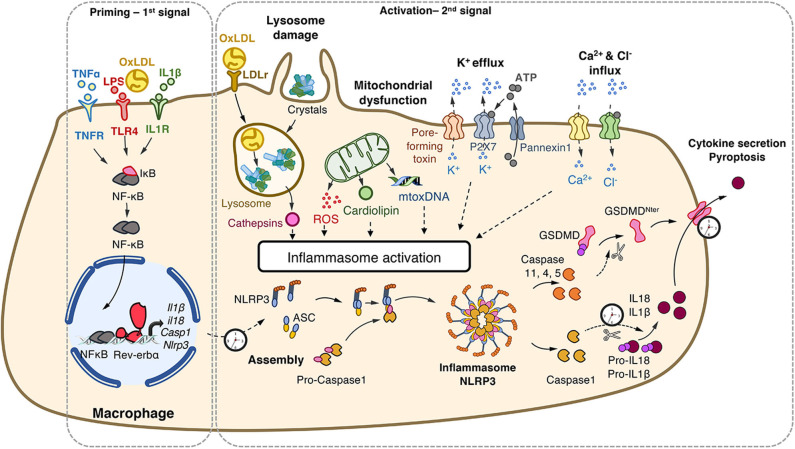
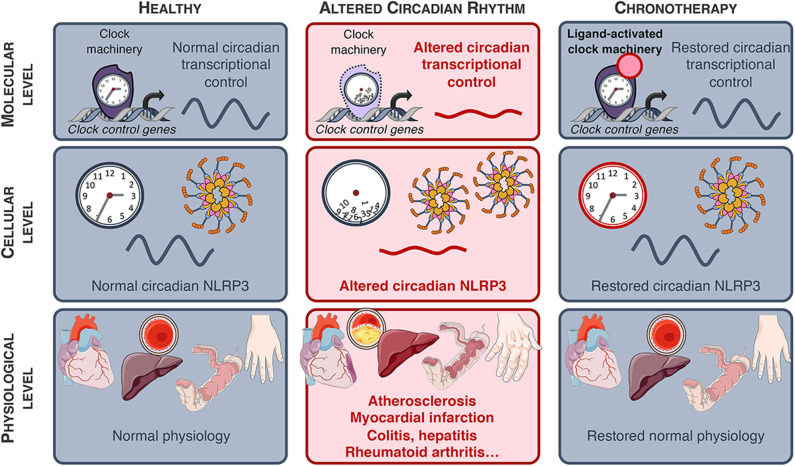
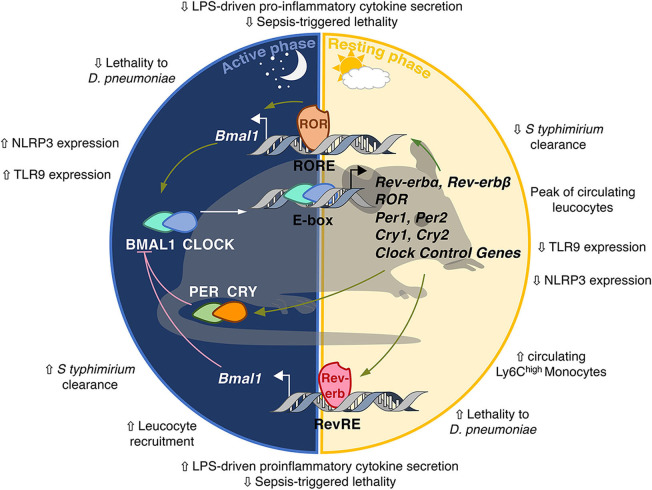
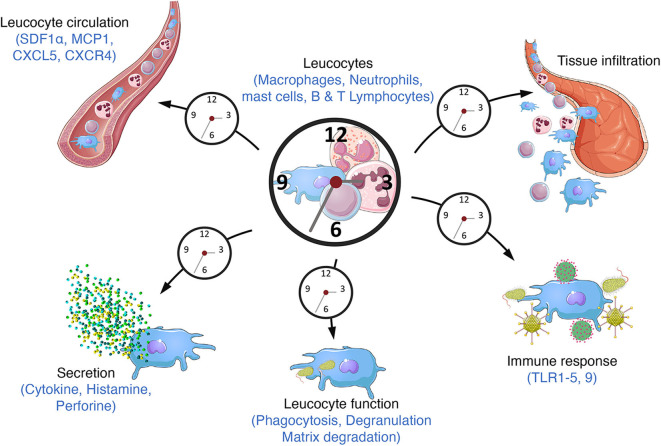
The innate immune system senses "non-self" molecules derived from pathogens (PAMPs) as well as endogenous damage-associated molecular patterns (DAMPs) and promotes sterile inflammation that is necessary for injury resolution, tissue repair/regeneration, and homeostasis. The NOD-, LRR- and pyrin domain containing protein 3 (NLRP3) is an innate immune signaling complex whose assembly and activation can be triggered by various signals ranging from microbial molecules to ATP or the abnormal accumulation of crystals, thus leading to IL-1β and IL-18 maturation and secretion. Deregulation of the NLRP3 signaling cascade is associated with numerous inflammatory and metabolic diseases including rheumatoid arthritis, gout, atherosclerosis or type 2 diabetes. Interestingly, the circadian clock controls numerous inflammatory processes while clock disruption leads to or exacerbates inflammation. Recently, the biological clock was demonstrated to control NLRP3 expression and activation, thereby controlling IL-1β and IL-18 secretion in diverse tissues and immune cells, particularly macrophages. Circadian oscillations of NLRP3 signaling is lost in models of clock disruption, contributing to the development of peritonitis, hepatitis, or colitis. Sterile inflammation is also an important driver of atherosclerosis, and targeting the production of IL-1β has proven to be a promising approach for atherosclerosis management in humans. Interestingly, the extent of injury after fulminant hepatitis or myocardial infarction is time-of-day dependent under the control of the clock, and chronotherapy represents a promising approach for the management of pathologies involving deregulation of NLRP3 signaling.
天然免疫系统可以识别来自病原体(PAMPs)的“非自身”分子以及内源性损伤相关分子模式(DAMPs),并促进无菌性炎症,这对于损伤的解决、组织修复/再生和体内平衡是必要的。NOD、LRR 和 pyrin 结构域包含蛋白 3(NLRP3)是一种天然免疫信号复合物,其组装和激活可以被多种信号触发,从微生物分子到 ATP 或晶体的异常积累,从而导致 IL-1β 和 IL-18 的成熟和分泌。NLRP3 信号级联的失调与许多炎症和代谢疾病有关,包括类风湿关节炎、痛风、动脉粥样硬化或 2 型糖尿病。有趣的是,生物钟控制着许多炎症过程,而时钟的破坏会导致或加剧炎症。最近,生物时钟被证明可以控制 NLRP3 的表达和激活,从而控制各种组织和免疫细胞,特别是巨噬细胞中 IL-1β 和 IL-18 的分泌。在时钟破坏的模型中,NLRP3 信号的昼夜节律性振荡丧失,导致腹膜炎、肝炎或结肠炎的发生。无菌性炎症也是动脉粥样硬化的一个重要驱动因素,靶向 IL-1β 的产生已被证明是人类动脉粥样硬化管理的一种很有前途的方法。有趣的是,在时钟的控制下,暴发性肝炎或心肌梗死后的损伤程度与时间有关,时间治疗代表了一种有前途的方法,可以管理涉及 NLRP3 信号失调的病理。