Centre of Molecular and Macromolecular Studies, Polish Academy of Sciences, Sienkiewicza 112, 90-362 Lodz, Poland.
Polymer Institute, Slovak Academy of Sciences, Dubravska Cesta 9, 845 41 Bratislava, Slovakia.
Molecules. 2020 Oct 23;25(21):4919. doi: 10.3390/molecules25214919.
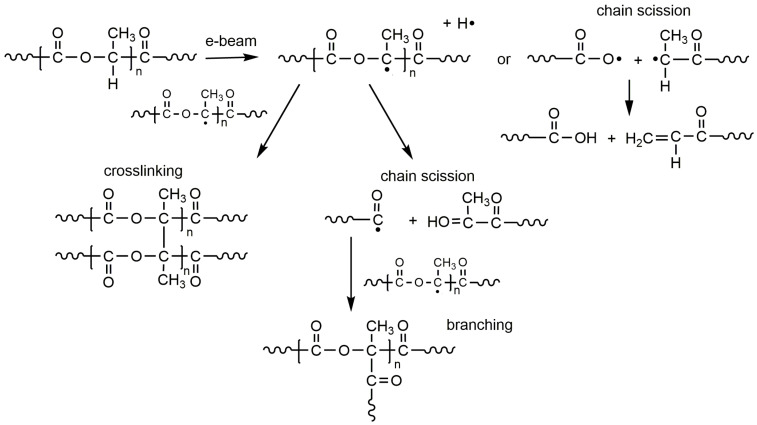
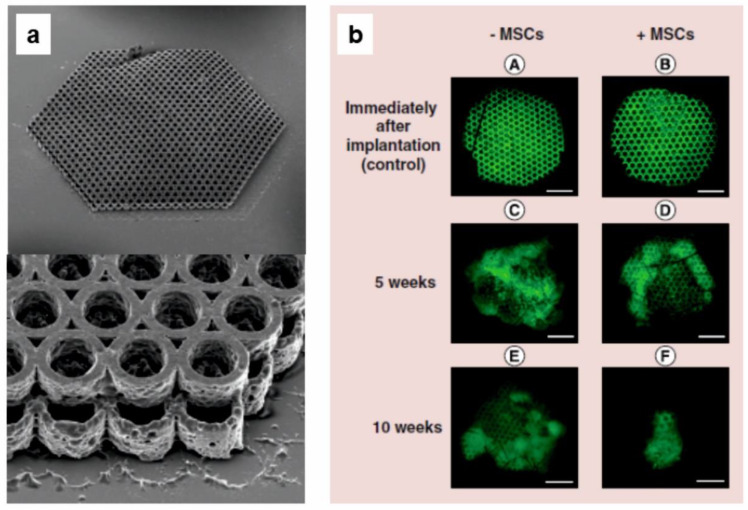
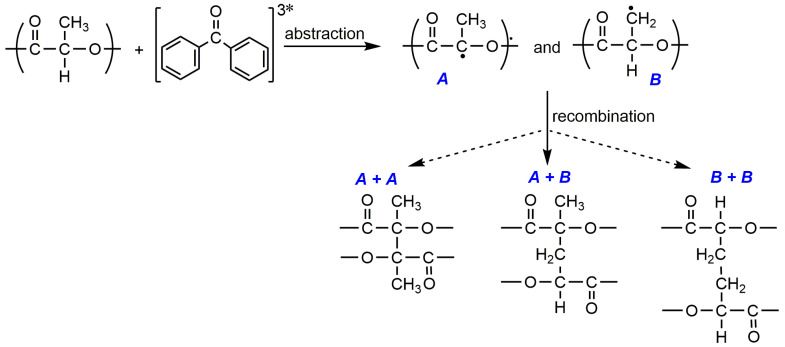
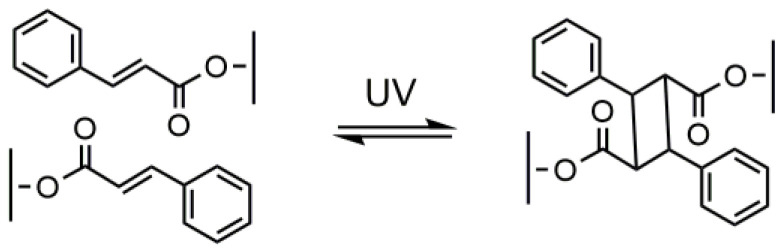
Polylactide (PLA) is presently the most studied bioderived polymer because, in addition to its established position as a material for biomedical applications, it can replace mass production plastics from petroleum. However, some drawbacks of polylactide such as insufficient mechanical properties at a higher temperature and poor shape stability have to be overcome. One of the methods of mechanical and thermal properties modification is crosslinking which can be achieved by different approaches, both at the stage of PLA-based materials synthesis and by physical modification of neat polylactide. This review covers PLA crosslinking by applying different types of irradiation, i.e., high energy electron beam or gamma irradiation and UV light which enables curing at mild conditions. In the last section, selected examples of biomedical applications as well as applications for packaging and daily-use items are presented in order to visualize how a variety of materials can be obtained using specific methods.
聚乳酸(PLA)是目前研究最多的生物衍生聚合物,因为除了作为生物医学应用材料的既定地位外,它还可以替代石油基的大规模生产塑料。然而,聚乳酸的一些缺点,如在较高温度下机械性能不足和形状稳定性差,必须加以克服。机械和热性能改性的方法之一是交联,这可以通过不同的方法来实现,既可以在 PLA 基材料合成的阶段,也可以通过纯聚乳酸的物理改性来实现。这篇综述涵盖了通过应用不同类型的辐射,即高能电子束或伽马射线和紫外线,在温和条件下进行交联的方法。在最后一节中,介绍了生物医学应用以及包装和日常用品应用的一些例子,以便说明如何使用特定的方法获得各种材料。