Sanchez Elynn Kann, Speizer Ilene S, Tolley Elizabeth, Calhoun Lisa M, Barrington Clare, Olumide Adesola O
Department of Maternal and Child Health, Gillings School of Global Public Health, UNC, Chapel Hill, North Carolina, USA.
Carolina Population Center, University of North Carolina-Chapel Hill, Chapel Hill, North Carolina, 27516, USA.
Reprod Health. 2020 Oct 28;17(1):167. doi: 10.1186/s12978-020-01019-1.
Despite international support for increasing access to contraceptives among adolescents, gaps in use still exist worldwide. Past research has identified barriers to use across all levels of the socioecological model including restrictive policies, a lack of youth friendly services, and knowledge gaps. This study was conducted to further identify influences on contraceptive use among adolescent girls in Nigeria in hopes of guiding future policies and programs.
In 2018, 12 focus group discussions (FGD) were conducted in three cities in Nigeria with young women ages 15-24 with the objective of determining what and who influence adolescents' contraceptive seeking behaviors. A vignette structure was used to identify perceptions on injunctive and descriptive community norms that influence adolescent contraceptive behaviors. The FGDs were conducted by members of the University of Ibadan Centre for Population and Reproductive Health (CPRH) and analyzed by a researcher at the University of North Carolina-Chapel Hill's Carolina Population Center using a thematic analysis approach.
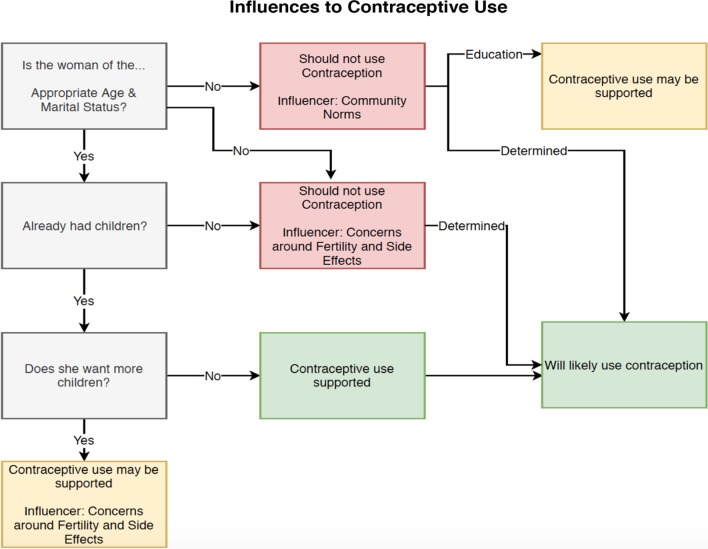
Participants identified community level resistance to sex and contraceptive use among unmarried adolescents though also acknowledged that these adolescent behaviors are still occurring despite established norms. Concerns about side effects and the preservation of fertility were frequently attached to contraceptive use and pointed to as a reason for community resistance to contraceptive use among this population. Participants saw peers, parents and partners as influencers on a girl's decision to seek a method, though each were believed to play a different role in that decision.
The findings show that that despite barriers created by established injunctive norms, young women with a supportive social network can access contraceptive methods despite these barriers. By harnessing the influence of peers, partners and parents, the Nigerian family planning efforts can strive to improve the health and well-being of young people.
尽管国际社会支持增加青少年获取避孕药具的机会,但全球范围内在使用方面仍存在差距。过去的研究已经确定了社会生态模型各个层面上使用避孕药具的障碍,包括限制性政策、缺乏对青少年友好的服务以及知识差距。开展这项研究是为了进一步确定影响尼日利亚少女使用避孕药具的因素,以期为未来的政策和项目提供指导。
2018年,在尼日利亚的三个城市对15至24岁的年轻女性进行了12次焦点小组讨论(FGD),目的是确定影响青少年寻求避孕行为的因素及相关人群。采用了一种情景结构来确定对影响青少年避孕行为的禁令性和描述性社区规范的看法。焦点小组讨论由伊巴丹大学人口与生殖健康中心(CPRH)的成员进行,北卡罗来纳大学教堂山分校卡罗来纳人口中心的一名研究人员使用主题分析方法进行分析。
参与者指出社区层面存在对未婚青少年性行为和使用避孕药具的抵制,不过也承认尽管有既定规范,这些青少年行为仍在发生。对副作用和生育能力保护的担忧经常与避孕药具的使用相关,并被指出是社区抵制该人群使用避孕药具的一个原因。参与者认为同龄人、父母和伴侣是影响女孩寻求避孕方法决定的因素,不过他们认为每个人在该决定中发挥的作用不同。
研究结果表明,尽管既定的禁令性规范造成了障碍,但拥有支持性社交网络的年轻女性仍能克服这些障碍获取避孕方法。通过利用同龄人、伴侣和父母的影响力,尼日利亚的计划生育工作可以努力改善年轻人的健康和福祉。