Cartwright Alice F, Otai Jane, Maytan-Joneydi Amelia, McGuire Courtney, Sullivan Emily, Olumide Adesola, Baye Easton Catherine, Speizer Ilene S
Department of Maternal and Child Health, Gillings School of Global Public Health, University of North Carolina at Chapel Hill, Chapel Hill, NC, 27599, USA.
Jhpiego, an affiliate of Johns Hopkins University, 1615 Thames Street, Baltimore, MD, 21231, USA.
Gates Open Res. 2019 Jul 25;3:1513. doi: 10.12688/gatesopenres.13045.2. eCollection 2019.
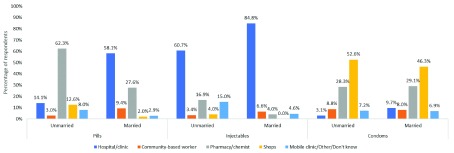
: With growing populations of young people, low and middle-income countries have renewed focus on reaching both unmarried and married youth with family planning (FP) services. Young people themselves bring an important perspective to guide future programmatic directions. : In October 2018, 207 youth leaders in FP from around the world completed an online survey prior to their participation at the International Conference on Family Planning (ICFP). These youth leaders provided their perspectives on the most important influencers for youth FP use, how easy or hard it is for youth to obtain FP, preferred sources of FP methods for youth, and perceptions of commonly used terms in FP programming. We examined differences in perceptions of unmarried and married youth's access to and use of FP using bivariate analyses. : Respondents reported that peers/friends were the most important influencer on use of FP among unmarried youth (80.2%), while spouse/partner was the most important for married youth (80.4%). Oral contraceptive pills, injectable contraception, and contraceptive implants were perceived as significantly harder for unmarried youth to access. Privacy, confidentiality, and anonymity were all important factors for the locations to access FP for unmarried youth, while married youth were more influenced by cost. None of the commonly used terms for FP were perceived positively by a majority of respondents, with the exception of 'birth spacing' by African respondents (51.0%). : These findings indicate that the preferences and needs of unmarried youth are different than married youth, but that all young people face barriers accessing FP. Unmarried youth seeking family planning are more influenced by peers and friends and continue to face difficulty accessing methods compared to married youth. These findings indicate the importance of including youth perspectives in development of youth-focused family planning programs.
随着年轻人数量的不断增加,低收入和中等收入国家重新将重点放在为未婚和已婚青年提供计划生育(FP)服务上。年轻人自身带来了重要的视角,可用于指导未来的项目方向。2018年10月,来自世界各地的207名计划生育青年领袖在参加国际计划生育会议(ICFP)之前完成了一项在线调查。这些青年领袖就影响青年使用计划生育的最重要因素、青年获取计划生育服务的难易程度、青年首选的计划生育方法来源以及对计划生育项目中常用术语的看法提供了他们的观点。我们使用双变量分析研究了未婚和已婚青年在获取和使用计划生育服务方面认知上的差异。受访者报告称,同龄人/朋友是未婚青年使用计划生育的最重要影响因素(80.2%),而配偶/伴侣对已婚青年来说是最重要的(80.4%)。未婚青年认为口服避孕药、注射用避孕药和避孕植入物获取难度明显更大。隐私、保密性和匿名性都是未婚青年获取计划生育服务地点的重要因素,而已婚青年则更多地受成本影响。除了非洲受访者对“生育间隔”的看法(51.0%)外,大多数受访者对计划生育的常用术语看法都不积极。这些发现表明,未婚青年的偏好和需求与已婚青年不同,但所有年轻人在获取计划生育服务方面都面临障碍。与已婚青年相比,寻求计划生育的未婚青年更容易受到同龄人和朋友的影响,并且在获取相关方法方面仍然面临困难。这些发现表明,在制定以青年为重点的计划生育项目时纳入青年视角非常重要。